


An unexpected injury on someone else’s property is more than just painful—it’s frustrating. You went to a store or a friend’s house expecting to be safe, not to end up hurt because of a wet floor or a broken stair. You shouldn’t have to deal with the consequences alone. When you suffer an injury, property owner negligence is often the cause. Premises liability law exists for this exact reason: to hold them accountable for unsafe conditions. This guide will walk you through what that means and how you can get the support you deserve.
Key Takeaways
- Proving Negligence Is Your Main Goal: An injury alone doesn’t make a property owner liable. You must show they failed to fix a hazard they knew about, or should have known about, and that this specific failure is what caused your injury.
- Your Visitor Status Defines the Owner’s Duty: The law treats a customer in a store differently than a social guest at a party. A property owner’s legal responsibility to keep you safe is highest when you are on their property for their business benefit.
- Act Quickly to Protect Your Claim: What you do immediately after an injury is critical. Prioritize getting medical care, then use your phone to take photos of the hazard and get contact information from any witnesses to preserve key evidence.
What Does “Premises Liability” Actually Mean?
When you visit a store, a friend’s house, or even a public park, you expect the space to be reasonably safe. But what happens when it’s not, and you get hurt as a result? That’s where the legal concept of premises liability comes in. It’s a specific area of personal injury law that holds property owners accountable for injuries caused by unsafe conditions on their property. Think of it as a property owner’s responsibility to not let their carelessness cause harm to others. This doesn’t mean they have to guarantee no one ever gets hurt, but it does mean they need to take reasonable steps to maintain their property and address known dangers.
If a property owner fails to uphold this responsibility and someone is injured, they may be held legally responsible for the resulting medical bills, lost wages, and other damages. This area of law exists to ensure that people who are injured due to a property owner’s neglect have a way to seek compensation for their suffering and financial losses. It’s about fairness and accountability. The law recognizes that property owners are in the best position to identify and fix hazards on their land, and it places the duty on them to do so for the safety of their visitors.
Premises Liability Explained Simply
Let’s cut through the legal jargon. At its core, premises liability means a property owner can be held responsible if you get hurt on their property because of a dangerous condition they knew about, or should have known about, and didn’t fix. This applies whether you’re on commercial property, like a grocery store, or private property, like a neighbor’s backyard.
While the classic “slip and fall” on a wet floor is the most common example, premises liability covers a much wider range of incidents. It could be a fall caused by a broken staircase, an injury from falling merchandise at a big-box store, or even an attack that happens because of inadequate security lighting in a parking lot. The central issue is always whether an injury was caused by a dangerous problem on someone else’s property that the owner neglected to address.
How It Fits into Personal Injury Law
Premises liability is a specific type of negligence case. In the legal world, “negligence” simply means that someone had a duty to act with reasonable care, they failed to do so, and their failure caused someone else to get hurt. To have a successful premises liability claim, you generally have to prove that the property owner was negligent.
This means showing that the owner either created the unsafe condition, knew about it and did nothing, or should have discovered it through regular maintenance and inspection. For example, if a restaurant owner knows a freezer is leaking but doesn’t put up a warning sign or clean the puddle, they are likely being negligent. Proving this failure is the key to connecting your injury to the property owner’s legal responsibility.
What Are a Property Owner’s Legal Responsibilities?
When you step onto someone else’s property, whether it’s a grocery store, a friend’s house, or a public park, you have a reasonable expectation of safety. Property owners have a legal obligation, known as a “duty of care,” to maintain their premises to prevent foreseeable harm to visitors. This doesn’t mean they have to guarantee no one ever gets hurt, but it does mean they must take sensible steps to identify and fix potential dangers.
This responsibility is the foundation of all premises liability cases. If an owner fails to meet this standard through carelessness or neglect, and someone gets injured as a result, the owner can be held legally responsible for the damages. The key is determining what level of care was required and whether the owner’s actions—or lack thereof—fell short of that standard. The specifics of this duty can change depending on the situation and why you were on the property in the first place, which is where these cases can get complicated.
Does the “Duty of Care” Change for Different Visitors?
A property owner’s responsibility isn’t the same for every person who sets foot on their land. The law adjusts the “duty of care” based on the visitor’s legal status. Generally, visitors fall into one of three categories: invitees, licensees, or trespassers. An invitee, like a customer in a retail store, is owed the highest duty of care. The owner must actively inspect the property for hazards and fix them or warn customers about them. A licensee, such as a social guest at a dinner party, is owed a lesser duty; the owner must warn them of known dangers but isn’t required to inspect for unknown ones. The lowest duty is owed to trespassers, though owners still can’t intentionally harm them.
Why Regular Upkeep and Inspections Matter
A property owner’s duty of care isn’t just a passive concept—it requires action. To keep a property reasonably safe, owners must perform regular upkeep and inspections. Negligence often arises from a failure to do so. For example, a restaurant owner should have procedures for checking for spills, and a landlord should inspect stairways for loose railings. To build a successful claim, an injured person typically has to show that the property owner either created the dangerous condition, knew about it and did nothing, or should have known about it through reasonable inspection. This is why proactive maintenance is so critical from a legal standpoint.
A Look at Missouri’s Specific Property Laws
Here in Missouri, the law is clear: property owners are required to maintain their premises in a reasonably safe condition for lawful visitors. This includes an obligation to warn people of any known dangers that aren’t immediately obvious. For instance, if a floor is wet and slippery but doesn’t look it, a warning sign is necessary. These state-specific rules are what we use to establish fault in a personal injury claim. Understanding how Missouri courts interpret “reasonable care” and “known dangers” is essential to proving that a property owner was negligent and should be held accountable for your injuries.
What Do Premises Liability Claims Look Like in Real Life?
When you hear “premises liability,” you might immediately picture a slip and fall at the grocery store. While that’s a classic example, these cases cover a much wider range of incidents where a property owner’s negligence leads to injury. Understanding these common scenarios can help you recognize when you might have a valid claim. From unsafe walking surfaces to inadequate security, the owner’s responsibility is to keep their property reasonably safe for visitors. Let’s look at some of the most frequent types of premises liability claims.
The Classic Slip and Fall Case
Slip and fall accidents are incredibly common and can happen almost anywhere. Think of a freshly mopped floor without a “wet floor” sign, a patch of ice on a store’s walkway that wasn’t salted, or a broken stair in an apartment complex. These incidents also include trips over uneven pavement, potholes in a parking lot, or poorly lit hallways. The central question in these cases is whether the property owner knew, or should have reasonably known, about the dangerous condition and failed to fix it or warn you about it. Proving this negligence is a key part of any successful personal injury claim.
When Poor Security Leads to Injury
Property owners don’t just have a duty to maintain the physical space; they also have a responsibility to protect visitors from foreseeable criminal acts. This is known as negligent or inadequate security. For example, if an apartment building is in an area with a high crime rate, the landlord may be responsible for ensuring all locks on doors and windows are functional. Other examples include poor lighting in a parking garage that allows for an assault to occur or a bar failing to hire enough security staff to handle a rowdy crowd. In these situations, the owner’s failure to provide reasonable security measures could make them liable for a visitor’s injuries.
Dog Bites and Animal-Related Injuries
In Missouri, pet owners are generally held responsible for injuries their animals cause. Dog bite cases are a frequent type of premises liability claim. If you are lawfully on someone’s property—as a guest, mail carrier, or customer—and their dog bites you, the owner is typically liable for your injuries. This is often true even if the dog has never shown aggression before. However, there are exceptions. If you were trespassing on the property or were provoking the animal, the owner may not be held responsible. It’s important to understand your rights if you’ve been injured by someone else’s pet.
Injuries from Unsafe Building Conditions
Sometimes, injuries are caused by the building itself or the environment on the property. These cases can involve a wide range of hazards, such as faulty electrical wiring that leads to a shock, a deck collapse due to rotten wood, or exposure to toxic substances like lead paint or mold. Other examples include swimming pool accidents caused by broken gates or a lack of proper safety equipment. If a property owner fails to follow building codes or ignores necessary repairs, they can be held accountable for any harm that results. If you’ve been hurt due to an unsafe condition, it’s wise to contact an attorney to discuss your situation.
Injuries from Falling Objects
You don’t expect a shopping trip to end in the emergency room, but injuries from falling objects are a serious risk in retail stores, warehouses, and other commercial spaces. These incidents often happen when shelves are overloaded or when merchandise isn’t secured correctly. A property owner has a legal duty to make sure their premises are safe, and that includes how they store their inventory. When they fail to take simple precautions, like using safety straps or following weight limits on shelving, they create a dangerous environment that can lead to severe head, neck, and back injuries. If you’ve been hurt by a falling object, the owner’s failure to properly secure their merchandise could be considered negligence, making them responsible for your medical expenses and other losses.
Accidents on Dangerous Playground Equipment
Playgrounds are supposed to be places of fun and adventure for children, but that fun can quickly turn to tragedy when the equipment is unsafe. Accidents caused by dangerous or poorly maintained playground structures are a common and heartbreaking type of premises liability case. Property owners—whether it’s a school, a city park, or a daycare—have a responsibility to keep their play areas safe for children. This means they need to perform regular inspections and maintenance to fix hazards like broken swings, rusty metal with sharp edges, or unstable climbing structures. When they neglect this duty, they put children at risk for falls, cuts, and other serious injuries. An injury on a playground isn’t just an accident; it’s often the result of negligence.
Who Can Be Held Responsible for an Injury?
After an injury, one of the first questions that comes to mind is, “Who is at fault?” In a premises liability case, the answer isn’t always as simple as pointing to the person whose name is on the deed. While the property owner is often the primary responsible party, liability can be more complex. Depending on the circumstances, responsibility could fall on a tenant, a property management company, or even a third-party contractor who was working on the site. Identifying the correct party—or parties—is a critical step in pursuing a claim. The key is to determine who had control over the area where the injury occurred and who had the legal duty to ensure it was safe for visitors.
Figuring this out requires a careful look at the specific situation. For example, in a rented apartment, is the landlord responsible for a broken step inside the unit, or is the tenant? If you slip on a wet floor in a large retail store, is the store owner liable, or is it the third-party cleaning company they hired? Often, more than one person or group can be responsible. Untangling these relationships is essential because it ensures you are holding the right people accountable for their negligence. An experienced attorney can help investigate the details of your case to determine who failed to uphold their duty of care.
The Property Owner
The property owner is usually the first person you think of, and for good reason. Owners have a fundamental legal obligation, known as a “duty of care,” to keep their property in a reasonably safe condition to prevent foreseeable harm to visitors. This means they can’t just ignore potential dangers. They are expected to take sensible steps to find and fix hazards, or at the very least, warn people about them. For example, if a store owner knows a freezer is leaking, they must clean it up promptly or put out a warning sign. This duty is the cornerstone of any premises liability claim and holds the owner accountable for their neglect.
Tenants and Property Managers
Responsibility can shift when a property is rented or managed by someone other than the owner. A tenant who rents a house, for instance, generally takes on the responsibility for keeping the interior of that house safe for their guests. If a friend trips over a rug the tenant placed poorly, the tenant, not the landlord, would likely be responsible. Similarly, property management companies are often hired to handle the day-to-day upkeep of a property, like an apartment complex or a commercial building. If they fail to address a reported safety issue, like a broken lock or a burned-out light in a stairwell, they could be held liable for an injury that results from their inaction.
Landlords in Rental Situations
When you rent a property, the lines of responsibility between you and the landlord can seem blurry. While tenants are expected to keep their own living space safe, landlords retain a significant duty of care, especially for certain parts of the property. Their liability for problems that come up after a tenant takes control is limited, but it doesn’t disappear entirely. The landlord is still on the hook for dangers they knew about and didn’t fix before the tenant moved in, as well as for maintaining common areas that are shared by all residents. Understanding these distinctions is key to knowing who to hold accountable.
Liability for Common Areas
In a multi-unit property like an apartment building, landlords are almost always responsible for the safety of common areas. These are the spaces that aren’t part of any single tenant’s lease but are used by everyone, such as hallways, stairwells, elevators, parking lots, and laundry rooms. If you are injured because of a hazard in one of these areas—like tripping on a torn carpet in a hallway or slipping on an icy patch in the parking lot—the landlord is the one who is typically held responsible. They have a clear duty to regularly inspect and maintain these shared spaces for the safety of all residents and their guests.
Responsibility for Known Dangers
A landlord can also be held liable for injuries that happen inside a rented unit if the injury was caused by a danger they knew about but failed to fix. For example, if a tenant repeatedly notified the landlord about a leaky pipe that was creating a slippery floor, and the landlord did nothing, they could be responsible if someone gets hurt. The law doesn’t allow property owners to ignore known hazards simply because a tenant is living there. If the owner was aware of a dangerous condition and had the opportunity to repair it, their failure to act can be considered negligence.
Contractors and Third Parties
Sometimes, the person at fault for an injury isn’t the owner or the tenant, but an independent contractor or third-party company working on the property. For instance, if a construction company leaves tools and debris on a public sidewalk and someone trips and gets hurt, that company could be liable. Another common example is a cleaning service that mops a floor in an office building but fails to put up a “wet floor” sign, leading to a slip and fall. In these situations, the property owner might also share some responsibility, but the contractor who created the immediate hazard can be held directly accountable for their negligence. If you’ve been injured, it’s important to discuss your case to identify all potential parties who may be at fault.
How Do You Prove a Property Owner Was Negligent?
Getting injured on someone else’s property isn’t automatically enough to win a legal claim. The key is proving the property owner was negligent—a legal term that basically means they were careless and failed to keep their property reasonably safe. Think of it as a three-part puzzle you need to solve. First, you have to show that a dangerous condition existed. Second, you must prove the property owner didn’t act reasonably to fix it. Finally, you have to connect their failure directly to your injury.
Successfully demonstrating these points is the foundation of any premises liability case. It requires gathering evidence that tells a clear story: the owner knew, or should have known, about a hazard and did nothing, which led to you getting hurt. This might involve taking photos of the scene, talking to witnesses, or getting security footage. The goal is to move beyond saying “I fell” to proving “I fell because the owner neglected a specific, preventable danger.” It’s about showing a breach of their responsibility to keep visitors safe from harm.
What Does It Mean to Be a “Reasonable” Property Owner?
The law doesn’t expect property owners to be perfect, but it does expect them to be “reasonable.” This is a legal standard that asks what a typical, careful person would have done in the same situation. A reasonable owner would mop up a spill in a grocery aisle, fix a broken handrail on a staircase, or put up a “Wet Floor” sign. They would perform regular checks to find and fix potential hazards before someone gets hurt.
To prove negligence, you need to show that the property owner’s actions fell short of this standard. The question becomes: Did they fail to do something a prudent owner would have done? If the answer is yes, that’s a strong indicator of negligence.
Did the Owner Know About the Hazard?
This is often the most challenging part of a case. To hold an owner responsible, you generally need to show they had “notice” of the dangerous condition. This can happen in a few ways. The owner might have actual knowledge—meaning they knew about the specific leaky pipe or icy patch. Or, they might have constructive knowledge, which means they should have known about the hazard if they were conducting reasonable inspections. For example, if a broken tile has been there for weeks, an owner should have discovered it.
Finally, if the owner or their employee created the dangerous condition, like by spilling something and not cleaning it up, they are automatically considered to have known about it. Proving the owner was aware of the danger is a critical step in establishing their failure to act.
How Courts Determine Fault in an Injury Case
When a court decides if a property owner was at fault, it looks at all the evidence together. They’ll consider how long the hazard existed, what the owner did (or didn’t do) to fix it, and whether they provided any warnings. The court will also look at your status as a visitor—whether you were a customer, a social guest, or a trespasser—as this affects the level of care the owner was required to provide.
Ultimately, the burden is on you, the injured person, to prove your case. You must present enough evidence to convince the court that the owner’s carelessness was the direct cause of your injuries. An attorney can help you organize the facts and build a compelling argument that clearly demonstrates the property owner’s fault.
Are You Legally Protected on Someone Else’s Property?
When you get hurt on someone else’s property, your legal rights often depend on one simple question: Why were you there? It might seem strange, but Missouri law classifies visitors into three distinct categories, and the property owner’s responsibility—what lawyers call their “duty of care”—changes for each one. Understanding where you fit can make a significant difference in a premises liability case, shaping whether you can hold the owner accountable for your injuries.
The law provides the highest level of protection to “invitees.” These are people who are on the property for the owner’s benefit, like customers in a store or patients in a clinic. Next are “licensees,” who are social guests present with permission but for their own enjoyment, like a friend you invite over for a barbecue. Finally, there are “trespassers,” who enter a property without any permission at all. Each group is owed a different level of safety, and proving which category you fall into is a key step in any claim. This framework helps courts determine what a property owner should have done to prevent an injury and whether they failed to meet their legal obligations.
Protections for Invitees (like Customers)
An invitee is someone who enters a property for the financial benefit of the owner. Think of shoppers in a retail store, diners in a restaurant, or clients visiting an office. Because their presence is part of the owner’s business, the law gives invitees the highest level of protection. Property owners have a duty to keep their premises reasonably safe. This means they must actively inspect for hidden dangers, repair any hazardous conditions, and warn visitors of any risks they know about or should have known about. For example, a grocery store manager must not only clean up a spill but also put out a “wet floor” sign to warn shoppers. This duty is central to many personal injury claims.
Protections for Licensees (like Social Guests)
A licensee is someone who is on a property with the owner’s permission but for their own social reasons, not for the owner’s financial gain. The most common example is a guest you invite to your home for dinner or a party. The duty of care for a licensee is lower than for an invitee. A property owner must warn a licensee of any known dangers that aren’t obvious. For instance, if you know one of your front steps is broken, you need to tell your friend about it. However, you don’t have the same legal obligation to regularly inspect your entire property for potential hazards you aren’t already aware of.
Trespassers: What Protections Do They Have?
A trespasser is someone who enters a property without permission. As you might expect, property owners owe the lowest duty of care to trespassers. In most cases, an owner is not liable for injuries a trespasser sustains, as they have no obligation to make the property safe for uninvited individuals. The main rule is that an owner cannot intentionally harm a trespasser. However, there is a major exception for children. Under the “attractive nuisance” doctrine, a property owner may be held responsible if a child is injured by something on the property that is likely to attract them, like a swimming pool, trampoline, or abandoned appliance. This is because the law recognizes that children may not understand the risks involved.
An Owner’s Duty to Warn Trespassers
While property owners owe the lowest duty of care to trespassers, this doesn’t give them a free pass to be reckless. The most fundamental rule is that an owner cannot intentionally injure a trespasser or set up traps designed to cause harm. Beyond that, the responsibility can shift slightly if the owner is aware of frequent trespassing. For example, if a landowner knows people often cut across a corner of their property, they may have a duty to warn about a hidden, man-made danger they’ve created, like a deep ditch or a wire fence that isn’t easily visible. This duty to warn doesn’t require them to make the property safe, but it does require them to alert known trespassers to serious, non-obvious risks. This distinction is a key part of understanding a property owner’s legal obligations in these specific situations.
The 3 Things You Must Prove to Win Your Case
Winning a premises liability case involves more than just showing you were injured on someone else’s property. You need to build a clear, logical argument that connects the property owner’s actions—or lack thereof—directly to your injury. Think of it as telling a story with three essential parts. First, you establish that the property owner had a responsibility to keep you safe. Second, you show exactly how they failed to meet that responsibility. And third, you draw a direct line from their failure to the harm you suffered.
Each of these steps is crucial. Without proving all three, it’s difficult to hold a property owner legally accountable. This framework helps courts determine whether an injury was just an unfortunate accident or the result of negligence. It’s the foundation of all premises liability claims, from a slip in a grocery store to an injury caused by poor building maintenance. Understanding these elements will help you see your situation more clearly and figure out what information is most important to gather. It shifts the focus from “I got hurt here” to “I got hurt here because the owner was careless.” This distinction is everything in a personal injury case and is what separates a valid claim from a simple mishap.
1. Proving the Property Owner’s Duty of Care
The first step is to establish that the property owner owed you a “duty of care.” This is a legal term that simply means they had a responsibility to keep their property reasonably safe for visitors. If you were on the property legally—as a customer in a shop, a guest at a friend’s house, or a tenant in an apartment building—the owner had a duty to you. This doesn’t mean they have to guarantee no one ever gets hurt. Instead, they must take reasonable steps to prevent foreseeable harm, like fixing a broken step or cleaning up a spill.
2. Showing the Owner Breached That Duty
Next, you have to show that the property owner was careless and failed to uphold their duty of care. This failure, or “breach,” can happen in a few different ways. An owner is generally considered negligent if they created the dangerous condition, knew about the hazard but did nothing to fix it, or should have known about the danger if they were properly inspecting their property. For example, if a store manager knows a freezer is leaking but doesn’t clean the puddle or put up a warning sign, they have likely failed in their duty to keep shoppers safe.
3. Linking Their Breach Directly to Your Injury
Finally, you must prove that the owner’s carelessness was a direct cause of your injury. It’s not enough to show there was a hazard and you were hurt—you have to connect the dots. This is known as causation. Using the leaky freezer example, you would need to show that you slipped specifically on the puddle from the leak and that the fall is what caused your injury. This crucial link proves that your harm wasn’t just a random accident but a direct result of the owner’s negligence. Proving this connection can be complex, which is why it’s often helpful to discuss your case with an attorney.
What Types of Compensation Can You Claim?
When you’re injured because of a property owner’s negligence, the impact goes far beyond the initial pain. Suddenly, you’re facing a mountain of medical bills, time off work, and the emotional toll of a traumatic event. The goal of a premises liability claim is to secure compensation that helps you manage these burdens and, in a legal sense, makes you “whole” again. This compensation, known as damages, is designed to cover all the losses you’ve suffered—both the ones with a clear price tag and the ones that are harder to measure.
These damages are typically broken down into a few key categories. Economic damages cover your direct financial losses, like medical expenses and lost income. Non-economic damages address your personal suffering, such as pain, emotional distress, and a diminished quality of life. In some cases, you can also claim compensation for any personal property that was damaged during the incident. Understanding what you can claim is the first step toward getting the resources you need to focus on your recovery. It’s about ensuring the person responsible for your injury is also responsible for the consequences.
Economic Damages for Financial Losses
Economic damages are the most straightforward part of a personal injury claim because they cover the tangible, out-of-pocket costs you’ve incurred. These are the losses you can prove with receipts, bills, and pay stubs. Think of this as reimbursement for every dollar the injury has forced you to spend or lose. When a property owner’s failure to maintain a safe environment leads to an accident, they can be held legally responsible for these financial setbacks. The goal is to restore you to the financial position you were in before the accident happened, ensuring you aren’t left paying for someone else’s carelessness.
Medical Bills and Future Care
The most immediate financial burden after an injury is almost always the medical bills. Compensation covers everything from the initial emergency room visit and ambulance ride to surgery, hospital stays, and prescription medications. But it doesn’t stop there. It also includes the cost of ongoing treatments like physical therapy, rehabilitation, and any assistive devices you might need, such as crutches or a wheelchair. If your injury will require long-term care, a claim can also account for these anticipated future medical expenses, so you don’t have to worry about how you’ll afford the treatment you need down the road.
Lost Wages and Earning Capacity
An injury often means taking time off work to recover, which can lead to a significant loss of income. You can claim compensation for these lost wages, covering the salary or hourly pay you missed while you were unable to work. If your injuries are severe and permanently affect your ability to do your job or earn the same income as before, you may also be able to seek damages for loss of future earning capacity. This type of compensation is more complex, but it’s designed to account for the long-term financial impact the injury will have on your career and livelihood.
Non-Economic Damages for Personal Suffering
Not all losses come with a receipt. Non-economic damages are meant to compensate you for the intangible, personal ways an injury has affected your life. This includes the physical pain, emotional distress, and overall loss of enjoyment you’ve experienced since the accident. While no amount of money can truly erase suffering, the legal system recognizes that these harms are very real and deserve to be acknowledged. Calculating these damages is more subjective than adding up bills, but they are a critical part of any personal injury claim because they address the true human cost of an injury.
Pain and Suffering
This category addresses the physical and emotional distress caused by your injury. Physical pain and suffering refers to the actual pain you endure from the injury itself, as well as the discomfort from medical treatments and the recovery process. Emotional pain and suffering covers the mental anguish that often accompanies a serious injury, such as fear, anxiety, depression, and sleeplessness. The law recognizes that an injury is more than just a physical event; it’s a traumatic experience that can have a lasting impact on your well-being, and you deserve to be compensated for that suffering.
Emotional Distress
Emotional distress is a specific type of non-economic damage that focuses on the psychological impact of an injury. While it overlaps with pain and suffering, it can also be claimed for specific mental health conditions that arise from the trauma of the accident. This can include conditions like post-traumatic stress disorder (PTSD), severe anxiety, or a new phobia related to the circumstances of your injury. For example, someone who fell down a flight of stairs might develop an intense fear of heights. These are significant harms that can disrupt your daily life, and the law allows you to claim damages for this mental toll.
Compensation for Damaged Personal Property
Sometimes, the incident that caused your injury also results in damage to your personal belongings. For example, if you slip and fall, you might break your smartphone, shatter your eyeglasses, or tear your clothing. You have the right to be compensated for these losses as well. This compensation is intended to cover the cost of repairing or replacing the items that were damaged. Be sure to keep any damaged items and take photos of them, as this will serve as evidence to support your claim for property damages.
The Role of Insurance in a Premises Liability Case
When you’re injured on someone else’s property, the thought of taking legal action can be intimidating, especially if the owner is a neighbor or a local business you like. It’s important to understand that in most cases, you aren’t seeking money directly from the owner’s pocket. Instead, you are typically filing a claim against their insurance policy. Property owners, both residential and commercial, carry insurance specifically for this reason: to cover costs when someone is accidentally hurt on their premises. This insurance is designed to protect them from financial ruin while also providing a way for injured individuals to be compensated for their medical bills, lost wages, and other damages. The process is less about personal conflict and more about holding the responsible insurance company accountable.
Homeowners Insurance and Personal Liability Coverage
For injuries that happen at a private residence, the owner’s homeowners insurance policy is usually the first place to look. A standard policy includes personal liability coverage, which is designed to protect the homeowner if a visitor is injured on their property due to the owner’s negligence. This coverage can pay for medical expenses, lost income, and pain and suffering resulting from an accident like a fall on a broken step or an injury from a falling tree branch. The purpose of this liability insurance is to handle these claims so the homeowner doesn’t have to pay for everything out of pocket. When you file a claim, you are essentially asking their insurance provider to fulfill its contractual duty.
“Medical Payments to Others” Coverage
Many insurance policies also include a feature called “Medical Payments to Others” coverage, often referred to as MedPay. This is a smaller, no-fault benefit that can cover an injured person’s initial medical bills up to a certain limit, typically between $1,000 and $5,000. The key benefit of MedPay is that it pays out regardless of who was at fault for the accident. This allows you to get immediate medical care without having to first prove that the property owner was negligent. While it won’t cover all the costs of a serious injury, it provides a crucial first layer of support while the larger premises liability claim is being investigated and negotiated.
Common Defenses Property Owners Use After an Injury
When you’re injured on someone else’s property, you might expect the owner to take responsibility. Unfortunately, it’s rarely that straightforward. Property owners and their insurance companies have common legal strategies they use to challenge premises liability claims. Understanding these defenses can help you prepare for what’s ahead and see why having an experienced advocate is so important.
Arguing the Danger Was “Open and Obvious”
This defense is exactly what it sounds like. The property owner argues that the hazard causing your injury was so apparent that you should have seen and avoided it. Think of a large, bright yellow “wet floor” sign next to a spill or a deep hole in a lawn that isn’t hidden. Their argument is that a reasonable person would have noticed the danger and taken precautions. If a court agrees, it can reduce or even eliminate the owner’s responsibility, shifting the focus to whether you were paying reasonable attention to your surroundings at the time of the accident.
Claiming You Share Some of the Blame
This is a very common tactic. The property owner might admit a hazard existed but claim your own actions contributed to the injury. For example, they could argue you were looking at your phone when you tripped or were running in an area where you should have been walking. Missouri follows a “pure comparative fault” rule, which means your compensation can be reduced by your percentage of blame. If you’re found 20% at fault, your final award is cut by 20%. This defense can complicate a case, turning it into a debate over who was more careless.
The “I Didn’t Know” Defense
A property owner generally isn’t liable for a hazard they didn’t know about and had no reasonable opportunity to discover. This defense centers on “notice.” To hold an owner responsible, you usually need to show they had either “actual notice” (they knew about the specific danger) or “constructive notice” (the danger existed for so long they should have known about it). If a jar breaks in a grocery aisle, the store isn’t immediately liable. But if the mess sits there for an hour, it becomes much harder for them to claim they didn’t have a chance to clean it up.
Arguing You “Assumed the Risk”
Another defense you might encounter is “assumption of risk.” This is when the property owner argues that you were aware of a specific danger but voluntarily chose to face it anyway. For example, if you decide to use a staircase that has a clear “Stairway Closed for Repairs” sign and get injured, the owner will likely argue that you accepted the risk. However, this defense has its limits. It typically applies only to risks that are obvious and inherent to a situation. It doesn’t give a property owner a pass for being negligent in other ways. If the danger was not apparent or was created by the owner’s carelessness, you can’t be said to have assumed it. The court will still weigh the owner’s responsibility against your actions.
Don’t Believe These Premises Liability Myths
When you get hurt on someone else’s property, it’s easy to get swept up in advice from well-meaning friends or things you’ve read online. Unfortunately, there’s a lot of misinformation out there about premises liability. Let’s clear the air and tackle some of the most common myths so you can understand your situation with more clarity. Knowing the facts is the first step toward protecting your rights and making informed decisions about what to do next.
Myth #1: The Owner Is Automatically at Fault for an Injury
This is probably the biggest misconception out there. Just because an injury happens on someone’s property doesn’t automatically make the owner legally responsible. For a claim to be valid, you have to show that your injury was a direct result of the owner’s negligence. This means they knew, or reasonably should have known, about a dangerous condition and failed to fix it or warn you about it. The core of a premises liability claim isn’t just that you got hurt—it’s that you got hurt because the owner was careless in their responsibility to keep the property reasonably safe.
Myth #2: Why You Were on the Property Is Irrelevant
Your legal status as a visitor is actually one of the most important factors in a premises liability case. The law classifies visitors into different categories—usually invitees, licensees, or trespassers—and the property owner’s legal obligation changes for each one. For example, a customer in a store (an invitee) is owed the highest duty of care. The owner must actively inspect for and fix dangers. A social guest (a licensee) is owed a lesser duty, and a trespasser is owed the least. The owner’s duty to keep you safe is directly tied to why you were on the property in the first place.
Myth #3: Any Injury Guarantees a Payout
Getting injured is a critical part of a claim, but it’s not the only part. An injury alone doesn’t guarantee compensation. To succeed in a premises liability case, you must prove three key things. First, that a dangerous condition existed. Second, that the property owner was negligent in addressing that condition. And third, that their negligence directly caused your injury. If you trip over a perfectly visible, well-maintained step, for instance, it would be difficult to prove the owner was at fault. You must be able to draw a clear line from their failure to your harm.
Your First Steps After an Injury on Someone’s Property
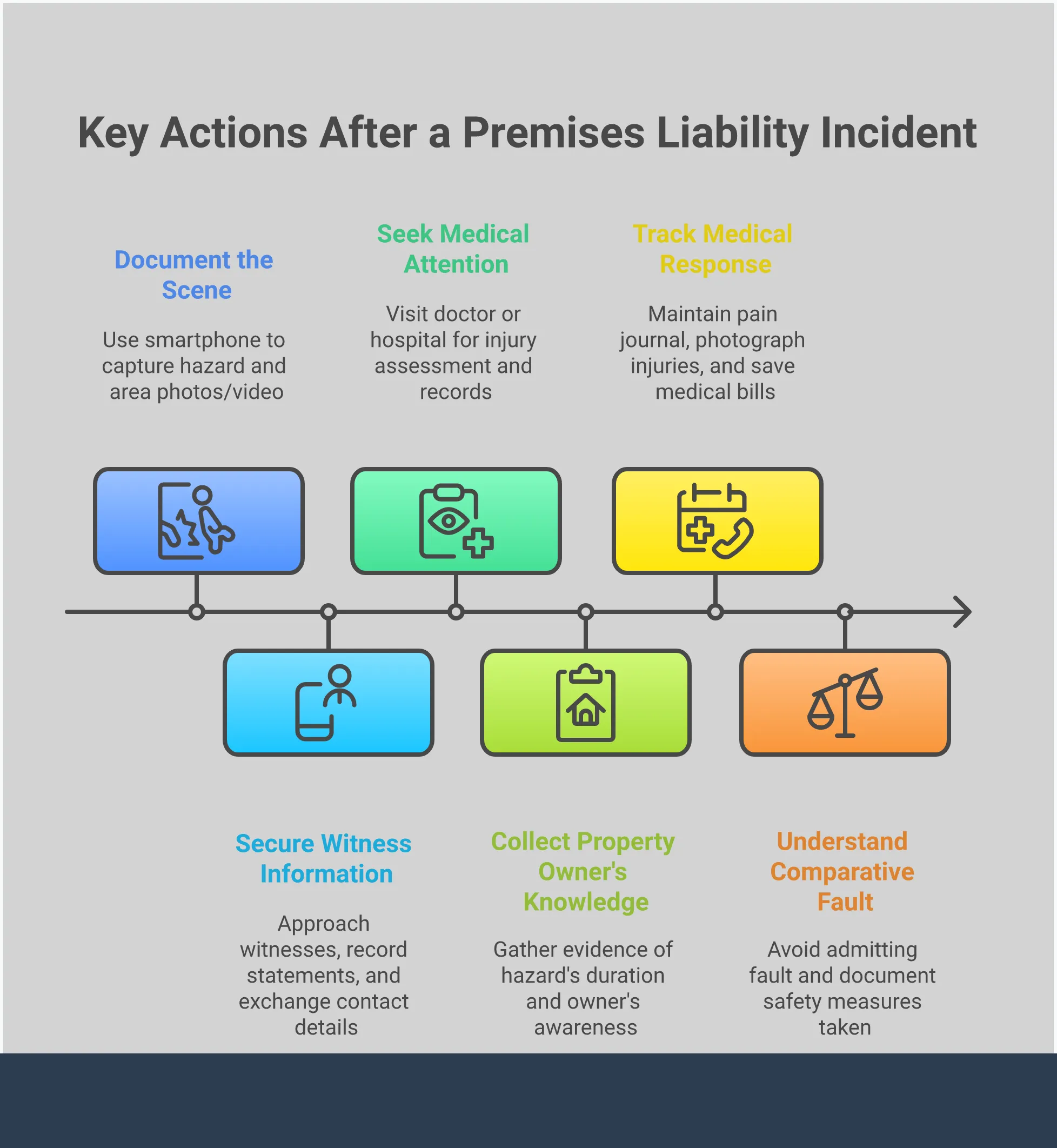
Getting hurt on someone else’s property can be a confusing and painful experience. In the moments after an accident, it’s hard to think clearly. But taking a few specific actions right away can protect your health and preserve your legal rights. If you find yourself in this situation, focus on these three essential steps.
Step 1: Get Medical Attention Immediately
Before you do anything else, take care of yourself. Get medical help immediately, even if you think your injuries are minor. Some serious issues don’t show symptoms right away, and a doctor’s evaluation is the only way to be sure you’re okay. This step is also critical for any future legal claim. Your medical records create an official timeline of your injuries and the treatment you needed, which serves as vital evidence. If you were injured because of a dangerous condition the property owner should have known about, it’s wise to talk to an experienced attorney who can help you understand your options.
Step 2: Document the Scene and Your Injury
Evidence can disappear quickly, so it’s important to document as much as you can while you’re still at the scene. Use your phone to take pictures and videos of the exact spot where you were injured. Capture the hazard that caused your injury—whether it was a wet floor without a sign, a broken stair, or poor lighting. If anyone saw what happened, ask for their name and phone number. Their account could be very helpful later. As soon as you can, write down everything you remember about the incident, including the date, time, and what you were doing right before it happened.
Step 3: Report the Incident to the Owner or Manager
Once you’ve documented the scene, your next move is to report the incident to the property owner or manager. It’s important to tell them exactly what happened, calmly and factually. This creates an official record that the accident occurred and that they were notified. Most businesses will have you fill out an incident report—always ask for a copy for your own files. When you describe what happened, stick to the facts and avoid guessing about details or saying anything that could be misinterpreted as admitting fault. This formal report is a crucial piece of evidence that establishes a clear timeline and shows you took the right steps from the start.
Step 4: Preserve Physical Evidence
The evidence you collect is the foundation of a potential personal injury claim, so it’s essential to preserve everything. Set aside the shoes and clothes you were wearing at the time of the accident without washing them, as any damage can serve as important evidence. Do the same with any personal items that were broken, like your phone or glasses. You’ll also want to start a dedicated folder for all your paperwork. This should include every medical record, bill, and receipt for related expenses—from prescriptions to parking fees at the doctor’s office. Be sure to keep a running log of any wages you lose from missing work. This collection of documents will create a detailed record of the financial and physical toll the injury has taken.
Step 3: Be Aware of Filing Deadlines
In Missouri, there are strict deadlines for filing a personal injury lawsuit. This time limit is called the statute of limitations, and if you miss it, you could lose your right to seek compensation forever. The clock usually starts ticking on the date of the injury, so time is of the essence. These deadlines can be complex and vary depending on the circumstances, especially if a government entity is involved. Understanding which laws apply to your situation is crucial. Because these time limits are so strict, it’s a good idea to discuss your case with a legal professional who handles premises liability claims to ensure you act within the required timeframe.
The “Discovery Rule” and Your Timeline
In Missouri, you generally have five years from the date of an accident to file a personal injury claim. While that might seem like a long time, understanding exactly when that clock starts ticking is essential. This is where a legal concept called the “discovery rule” can make a big difference. The discovery rule acknowledges that not all injuries are obvious right away. It states that the legal deadline doesn’t begin until the date you actually discover your injury—or reasonably should have discovered it—and its connection to the property owner’s negligence. For example, if you slip and fall but don’t realize you have a serious internal injury until a doctor diagnoses it weeks later, the five-year clock might start from the date of your diagnosis, not the date of the fall. This rule is a critical protection, ensuring you don’t lose your right to seek compensation simply because an injury took time to surface.
When Is It Time to Call a Premises Liability Attorney?
After an injury, your main focus is on healing, not legal strategy. But knowing when to bring in a professional can make all the difference in your recovery—both physically and financially. While you might think you can handle things on your own, certain situations are complex and have high stakes. If you find yourself in a scenario where the property owner is denying responsibility, the insurance company is pressuring you, or you’re unsure what your claim is truly worth, it’s time to consider legal help. An experienced attorney can step in to protect your rights and manage the details so you can focus on getting better.
If You’re Unsure Who Is at Fault
Proving a property owner was negligent is the foundation of any premises liability claim. This means showing they knew (or should have known) about a dangerous condition, failed to fix it, and that their failure led directly to your injury. But what happens when the owner argues the hazard was obvious, or that you were partially to blame? These situations can quickly become complicated. An attorney can investigate the incident, gather evidence like maintenance records or witness statements, and build a clear argument that establishes the owner’s negligence. They know how to counter common defense tactics and present the facts in a way that supports your case.
When the Insurance Company Gets Involved
Soon after your injury, you’ll likely get a call from the property owner’s insurance adjuster. It’s important to remember that their job is to protect their company’s bottom line by paying out as little as possible. They may ask you for a recorded statement or offer a quick, lowball settlement before you even know the full extent of your injuries. Dealing with them on your own can be incredibly stressful and may even jeopardize your claim. A skilled attorney can take over all communications with the insurance company. They will handle the negotiations and ensure you don’t say or sign anything that could weaken your position, giving you the space to heal without the pressure.
To Ensure You Receive Fair Compensation
How do you put a number on your injury? It’s more than just the initial emergency room bill. Fair compensation should cover all of your medical expenses (present and future), lost wages from time off work, and even the impact on your future earning ability. It also includes non-economic damages like pain and suffering. It’s easy to underestimate these long-term costs, and insurance companies will rarely offer a settlement that covers them fully. An attorney with experience in these cases, like Chad G. Mann, knows how to calculate the true value of your claim and fight to make sure you receive the resources you need for a full recovery.
Related Articles
- Missouri Premises Liability Law: The Complete Guide
- WHAT IS A SLIP AND FALL LAWSUIT?
- Dog Bite Injury Claims and Owner Affirmative Defenses
- Dog Bite in Missouri? Step-by-Step Legal Guide
Frequently Asked Questions
What if I was partly at fault for my own injury? This is a very common concern, and it doesn’t automatically disqualify your claim. Missouri law uses a “pure comparative fault” system. In simple terms, this means that if you are found to be partially responsible for your accident, your compensation will be reduced by your percentage of fault. For example, if you are awarded $10,000 but found to be 20% at fault, your award would be reduced to $8,000. It’s a way for the court to acknowledge that multiple factors may have contributed to an incident.
How long do I have to file a claim in Missouri? There is a strict legal deadline, known as the statute of limitations, for filing a personal injury lawsuit in Missouri. This time limit begins on the date of your injury, and if you miss it, you will likely lose your right to seek compensation forever. Because these deadlines can be complex and have very few exceptions, it is incredibly important to act quickly and understand the specific timeframe that applies to your situation.
Do I have a case if I was trespassing when I got hurt? Generally, property owners have a very limited responsibility to people who are on their property without permission. The main rule is that an owner cannot intentionally cause harm to a trespasser. However, there is a significant exception when it comes to children. If a child is injured by something on the property that is likely to attract them, like an unfenced swimming pool or an old trampoline, the owner may still be held responsible.
What kind of evidence is most important for my case? Strong evidence is key to proving the property owner was negligent. The most helpful items often include clear photos and videos of the hazard that caused your injury, taken before it can be cleaned up or repaired. It’s also vital to get the names and contact information of any witnesses. If you filed an incident report with the business, a copy of that report is important, as are all of your medical records that connect your injuries directly to the accident.
The owner’s insurance company offered me a quick settlement. Should I take it? You should be very cautious with early settlement offers. Insurance companies often try to resolve claims quickly and for the lowest amount possible. An initial offer is usually made before the full extent of your injuries and long-term medical needs are known. Accepting it means you give up your right to seek any further compensation, even if your medical costs end up being much higher than you anticipated. It’s wise to understand the true value of your claim before agreeing to anything.