


Let’s get one thing straight before anyone hops in the back: a truck bed is for cargo, not people. It has no seatbelts, no airbags, and zero structural protection. So while you’re asking is it illegal to ride in the bed of a truck, the real question is whether it’s ever truly safe. While traffic laws vary by state, the laws of physics are universal. The risk of ejection in a sudden stop or collision is dangerously high. This guide covers the state-by-state rules, but more importantly, it details the serious dangers so you can protect the people you care about.
Key Takeaways
- State Laws Dictate the Rules: There is no single federal law for riding in a truck bed, so the rules change the moment you cross state lines. It’s your responsibility as the driver to know the specific regulations—especially age restrictions—for your current location to avoid fines.
- The Truck Bed Offers Zero Protection: A truck bed is designed for cargo, not people, and lacks essential safety features like seatbelts or airbags. The most significant risk is being ejected during a sudden stop, swerve, or collision, which often leads to catastrophic injuries.
- The Driver Bears All Responsibility: As the driver, you are legally and financially accountable for your passengers’ safety. Allowing someone to ride in the truck bed can result in steep fines, license points, and denied insurance claims, and you could face serious criminal charges if an injury occurs.
So, Is It Actually Illegal to Ride in a Truck Bed?
It’s a classic scene: a beautiful day, the windows are down, and there’s an open truck bed that looks like the perfect spot to catch a breeze. But before you or your loved ones hop in the back, it’s important to ask whether it’s actually legal. The answer isn’t a simple yes or no—it completely depends on where you are.
Riding in the back of a pickup truck is one of those activities governed by a patchwork of local rules rather than a single, nationwide law. Because the regulations can change dramatically the moment you cross a state line, what’s perfectly acceptable in one place could get you pulled over in another. Understanding these differences is key to staying safe and on the right side of the law. If an accident does happen, knowing the rules can be a critical part of a personal injury claim.
Why Truck Bed Laws Aren’t the Same Everywhere
Think about how speed limits or cell phone laws change from one state to another. The rules for riding in a truck bed are no different. Each state has the authority to set its own traffic laws, which results in a wide range of regulations across the country. Some states have an outright ban on passengers in the cargo area of a truck. Others allow it but with specific restrictions, such as setting a minimum age for passengers or limiting it to certain types of roads.
This variation means you can’t assume the rules you know from your home state apply when you’re on a road trip. Because there is no federal standard, it falls to drivers to know the specific state and local laws wherever they are driving.
Geographic and Demographic Differences
The laws about riding in the back of a pickup truck are incredibly different from state to state. In fact, 21 states have no laws at all restricting passengers in a truck bed, while the other 29 have specific rules that range from a complete ban to allowing it only under certain conditions. Many of these rules are based on age; for example, some states require passengers to be 18 or older. Here in Missouri, the law permits passengers over 18 to ride in the back, but those under 18 can only do so if the truck is not on a state or federal highway. It’s a perfect example of how complex these regulations can be. The bottom line is that even where it’s technically allowed, you’re still missing the most basic safety features, and the risks are the same everywhere.
Cultural Perceptions and Media Influence
Let’s be honest—movies, TV shows, and music videos often portray riding in a truck bed as a symbol of freedom and fun. This image can make the activity seem harmless, especially to young people. However, this romanticized view completely ignores the devastating reality of what can happen in an accident. Without any safety restraints, a person can be easily ejected, leading to catastrophic outcomes like brain damage, spinal cord injuries, or even death. These aren’t just abstract risks; they are life-altering consequences that can result from a single sudden stop or swerve. If you or a loved one has been injured in an automobile accident, you understand that the fun of the moment is never worth a lifetime of pain and recovery.
Federal Guidelines vs. State Law: Who Makes the Rules?
One of the main reasons for all this confusion is that there is no federal law that prohibits or allows riding in the back of a pickup truck. The U.S. government leaves this decision entirely up to the individual states. As a result, you have a real mix of approaches. In fact, about twenty states have no specific state law that stops people from riding in a truck bed at all.
This hands-off federal approach puts the responsibility squarely on drivers. Before you let anyone ride in the back, it’s essential to check the regulations for the state you’re in. A quick search for your state’s vehicle code is the best way to get a clear answer and ensure you’re making a safe and legal choice for your passengers.
Just How Common (and Dangerous) Is It?
While the legal debate is complex, the physical risks are brutally simple. It’s easy to dismiss the danger when you see people riding in truck beds all the time, especially on rural roads or during a parade. But this common sight creates a false sense of security. The reality is that a truck’s cargo bed is one of the most dangerous places to be in a moving vehicle. Without any safety features to speak of, a passenger is completely exposed to forces that the rest of the truck is designed to withstand. Understanding just how frequently this happens—and the devastating consequences it can have—is the first step toward making a safer choice.
Truck Bed Passenger Statistics
Seeing someone in the back of a pickup is so common that you might assume it’s perfectly fine. The numbers show why this perception exists. Across the United States, there’s no consensus on the issue, with 21 states having no laws at all that restrict passengers from riding in a truck bed. The other 29 states have a mix of regulations, ranging from outright bans to rules based on age or the type of road. This legal gray area means that on any given day, countless people are riding unprotected. This patchwork of laws contributes to the idea that the practice is safe, but legality and safety are two very different things. Just because you can do something doesn’t always mean you should.
The Sobering Injury Data
The most significant danger of riding in a truck bed is the complete lack of protection. There are no seat belts to hold you in place and no airbags to cushion an impact. In a sudden stop, a sharp turn, or a collision, a person can be easily thrown from the vehicle. This is called ejection, and it is a primary cause of catastrophic injuries in traffic accidents. The potential outcomes are severe and often life-altering, including traumatic brain injuries, broken bones, internal bleeding, and spinal cord damage that can lead to paralysis. One study highlighted this risk, finding 40 patients were injured from riding in truck beds over a 40-month period. These aren’t just statistics; they represent real people whose lives were changed in an instant.
Truck Bed Riding Laws: A State-by-State Guide
When it comes to riding in the back of a pickup truck, there’s no single, nationwide rule. Instead, you’ll find a patchwork of state laws that range from strict prohibitions to having no specific regulations at all. This can be confusing, especially if you’re traveling across state lines. Generally, states fall into one of three categories: those that ban the practice for everyone, those that have age-based restrictions, and those that have yet to pass any specific laws on the matter. Understanding where your state stands is the first step in ensuring every trip is a safe and legal one.
States Where It’s Always Illegal
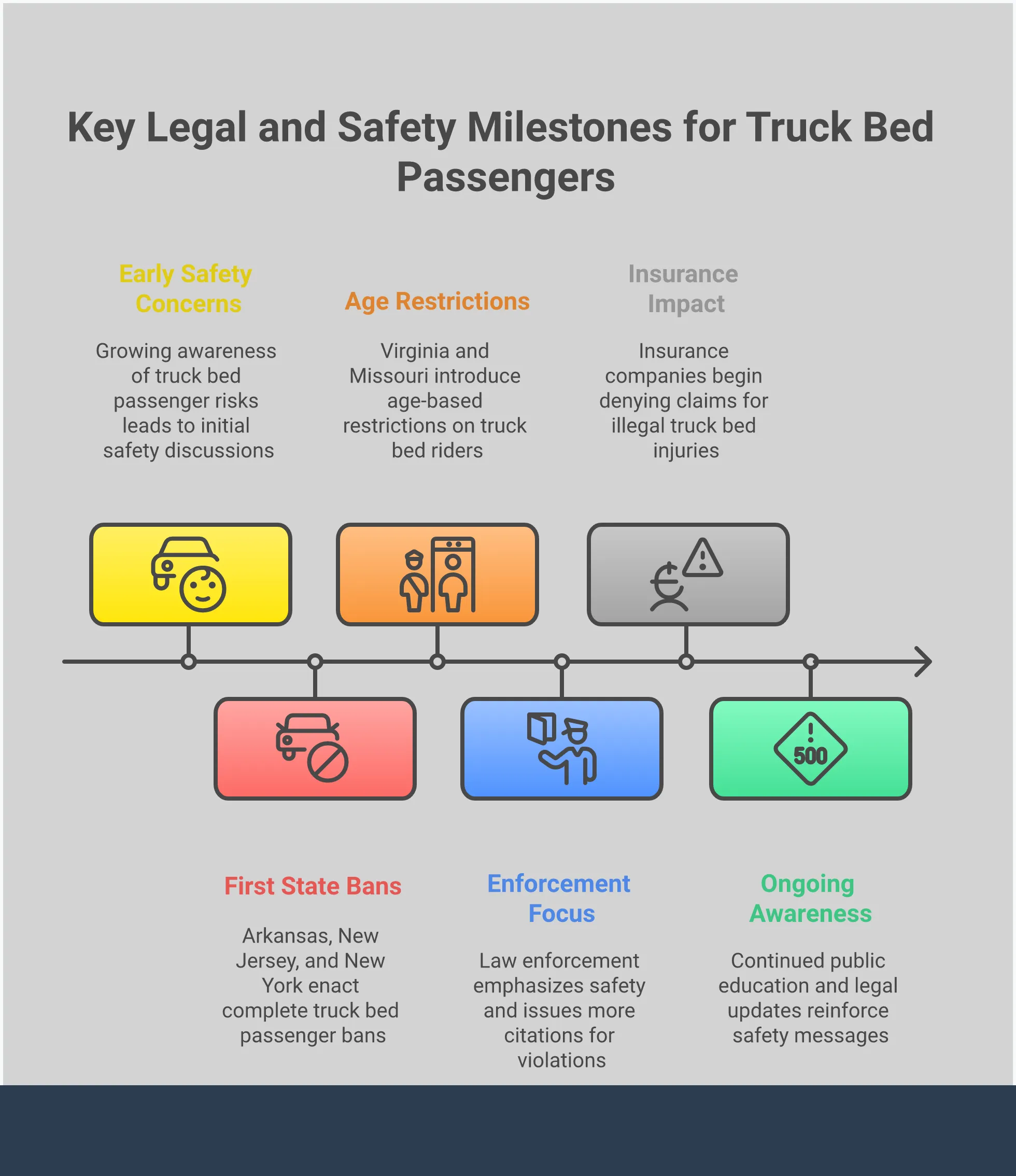
A handful of states have taken a firm stance by making it illegal for anyone, regardless of age, to ride in the open bed of a pickup truck. States like Arkansas, New Jersey, and New York have laws that generally outlaw the practice on public roads. However, even these strict rules come with specific exceptions. For instance, the laws often don’t apply to on-duty employees who need to ride in the back for work, during official parades, or in emergency situations. These limited exceptions are narrowly defined, so it’s always best to assume the ban applies to you unless you clearly fall into one of these categories.
Examples: California, Arkansas, and New Jersey
To see just how much the rules can differ, let’s look at a few states that represent the full spectrum of regulations. What’s perfectly legal in one state could get you a serious ticket just a few miles down the road.
- California: The Golden State’s law is a perfect example of a rule that seems flexible but is actually very strict. While it’s not an outright ban, the California Vehicle Code requires any passenger in the cargo area to be secured by a federally-approved restraint system. This means you can’t just have someone sitting freely in the back; they would need to be in a proper seat with a seatbelt. Since most truck beds aren’t equipped this way, the law effectively prohibits the casual practice of riding in the back while still allowing for specially modified vehicles.
- Arkansas: Taking a much more direct approach, Arkansas law makes it illegal for anyone, regardless of age, to ride in the open bed of a pickup truck on public roads. This firm stance prioritizes passenger safety above all else, acknowledging that a truck bed offers zero protection in a sudden stop, swerve, or collision. The law is straightforward and leaves little room for interpretation, sending a clear message that the cargo area is for cargo only. This type of clear-cut rule is often the easiest for drivers to follow, as there are no age or road-type exceptions to remember.
- New Jersey: Similar to Arkansas, New Jersey also prohibits passengers from riding in an open truck bed. This law is designed to prevent the catastrophic injuries that can occur when a person is ejected from a vehicle during an accident. While there are a few very specific exceptions, such as for on-duty employees who need to be in the back for work-related tasks, these are narrowly defined and do not apply to the general public. For everyday drivers, the rule is simple and absolute: all passengers must be safely inside the cab of the truck.
These examples really drive home the point that you can’t make assumptions. A quick check of local laws before you travel is the only way to stay safe and avoid legal trouble.
States Where Age Limits Apply
The most common approach states take is to restrict truck bed riding based on age. These laws are designed to protect children and teenagers, who are most vulnerable to serious injury. For example, in Virginia, it’s illegal for anyone under 16 to ride in a truck bed. Here in Missouri, the law prohibits passengers under 18 from riding in the unenclosed bed of a truck on state highways. As with other states, there are exceptions for activities like farming, participating in authorized parades, or when it’s necessary for employment. These age-based laws aim to strike a balance, allowing for necessary work-related transport while protecting young passengers from unnecessary risks during casual travel.
Examples: Louisiana, North Carolina, and Ohio
To give you a better idea of how much these age-based rules can differ, let’s look at a few states. In Louisiana, the law allows adults to ride in the back of a truck, but it sets clear restrictions for children. Anyone under the age of 12 is prohibited from riding in an open truck bed unless they are in a properly enclosed area. This rule is designed to add a layer of safety for the youngest passengers while still allowing adults to make their own choice.
Other states draw the line at a higher age. North Carolina, for instance, takes a stricter approach by prohibiting anyone under 16 from riding in the open cargo area of a truck. Ohio’s law is very similar, requiring all passengers in the back of a pickup to be at least 16 years old. These examples from just three states show why you can never assume the rules are the same when you cross state lines. A quick check of local laws is always the smartest move before letting anyone hop in the back.
States with Few (or No) Restrictions
Surprisingly, about 20 states have no specific laws that prohibit passengers from riding in the back of a pickup truck. In these states—which include Alabama, Alaska, Arizona, Illinois, and Kentucky, among others—it is technically legal by default. However, the absence of a specific law doesn’t mean it’s a safe practice. Law enforcement in these areas may still be able to issue citations under other broad traffic safety or child endangerment laws if they believe passengers are in immediate danger. Just because you can doesn’t always mean you should, and the lack of specific state laws doesn’t change the physics of a car crash.
The Full List of Unrestricted States
It might come as a surprise, but a significant number of states don’t have any specific laws on the books that forbid passengers from riding in the cargo area of a pickup. These states include Alabama, Alaska, Arizona, Delaware, Idaho, Illinois, Indiana, Iowa, Kentucky, Minnesota, Mississippi, Montana, New Hampshire, North Dakota, Oklahoma, South Dakota, Vermont, Washington, West Virginia, and Wyoming. In these places, it’s technically legal by default. However, this legal gray area shouldn’t be mistaken for a green light. The absence of a specific prohibition doesn’t eliminate the inherent dangers, nor does it prevent law enforcement from using other statutes, like reckless endangerment, to issue a ticket if they feel a situation is unsafe.
A Note on States Like Mississippi
Even in states with no explicit restrictions, the simple truth remains: just because you can doesn’t always mean you should. The laws of physics don’t change when you cross a state line. A truck bed offers zero protection in a crash, and the risk of being thrown from the vehicle is incredibly high. A sudden stop, a sharp turn, or a collision can have devastating consequences for anyone in the back. It’s a critical reminder that legal permission doesn’t equal safety. Prioritizing the well-being of your passengers over convenience is always the right call, regardless of what the local vehicle code says.
Other Common Restrictions
Beyond the basic categories of “legal,” “illegal,” and “age-restricted,” many states have additional rules that drivers must follow. These regulations add another layer of complexity and are designed to mitigate some of the most obvious risks associated with riding in a truck bed. These restrictions often focus on the specific conditions under which someone can be in the back, such as the speed of the vehicle or the type of road you’re on. It’s not enough to know if it’s generally allowed; you also need to be aware of these finer points to avoid a ticket and, more importantly, to keep your passengers as safe as possible under the circumstances.
Speed Limits
Some states that permit passengers in a truck bed do so only under a certain speed limit. For example, a state might allow it on local roads where speeds are under 35 mph but strictly forbid it on highways or interstates. This is a common-sense approach, as the potential for a catastrophic accident increases exponentially at higher speeds. Before you let someone hop in the back, you need to consider your route. If your trip involves any travel on a major highway, you’ll likely need to ensure all passengers are safely buckled up inside the cab for the entire journey.
Seating and Restraint Requirements
This is where the reality of the danger truly sets in. A truck bed has no seats and, crucially, no seatbelts or other safety restraints. Some state laws specify that if passengers are in the back, they must be seated on the floor of the bed and not on the wheel wells or the edge of the truck. As the driver, you are legally and financially accountable for your passengers’ safety. If an accident occurs, allowing someone to ride unrestrained in the truck bed can lead to steep fines, points on your license, and denied insurance claims. In the event of an injury, the legal consequences can be severe, which is why understanding your responsibilities is a key part of preventing a tragedy. If you’ve been in an automobile accident involving complex liability, getting legal guidance is essential.
Are There Exceptions to the Rules?
While riding in the back of a pickup truck is generally unsafe and often against the law, there are a few specific situations where it might be permitted. These exceptions aren’t a green light for casual joyrides; they are typically tied to specific activities, locations, or work-related needs where practicality is a major factor. Lawmakers often carve out these allowances for industries like agriculture or for controlled community events where the risks are significantly lower than on a public highway. Even when the law allows it, safety should always come first. Understanding these specific exceptions can help you stay on the right side of the law, but remember that the safest place for any passenger is always inside the cab, buckled up.
Farming and Agricultural Work
In many states with strong agricultural roots, like Missouri, there are often exceptions for farming and ranching activities. The law recognizes the practical need to transport workers across large properties or between adjacent fields. This typically applies when a truck is being used directly for agricultural work, not for a personal trip into town. For example, moving a crew from one part of a farm to another to harvest crops might be allowed. These rules are strictly for work-related purposes and are a nod to the unique demands of the agricultural industry.
Parades and Community Events
You’ve likely seen people waving from the back of a pickup truck during a local parade. This is another common exception. Most states allow passengers in a truck bed during an organized parade or community event that has been officially approved by the local government or transportation department. In these controlled settings, traffic is blocked off, and vehicles move at very slow speeds, which greatly reduces the risk. This exception is strictly for sanctioned events and doesn’t apply to informal processions or celebrations on public roads. If you have questions about liability for an event, it’s always best to contact a legal professional.
When You’re on Private Property
The rules of the road are primarily designed for public highways and streets. Because of this, laws restricting passengers in truck beds often do not apply when you are driving on private property. This could include a private farm, a long driveway, or a large worksite away from public access. However, this is an important area to exercise caution. Just because it’s technically legal doesn’t make it safe. Accidents can and do happen on private land, and an injury could lead to a complicated premises liability claim.
Work and Emergency Scenarios
Some state laws include exceptions for certain work-related or emergency scenarios where riding in a truck bed is a matter of necessity. This might apply to construction workers on a closed job site or employees who need to be transported for a specific work duty where no other option is available. Similarly, emergency situations may create a need for unconventional transport. These exceptions are not loopholes for everyday travel; they are designed for very specific, function-based circumstances. Even in these cases, if an injury occurs due to someone else’s negligence, knowing your rights is crucial.
Special Approved Safety Seats
In some states, the law includes a very specific exception for passengers riding in a truck bed: the use of a special, approved safety seat. This might sound like a simple solution, but it’s important to understand what this actually entails. We’re not talking about a simple bench or a makeshift seat. For this exception to apply, the seat must be securely installed in the truck bed and equipped with a proper seatbelt. The catch is that these systems are incredibly rare, and many are not actually approved by the U.S. Department of Transportation for passenger use. This makes the exception more of a legal footnote than a practical option for most drivers. Before ever considering such a setup, remember that the fundamental lack of protection in a truck bed remains, and an accident could still have devastating consequences.
The Real Dangers of Riding in a Truck Bed
Even if state law gives a green light in certain situations, riding in the back of a pickup truck is incredibly risky. The laws of physics don’t change just because you’ve crossed a state line. A truck bed is designed to haul equipment and supplies, not people. When you or your loved ones ride back there, you’re putting yourselves in a vulnerable position with no real protection from the unexpected. Understanding these dangers is the first step toward making safer choices for everyone on the road.
No Seatbelts Means No Protection
Truck beds are for cargo, plain and simple. Think about the inside of a car—it’s a carefully engineered safety cell with seatbelts, airbags, and a reinforced frame designed to protect you in a crash. The bed of a truck has none of that. There are no restraints to hold you in place and nothing to cushion the impact of a collision. You are completely exposed. Without these basic vehicle safety features, a passenger in a truck bed is just as vulnerable as any other piece of unsecured cargo. In an accident, the consequences can be devastating.
The High Risk of Ejection and Injury
The single greatest danger of riding in a truck bed is being thrown from the vehicle. It doesn’t take a high-speed crash for this to happen. A sudden swerve, a sharp turn, or even hitting a large pothole can be enough to eject a passenger onto the pavement. Ejections are one of the most lethal events in any traffic accident. The resulting injuries are often catastrophic, including traumatic brain injuries, spinal cord damage, and broken bones. If you or a loved one has been injured in an automobile accident, you know how quickly life can change. Choosing to ride inside the cab is a simple decision that can prevent a lifetime of pain and regret.
Exposure to Debris and Toxic Fumes
Riding in an open truck bed exposes you to dangers you wouldn’t face inside a car. The road is constantly kicking up rocks, gravel, and other debris that can become dangerous projectiles at high speeds, causing serious eye or head injuries. Beyond flying objects, there’s also the invisible threat of carbon monoxide. Exhaust fumes from the truck’s own tailpipe can get trapped in the turbulent air of the truck bed, creating a pocket of poisonous gas. Breathing in these fumes can lead to dizziness, headaches, and even carbon monoxide poisoning without the passenger ever realizing what’s happening.
Exposure to the Elements
Beyond road debris and exhaust, the weather itself becomes a significant hazard when you’re riding in an open truck bed. You have no protection from the elements. On a hot day, direct sun exposure can quickly lead to severe sunburn or even heatstroke. A sudden downpour can make the truck bed dangerously slick and soak you in cold rain, increasing the risk of hypothermia. Even on a pleasant day, the wind chill at driving speeds can be much colder than you expect. These aren’t just matters of comfort; they are safety issues that can cause real harm or distract a passenger, making a fall more likely. If an accident happens under these conditions, the resulting injuries can be severe, complicating any potential personal injury claim.
The Long-Term Damage You Can’t See
Some dangers of riding in a truck bed aren’t as immediate as a crash but can still cause long-term harm. The constant roar of the wind and road noise at highway speeds can be loud enough to cause permanent hearing damage over time. It’s a risk many people don’t consider until it’s too late. Additionally, passengers in the back are exposed to everything in the air, including dust, pollen, and pollutants kicked up from the road surface. Inhaling these particles can irritate the lungs and worsen conditions like asthma or other respiratory issues. These hidden risks add to the long list of reasons why the cab is the only safe place for passengers.
What Happens If You Get Caught?
Ignoring truck bed safety laws isn’t just risky—it can lead to serious legal and financial consequences that go far beyond a simple warning. If a police officer pulls you over for having passengers in the back of your truck, you could be facing a combination of penalties. The exact outcome depends on your state’s laws and the specific circumstances, but the potential repercussions are significant enough to make anyone think twice. From hefty fines that hit your wallet to points on your license that threaten your driving privileges, the consequences can escalate quickly, especially if an accident occurs. Understanding these penalties is the first step toward making safer choices on the road.
Expect Fines and Financial Penalties
The most immediate consequence of getting caught with passengers in your truck bed is a financial one. Law enforcement can issue tickets with fines that can be surprisingly steep. The exact amount varies by state, but it’s rarely a minor expense. For example, if a driver allows someone under 16 to ride illegally in a truck bed, they can face significant fines. These penalties are in place not just to punish drivers but to strongly discourage a practice that puts passengers, especially young ones, in a vulnerable and dangerous position. The cost of a single ticket can easily outweigh any perceived convenience of a quick trip in the back of the truck.
Examples of Fines by State
To give you a better idea of how much these fines can differ, let’s look at a few states. In Texas, for instance, a driver could be fined anywhere from $25 to $200 for letting a child ride illegally in the back. Over in Mississippi, the penalty for a first-time offense is a flat $25. While these might not seem like huge amounts, it’s important to remember that violations can result in fines that increase with each repeat offense. In states with stricter bans, like California and New York, the consequences can go beyond just a ticket and may include points against your driver’s license. These penalties are designed to underscore the seriousness of the risk and hold drivers accountable for their passengers’ safety.
How It Affects Your Driving Record
Beyond the initial fine, a violation can also add points to your driver’s license. Most states use a point system to track traffic infractions, and accumulating too many points in a short period can lead to serious consequences. Getting points on your license could cause your auto insurance rates to go up, as insurers see you as a higher-risk driver. If you collect enough points, you could even face a license suspension, making it illegal for you to drive at all. This single decision can impact your ability to get to work, run errands, and manage your daily life, all because of a preventable traffic stop.
Could You Face Criminal Charges?
This is where the consequences can become life-altering. If someone is injured or killed while riding in the back of your truck, the situation moves from a traffic violation to a serious criminal matter. You could face charges like reckless endangerment or even vehicular manslaughter. These are not minor offenses; they can lead to jail time, a permanent criminal record, and devastating personal and financial fallout. When an accident happens, you need an advocate who understands the complexities of personal injury law. A seemingly innocent ride can turn into a legal battle that will follow you for years.
Will Your Car Insurance Rates Go Up?
Even if you avoid criminal charges, you’ll likely face a battle with your insurance company. After an accident, your insurer will investigate the details. If they discover that passengers were riding illegally in the truck bed, they may argue that you were using your vehicle in an unsafe manner not covered by your policy. As a result, they might refuse to pay for injuries or damages, leaving you personally responsible for massive medical bills and other costs. Navigating the aftermath of automobile accidents is challenging enough without having your insurance claim denied, which is a very real possibility in these situations.
What to Do If You’re Injured While Riding in a Truck Bed
If you or someone you love has been injured while riding in the back of a pickup truck, the moments after the accident can be overwhelming. Beyond the immediate medical concerns, you’re likely facing a complicated legal situation. The driver is typically held responsible for the safety of everyone in their vehicle, including those in the truck bed. As the driver, you are legally and financially accountable for your passengers’ safety. Allowing someone to ride in the truck bed can result in steep fines, license points, and denied insurance claims, and you could face serious criminal charges if an injury occurs. Understanding your rights and the steps to take next is essential for protecting your future.
Understanding Your Legal Options
When an injury happens, the legal landscape can be difficult to sort out on your own. Because the driver is responsible for their passengers, they are often liable for any injuries that occur. If someone is injured or killed while riding in the back of your truck, the situation moves from a traffic violation to a serious criminal matter. The driver could face charges like reckless endangerment or even vehicular manslaughter. For the injured passenger, this means a personal injury claim will likely involve complex questions of negligence and liability. It’s important to document everything, from medical treatments to any communication with the driver or their insurance company, to build a strong foundation for your case.
Why You Need an Experienced Attorney
Navigating the aftermath of an accident is challenging, especially when insurance companies get involved. After an accident, your insurer will investigate the details. If they discover that passengers were riding illegally in the truck bed, they may argue that you were using your vehicle in an unsafe manner not covered by your policy. This could lead to a denied claim, leaving you to cover medical bills and lost wages on your own. When an accident happens, you need an advocate who understands the complexities of personal injury law. An experienced attorney can handle the negotiations with insurance adjusters and fight to ensure you receive the compensation you deserve. If you have questions about your specific situation, don’t hesitate to contact a legal professional for guidance.
How to Keep Your Passengers Safe and Legal
Even if your state’s laws are lenient, putting people in the back of a pickup truck is never the safest choice. As a driver, you are responsible for everyone in your vehicle, and that responsibility goes beyond just following the letter of the law. It’s easy to think, “It’s just a short trip down a country road,” or “We did this all the time as kids.” But the reality is that a serious accident can happen in a split second, at any speed, on any road. Prioritizing safety means making smart, cautious decisions every time you get behind the wheel, regardless of how routine the drive feels. It’s about protecting the people you care about from preventable harm.
The difference between a fun outing and a tragedy can be as simple as insisting everyone buckle up inside the cab. The cab of your truck is a reinforced safety cell designed to protect occupants, while the bed is an open cargo box with no safety features whatsoever. Fortunately, keeping your passengers safe is straightforward. It starts with a simple mindset shift: the truck bed is for equipment, not people. By sticking to a few clear principles—using designated seats, finding other transport when you’re full, and understanding your vehicle’s built-in safety features—you can ensure everyone arrives at your destination safely. This also helps you avoid the serious legal and personal consequences of an accident. If you’ve been involved in an automobile accident where passenger safety was a factor, understanding your rights and responsibilities is the first step toward protecting yourself.
Rule #1: Keep Everyone Inside the Cab
The simplest rule is the most important: passengers belong in seats, and seats are inside the cab. Even if riding in the truck bed is technically legal in your area for a short trip, it’s never truly safe. The cab of your truck is a reinforced safety cage designed to protect occupants during a collision. The bed, on the other hand, is designed to haul cargo. It offers no protection from impact, rollovers, or sudden stops. Think of it this way: you wouldn’t transport a television in a passenger seat without securing it, so you shouldn’t transport a person in a cargo area with no safety features. Always fill the designated seats inside the cab first.
When Is It Safe? Only When Parked
Let’s cut to the chase: the only time it’s truly safe for anyone to be in the bed of a pickup truck is when it’s parked. The moment the engine starts and the truck begins to move, the bed becomes an incredibly dangerous place for a person. It’s designed for cargo, not people, and lacks the most basic safety features like seatbelts or airbags. The greatest danger is being ejected from the vehicle, which can happen from something as simple as a sharp turn or hitting a pothole—not just in a major collision. So, if you’re using the truck for a tailgate party or watching fireworks from a field, that’s one thing. But once the keys are in the ignition, everyone needs to be safely buckled up inside the cab. No exceptions.
Find a Safer Way to Get There
What if you have more passengers than seats? The answer is never to put the overflow in the truck bed. Instead, it’s time to find a better option. This might mean taking a second car, arranging a carpool with another driver, or calling a rideshare service. While it may seem inconvenient, a few minutes of planning can prevent a lifetime of regret. Prioritizing safety means making the responsible choice, even if it requires a little extra coordination. The goal is to get everyone to your destination in one piece, and using the truck bed as extra seating is a risk that’s just not worth taking. It’s a simple calculation of a minor inconvenience versus a potentially catastrophic outcome.
Use Your Truck’s Built-In Safety Features
Truck beds are made for cargo, not people. They don’t have the critical safety features that we often take for granted. When a passenger is inside the cab, they are protected by seat belts, airbags, a reinforced steel frame, and crumple zones designed to absorb the force of an impact. A person riding in the open bed has none of these protections. They are completely exposed to the elements, road debris, and the full force of any collision. In a crash, they can be easily ejected from the vehicle, which dramatically increases the risk of catastrophic injury or death. Always use the safety features the vehicle’s manufacturer designed for passengers; they are there for a reason.
Tips for Unavoidable Situations
Let’s be honest: a truly unavoidable situation where someone must ride in a truck bed is incredibly rare. If you have more people than seats, the safest answer is always to find another way, whether that means taking a second car or calling a rideshare. However, in those limited, legally permitted scenarios—like moving slowly across private farmland—there are ways to reduce the immense risk. Drive at a crawl and stay off public roads. Instruct passengers to sit on the floor of the bed, as low as possible, to prevent being ejected. Also, clear the bed of any tools or loose items that could become projectiles in a sudden stop. Even with these precautions, the danger is still very real, and as the driver, you carry the full responsibility for what happens. Understanding your liability in an automobile accident is critical, because the safest choice is always the one that keeps everyone buckled up inside.
Your Responsibility Behind the Wheel
As the driver, you carry the legal and moral responsibility for your passengers’ safety. If you allow someone to ride illegally in your truck bed and an accident occurs, the consequences can be severe. You could face steep fines, points on your driver’s license, and a significant increase in your insurance rates. In a worst-case scenario where a passenger is injured or killed, you could even face serious criminal charges like reckless endangerment. The legal fallout from such an incident can be complex and life-altering. If you have questions about your legal duties as a driver, it’s wise to contact a legal professional for guidance.
Related Articles
Frequently Asked Questions
So, is it ever completely safe to ride in the back of a truck? Even when it’s technically legal, riding in a truck bed is never truly safe. The back of a truck is designed for hauling cargo and has none of the safety features built into the passenger cab, like seatbelts or airbags. A sudden stop, a sharp turn, or a collision can easily throw a passenger from the vehicle, leading to catastrophic injuries. The safest choice is always to have every passenger buckled up inside the cab.
What are the specific rules for riding in a truck bed in Missouri? In Missouri, the law is focused on protecting younger passengers. It is illegal for anyone under the age of 18 to ride in the unenclosed bed of a truck while it’s being driven on a state highway. However, the law does include exceptions for specific situations, such as for agricultural work, in sanctioned parades, or for certain employment-related duties.
Does it matter if we’re just driving slowly on a private road or farm? State traffic laws generally apply to public roads, so the rules often don’t extend to private property. While you may not get a ticket for having passengers in the back on your own land, the physical dangers remain the same. An accident can happen anywhere, and an injury on private property can still lead to complex legal issues, including premises liability claims.
Can I get in trouble as a passenger, or is it only the driver’s responsibility? The driver of the vehicle is legally responsible for the safety of their passengers and is the one who will typically receive a ticket or face charges. As the person in control of the vehicle, the driver has the final say and the ultimate responsibility. However, as a passenger, choosing not to ride in a truck bed is a decision you can make for your own safety.
If an accident happens, will my car insurance cover injuries for someone who was in the truck bed? This can be a very complicated issue. If an insurance company finds that a passenger was injured while riding illegally in a truck bed, they may argue that the vehicle was being used in an unsafe or prohibited manner. This could give them grounds to deny the claim, potentially leaving the driver personally responsible for enormous medical bills and other damages.