


The bills after a car accident are obvious. You see the cost in the emergency room invoice, the mechanic’s estimate, and the paychecks you missed while recovering. But that’s only part of the story. A fair settlement must also account for the physical pain, the emotional toll, and the complete disruption to your daily life. These losses are just as real, and you deserve compensation. So when you ask, “how much is my car accident worth in Missouri?,” the answer isn’t just about adding up receipts. It’s about the full human cost of the crash, and we’ll show you exactly how that’s calculated.
Key Takeaways
- Understand the Full Scope of Your Losses: Fair compensation goes beyond your immediate medical bills. It must also cover future healthcare needs, lost wages, damage to your vehicle, and the significant, non-financial impact of your physical pain and emotional distress.
- Protect Your Claim from the Very Beginning: The steps you take right after an accident are crucial. Prioritize getting a medical evaluation, document everything at the scene, and be extremely cautious when speaking with insurance adjusters to avoid unintentionally hurting your case.
- Missouri Law Has Rules That Impact Your Payout: Your final settlement can be reduced if you’re found partially at fault due to the state’s comparative fault rule. Missing the strict legal deadline, known as the statute of limitations, can prevent you from recovering anything at all.
How Much Is Your Missouri Car Accident Claim Worth?
After a car accident, one of the first questions on your mind is likely, “How much is my claim worth?” While there’s no magic formula that can give you a perfect number, several key factors consistently shape the value of a settlement in Missouri. Understanding these elements is the first step toward ensuring you receive fair compensation for everything you’ve been through. It’s not just about the damage to your car; it’s about the full impact the accident has had on your life, your health, and your finances. An experienced attorney can help you evaluate these factors to build a clear picture of what your claim entails.
How Severe Are Your Injuries?
The most significant factor in your settlement is how seriously you were injured. A claim involving minor whiplash and a few doctor visits will be valued very differently from one involving a traumatic brain injury or paralysis that requires lifelong care. Insurance companies and juries look at the nature of the injury, the length of your recovery, and whether you’ll have permanent scarring, disability, or chronic pain. The more your injuries impact your ability to live your daily life, the higher the potential value of your claim. Documenting every symptom and following your doctor’s treatment plan is crucial for proving the extent of your injuries.
What if You Have No Medical Treatment?
It’s a question that comes up often: what happens if you’re in an accident but don’t go to the doctor? The straightforward answer is that if you weren’t injured, you don’t have a personal injury claim. But if you were hurt and chose not to seek treatment, you could be jeopardizing your ability to get any compensation. Insurance companies rely on official documentation to validate claims. Without a medical record, they can—and often will—argue that your injuries weren’t serious enough to warrant payment. It creates a situation where it’s just your word against theirs, and unfortunately, that’s rarely enough to secure a fair settlement.
Your medical records are the single most important piece of evidence in a personal injury case. They provide a clear, professional assessment of your condition and create a timeline that links your injuries directly to the accident. This documentation is what proves the extent of your pain, the cost of your care, and the impact on your daily life. The value of your claim is directly tied to your specific injuries and losses, and without a doctor’s notes, prescriptions, and treatment plans, it’s nearly impossible to prove those losses occurred. These records translate your experience into a language that insurance companies are legally required to recognize.
Delaying or forgoing a medical evaluation can also be misinterpreted by the insurance adjuster. They may assume that if you were truly in pain, you would have seen a doctor immediately. This perception can lead them to make a very low settlement offer or even deny your claim entirely, as some insurers may refuse to offer any payment without proof of treatment. For this reason, getting checked out by a medical professional after any accident is crucial. Adrenaline can easily mask symptoms, and seeing a doctor protects both your physical well-being and your legal rights down the road.
Accounting for Medical Bills and Future Care
Your settlement should cover all medical expenses related to the accident, both past and future. This includes every cost, from the initial ambulance ride and emergency room visit to surgeries, hospital stays, physical therapy, prescription medications, and specialist appointments. It’s essential to keep detailed records of every bill and payment. If your injuries require long-term care, like ongoing therapy or future medical procedures, an expert can help estimate those future costs so they can be included in your settlement demand. These clear financial losses form the foundation of your personal injury claim.
Recovering Lost Wages and Future Earnings
If your injuries kept you from working, you are entitled to compensation for the income you lost. This isn’t just your base salary; it also includes missed overtime, bonuses, commissions, and any sick or vacation time you had to use during your recovery. Furthermore, if your injuries are severe enough to prevent you from returning to your previous job or limit your ability to earn money in the future, you can seek damages for “loss of earning capacity.” This compensates you for the difference between what you would have earned and what you can earn now because of the accident.
Getting Compensated for Vehicle Damage
The property damage portion of your claim primarily covers the cost of repairing your vehicle. If the repairs cost more than the car is worth, the insurance company will declare it a total loss, and you should be compensated for its actual cash value right before the crash. This part of the settlement can also include the cost of a rental car while yours is in the shop and reimbursement for any personal items damaged in the accident, like a laptop or car seat. It’s important to remember that the at-fault driver’s insurance policy limits can cap how much you receive, which is a key reason to explore all your options.
Understanding Diminished Value Claims
Even after your car is perfectly repaired, it carries a history that can lower its market price. This frustrating reality is known as “diminished value.” Imagine you’re shopping for a used car and find two identical models. One has a clean record, while the other was in a wreck but has been fully repaired. Which one would you pay more for? Most buyers would choose the car without an accident history or expect a significant discount on the other. This isn’t a small dip in price, either; a car can lose between 10% and 30% of its value after a crash. If the other driver was at fault, you have the right to file a claim with their insurance to recover this very real financial loss.
How Much Does a Car’s Value Drop After an Accident?
The drop in your car’s value isn’t just about perception; it’s a documented fact. When a vehicle is in a significant accident, it gets reported to services like CARFAX, creating a permanent mark on its history report. This accident record follows the car forever, making it less attractive to future buyers and dragging down its resale value. Even with the highest quality repairs, that history can’t be erased. That’s why a comprehensive automobile accident claim must go beyond the repair invoice. It should also account for this long-term depreciation to ensure you are truly made whole after the crash.
How Do You Put a Price on Pain and Suffering?
A settlement covers more than just your bills; it also includes compensation for non-financial losses, often called “pain and suffering.” This is a legal term for the physical pain, emotional distress, anxiety, and loss of enjoyment of life you’ve experienced because of the accident. Since you can’t put a dollar amount on suffering, attorneys often use a “multiplier method.” They take your total economic damages (medical bills and lost wages) and multiply them by a number between 1.5 and 5, depending on the severity of your injuries and their impact on your life. Arguing for fair compensation for pain and suffering is where a skilled attorney can make a significant difference in your case.
What Damages Can You Claim in a Missouri Car Accident?
After a car accident, the term you’ll hear a lot is “damages.” This is the legal term for the money you can recover to compensate you for your losses. In Missouri, damages are generally sorted into three categories: economic, non-economic, and, in rare situations, punitive. Understanding what falls into each category is the first step in figuring out what your claim might be worth. Each part of your claim, from medical bills to the impact on your daily life, plays a role in the total compensation you may receive. An experienced attorney can help you identify all the losses you’ve suffered to ensure your claim is valued correctly.
What Are Economic Damages?
Economic damages are the most straightforward part of a car accident claim because they have a clear dollar value attached. These damages cover clear financial losses that can be quantified, such as medical bills (both past and future), lost wages, future lost earnings, and property damage. Think of these as any expense you can prove with a receipt, invoice, or pay stub. This includes the ambulance ride, hospital stay, physical therapy, and prescription medications. It also covers the income you lost from being unable to work and the cost of repairing or replacing your vehicle. We can help you gather the right documentation to build a strong case for all your financial losses.
What Are Non-Economic Damages?
This is where things get more personal. Non-economic damages refer to less tangible losses that are harder to quantify, including physical pain, emotional distress, loss of enjoyment of life, scarring, and loss of companionship. Just because these losses don’t come with a price tag doesn’t make them any less real. This type of compensation acknowledges the human cost of an accident—the chronic pain that keeps you up at night, the anxiety you feel getting back in a car, or the inability to enjoy hobbies you once loved. Calculating these damages requires a deep understanding of how your injuries have impacted your quality of life, which is a key part of our personal injury practice.
When Are Punitive Damages Awarded?
Punitive damages are different from the other two types because their goal isn’t to compensate you for a loss. Instead, punitive damages are awarded in rare cases to punish extremely careless behavior and discourage it from happening again. These are not typically given in standard car accident cases. For a court to award punitive damages, the at-fault driver’s actions must have shown a complete and conscious disregard for the safety of others. A common example is a driver who causes a serious accident while driving under the influence of drugs or alcohol. Because these are reserved for the most serious cases of misconduct, they are not a factor in most settlement negotiations.
Understanding Damage Caps and How They Might Apply
You may have heard about “damage caps” and wondered if they could limit the amount of money you can receive in a settlement. A damage cap is a law that puts a ceiling on the amount of compensation an injured person can be awarded, usually for non-economic damages like pain and suffering. The good news for those injured in Missouri is that, for most standard car accident claims, there are no caps on compensatory damages. This means there is no artificial legal limit placed on the amount you can recover for your pain, emotional distress, or loss of quality of life. This allows the value of your claim to be based on your unique circumstances rather than a one-size-fits-all number.
Because Missouri doesn’t limit your potential recovery in most car accident cases, the focus shifts to accurately proving the full extent of your losses. This makes it even more important to build a strong and detailed case that clearly demonstrates the true value of both your financial and personal suffering. While your economic damages are established with bills and pay stubs, your non-economic damages are proven by showing how the accident has genuinely impacted your daily life. A skilled attorney can help you gather the evidence needed to present a compelling argument for fair compensation, ensuring your story is heard and your suffering is properly valued as part of your personal injury claim.
What if You’re Partially at Fault? Missouri’s Law Explained
After a car accident, it’s natural to think in terms of who was right and who was wrong. But in Missouri, the law recognizes that fault isn’t always a 100% or 0% situation. Sometimes, more than one person shares responsibility for a crash. This is where the state’s “pure comparative fault” rule comes into play, and it has a direct impact on the amount of money you can recover in a settlement.
Understanding this concept is critical because the other driver’s insurance company will look for any reason to shift blame onto you. Their goal is to reduce the amount they have to pay, and arguing that you were partially at fault is one of the most common ways they do it. Knowing how this works empowers you to protect your claim and fight for the full compensation you deserve. Let’s break down what this legal rule means for your case.
What Is Pure Comparative Negligence?
Missouri is an “at-fault” state, which means the person who caused the accident is responsible for the damages. However, the law also uses a system called “pure comparative negligence” to assign financial responsibility when more than one party is to blame. In simple terms, this rule allows you to recover damages even if you were partially at fault for the accident. A judge or jury will assign a percentage of fault to each person involved. Unlike some states that bar you from recovering anything if you’re 50% or more at fault, Missouri’s “pure” rule lets you seek compensation no matter your share of the blame. This is a key aspect of our state’s personal injury law.
How Sharing Blame Can Reduce Your Settlement
Here’s the most important part: your final settlement or award will be reduced by your percentage of fault. The math is straightforward. If you are awarded $100,000 in damages but found to be 10% responsible for the crash, your final compensation would be reduced by 10% ($10,000), leaving you with $90,000. If you were 40% at fault, you would receive $60,000. This is precisely why insurance adjusters work so hard to find evidence that you contributed to the accident—every percentage point of fault they can assign to you saves their company money. It’s a strategy designed to minimize their payout, not to fairly compensate you for your losses.
How to Protect Yourself from Unfair Blame
Since the other driver’s insurance company will be looking for ways to blame you, you need to be careful from the very beginning. The most critical step is to be cautious when speaking with insurance adjusters. Their questions are often designed to get you to say something that implies fault. Never admit the accident was your fault or even say things like “I should have been paying more attention.” Stick to the basic facts of what happened. The best way to protect yourself is to let an experienced attorney handle all communications with the insurance company. We know their tactics and can ensure your words aren’t twisted to reduce your claim’s value. If you have questions, it’s always best to contact a lawyer first.
What’s a Typical Car Accident Settlement in Missouri?
While every car accident case is unique, looking at typical settlement ranges can give you a general idea of what to expect. These figures are based on the severity of the injuries, which directly impacts medical costs, lost wages, and the degree of pain and suffering. Remember, these are just starting points. The specific details of your accident and the strength of your legal strategy will ultimately determine your final compensation. An experienced personal injury attorney can give you a much more accurate assessment based on your individual circumstances.
National Averages as a General Benchmark
Looking at national figures can give you a general sense of what’s possible. Across the country, the average car accident settlement is about $37,000. But it’s important to take that number with a grain of salt. That average lumps together minor fender-benders with life-altering crashes, so it doesn’t really reflect any single person’s reality. While most personal injury claims settle for between $15,000 and $100,000, the final amount comes down to the specific details of your accident. The severity of your injuries and the total impact on your life are what truly determine the value of your claim, not a national average.
Settlement Ranges for Different Accident Types
The type of injury you sustain is the biggest factor in determining your settlement amount. For accidents causing minor issues with a quick recovery, settlements often fall between $10,000 and $15,000. In stark contrast, catastrophic injuries that permanently alter someone’s life command much higher compensation. For instance, a claim involving a traumatic brain injury could settle for anywhere from $500,000 to over $4 million. Cases involving spinal cord damage or paralysis can result in settlements from $1 million to $5 million or more. These huge variations highlight why a generic average is not a reliable predictor and why it’s essential to understand how different injuries are valued.
What’s the Average Payout for Minor Injuries?
For accidents resulting in minor injuries like whiplash, strains, or sprains, settlements in Missouri often fall between $2,500 and $10,000. These injuries, while painful and disruptive, typically don’t require surgery or long-term care. The settlement value is calculated to cover things like emergency room visits, physical therapy sessions, chiropractic care, and a few weeks of missed work. Even though they’re considered “minor,” these injuries can still cause significant discomfort and inconvenience, and your compensation should reflect that. It’s crucial to get a medical evaluation even if you feel okay, as some soft tissue injuries take time to appear.
What to Expect for Moderate Injury Settlements
When an accident causes more significant harm, such as bone fractures, herniated discs, or a concussion, the settlement range generally increases to between $15,000 and $75,000. These injuries often involve more extensive medical treatment, such as surgery, injections, or prolonged physical therapy, and can keep you out of work for months. The higher value accounts for these greater medical expenses and the longer, more painful recovery period. A dedicated legal advocate can help ensure that all your current and future medical needs are factored into the settlement demand.
Understanding Settlement Values for Severe Injuries
For catastrophic injuries like traumatic brain injuries (TBI), spinal cord damage, or amputations, settlements can easily exceed $100,000 and often reach into the millions. These life-altering injuries require lifelong medical care, home modifications, and may permanently prevent you from returning to work. The settlement must cover these immense costs and also compensate for the profound loss of quality of life. These complex cases require a thorough and aggressive approach to secure the financial stability you and your family will need for the future. If you or a loved one has suffered a severe injury, it is essential to get in touch with an attorney immediately.
Payouts for Traumatic Brain Injuries (TBI)
The injuries that often lead to the largest car accident settlements are those considered “life-altering,” and traumatic brain injuries (TBI) are at the top of that list. A TBI can fundamentally change a person’s life, affecting everything from their memory and cognitive abilities to their personality and emotional regulation. The settlement value reflects this profound impact, accounting for extensive medical treatment, long-term rehabilitation, and potentially permanent cognitive or physical impairments. Because a TBI can affect a person’s ability to work and live independently for the rest of their life, the compensation must be substantial enough to cover a lifetime of specialized care and lost income.
Settlements for Spinal Cord Damage and Paralysis
Spinal cord injuries that result in partial or full paralysis are among the most catastrophic outcomes of a car accident, and their settlement values reflect this reality. Settlements for these injuries can range from $1,000,000 to over $5,000,000 because the lifetime costs of care are astronomical. This compensation is not just for the initial hospitalization and surgeries; it is designed to cover a lifetime of necessary expenses. This includes ongoing medical care, assistive devices like wheelchairs, extensive home and vehicle modifications for accessibility, and potentially round-the-clock in-home nursing assistance. The goal is to provide the financial resources needed to manage a permanent, life-changing condition.
Compensation for Amputations and Severe Burns
Amputations and severe burns are devastating injuries that cause immense physical pain and lasting emotional trauma. Settlements for these injuries typically range from $300,000 to over $2,500,000, depending on the severity and location of the injury. For amputations, the compensation must account for the high cost of advanced prosthetics, which need to be replaced periodically, as well as extensive physical and occupational therapy. For severe burns, the value includes the cost of multiple painful surgeries, such as skin grafts, and treatment for scarring and disfigurement. In both cases, the settlement also addresses the significant psychological impact and the person’s diminished ability to perform daily tasks.
The Lifetime Cost of Catastrophic Injuries
When dealing with catastrophic injuries, a fair settlement is not about a short-term payout; it’s about securing a person’s financial future. These life-altering injuries require lifelong medical care, home modifications, and may permanently prevent you from returning to work. A proper settlement must account for every future need, from ongoing physical therapy and prescription medications to assistive technology and in-home care. Calculating these lifetime costs is a complex process that often requires input from medical and financial experts. If you or a loved one is facing this reality, it is vital to contact an attorney who can ensure your long-term needs are fully addressed.
How Insurance Companies Calculate a Settlement Offer
When you file a claim after a car accident, the insurance company doesn’t just pick a number out of thin air. They use specific formulas and methods to decide what they think your claim is worth. It’s important to remember that their primary goal is to protect their bottom line, which often means offering the lowest amount they think you’ll accept. Understanding how they arrive at their initial offer gives you the power to push back and fight for the compensation you actually deserve.
Insurance adjusters typically start by adding up your concrete financial losses, known as economic damages. This includes all your medical bills, property damage, and lost wages. From there, they use one of a few common methods to calculate the value of your non-economic damages, like pain and suffering. Knowing which method they’re using can help you and your attorney build a stronger case for a fair settlement. Let’s look at the most common approaches they take.
What Is the “Multiplier Method”?
One of the most common techniques adjusters use is the “multiplier method.” It sounds a bit technical, but the idea is simple. They take the total of your economic damages (your medical bills and lost income) and multiply it by a number, usually between 1.5 and 5. This number is the “multiplier.”
Where does that multiplier come from? It’s based on the severity of your injuries. If you have minor injuries like whiplash that heal relatively quickly, the adjuster might assign a low multiplier, like 1.5 or 2. But if you’ve suffered a traumatic brain injury or required major surgery, your case warrants a much higher multiplier, like a 4 or 5. The final number is their estimate for your pain and suffering.
How Does the “Per Diem” Method Work?
Another approach you might see is the “per diem” method. “Per diem” is just a Latin phrase that means “per day.” With this method, the insurance company assigns a daily dollar amount to your pain and suffering. This rate is then multiplied by the number of days you were in pain, from the date of the accident until you reached what doctors call “maximum medical improvement.”
The daily rate is often based on your daily earnings, working from the idea that dealing with the pain from an injury is at least as difficult as going to work every day. This method is often used for injuries that have a clear and finite recovery period, making it easier to calculate the total number of days you were affected.
The Role of Computer Software in Initial Offers
It’s important to know that the adjuster you speak with isn’t always the one doing the math. Major insurance companies rely on powerful computer software to calculate initial settlement offers. These programs analyze the data from your claim—like the type of injury and the cost of your medical care—and compare it to thousands of other cases in their database. The software then suggests a settlement range for the adjuster to use. The problem is that these programs are designed to save the company money, and they often produce offers that are far lower than what a skilled attorney would consider fair. This is a key reason why the first offer you receive is almost never the best one.
The software is good at processing numbers, but it can’t understand your story. It can factor in your medical bills and lost wages, but it can’t grasp the true extent of your pain, the anxiety you feel driving past the crash site, or how your injuries have affected your family. These programs reduce your experience to a set of data points and often overlook the very real human cost of an accident. This is why having a legal advocate is so important. An experienced attorney can build a case that tells your full story and fights for the compensation that a computer algorithm will never recognize. If you’ve received an offer that feels too low, it’s a good time to get in touch with a lawyer.
How Insurance Policy Limits Cap Your Settlement
This is a critical piece of the puzzle that many people overlook. No matter how high your medical bills are or how severe your injuries, the amount of money you can recover is often limited by the at-fault driver’s insurance policy. Every policy has a maximum amount it will pay out for an accident.
For example, if your total damages are $75,000, but the driver who hit you only has a $25,000 liability policy, their insurance company is only obligated to pay up to $25,000. This can leave you with significant uncovered expenses. An experienced attorney can help you explore other options for recovery, like your own underinsured motorist coverage. Understanding these limits is complex, so it’s wise to get a professional evaluation of your case.
Understanding Missouri’s Minimum Insurance Requirements
In Missouri, every driver is legally required to carry a minimum amount of liability insurance. This coverage includes $25,000 for bodily injury to one person, $50,000 for bodily injury per accident if multiple people are hurt, and a mere $10,000 for property damage. The state also mandates uninsured motorist coverage to protect you if you’re hit by someone with no insurance. While these are the legal minimums, they are often not enough to cover the full cost of a serious accident. The $10,000 property damage limit, for example, might not even cover the repairs for a newer vehicle, and the $25,000 bodily injury limit can be exhausted by a single hospital stay. This is why the at-fault driver’s policy is so critical—it often sets the ceiling for what you can recover directly from their insurer. If your losses exceed these low limits, it becomes essential to explore every other possible avenue for compensation, a process we can help you with when you contact our office.
Avoid These Mistakes That Hurt Your Settlement Value
After a car accident, you’re dealing with injuries, vehicle repairs, and a lot of stress. It’s a vulnerable time, and it’s easy to make decisions that could unintentionally reduce the value of your claim. Insurance companies are aware of this and may use it to their advantage. Understanding a few common pitfalls can help you protect your right to fair compensation as you focus on your recovery.
Why You Shouldn’t Accept the First Offer
Soon after the accident, you’ll likely get a call from the other driver’s insurance company with a settlement offer. It might seem like a relief to get quick money, but be cautious. Insurance companies often offer a low amount early on, hoping you’ll settle quickly. If you accept, you can’t ask for more money later, even if your injuries get worse or require more treatment than expected. It’s crucial to have a complete picture of your medical bills and lost wages before agreeing to any amount. Understanding all the potential damages in your automobile accident claim takes time.
The Risk of Talking to Adjusters Unprepared
When an insurance adjuster calls, remember their goal is to minimize the payout for their company. They are trained to ask questions that might get you to say something that hurts your claim. Be careful when talking to insurance adjusters; only share basic facts and never admit that the accident was your fault, even partially. You are not obligated to give a recorded statement without speaking to an attorney first. Politely decline and stick to the facts. If you feel pressured or unsure what to say, it’s a good sign that you should get in touch with a lawyer who can handle these communications for you.
How Waiting for Medical Care Can Cost You
Your health should always be your top priority. See a doctor as soon as possible after an accident, even if you don’t feel seriously hurt. Some injuries don’t show symptoms right away. Delays in seeking care can hurt your health and your case. An insurance company might argue that if you waited to see a doctor, your injuries must not have been severe or were caused by something else. Following all your doctor’s advice and attending follow-up appointments creates a clear link between the accident and your injuries. An experienced attorney understands how critical this medical documentation is to building a strong case.
How to Estimate the Value of Your Car Accident Claim
After a car accident, one of the first questions on your mind is likely, “How much is my claim worth?” While it’s natural to want a specific number, every case is unique. Calculating the true value involves more than just adding up your immediate bills; it requires a careful look at your injuries, financial losses, and how the accident has impacted your life. Here’s how you can get a clearer picture of what your claim might be worth.
The Problem with Online Settlement Calculators
You’ve probably seen online car accident settlement calculators that promise a quick estimate. While they seem helpful, take their results with a huge grain of salt. These tools use a basic formula and can’t account for the specific details of your situation. They don’t understand the nuances of Missouri law, the long-term costs of your medical care, or the real-world impact of your pain and suffering. An online calculator is a starting point at best, but relying on it can give you a dangerously inaccurate idea of your claim’s value. Insurance companies don’t use them, and you shouldn’t either when making important decisions.
Why You Need a Professional Claim Evaluation
The most reliable way to understand what your claim is worth is to get a professional evaluation from an experienced car accident attorney. A lawyer can sit down with you, listen to your story, and review all the details of your case. They will analyze your medical records, calculate lost wages, and work with experts to project future medical needs. Unlike a calculator, an attorney understands the different types of personal injury damages you can pursue in Missouri and knows how to build a case that reflects your true losses. This personalized assessment is the only way to get a realistic estimate.
Gather These Documents for an Accurate Estimate
To get the most accurate evaluation from an attorney, you’ll need to gather key documents. Strong documentation is the foundation of a strong claim. Start by collecting everything related to the accident, including medical bills, treatment records from every doctor you’ve seen, and receipts for prescriptions. Keep track of any time you’ve missed from work and get a letter from your employer detailing your lost wages. Don’t forget smaller expenses, like travel costs for appointments. The more detailed your records are, the better your attorney can substantiate your claim and fight for the full compensation you deserve.
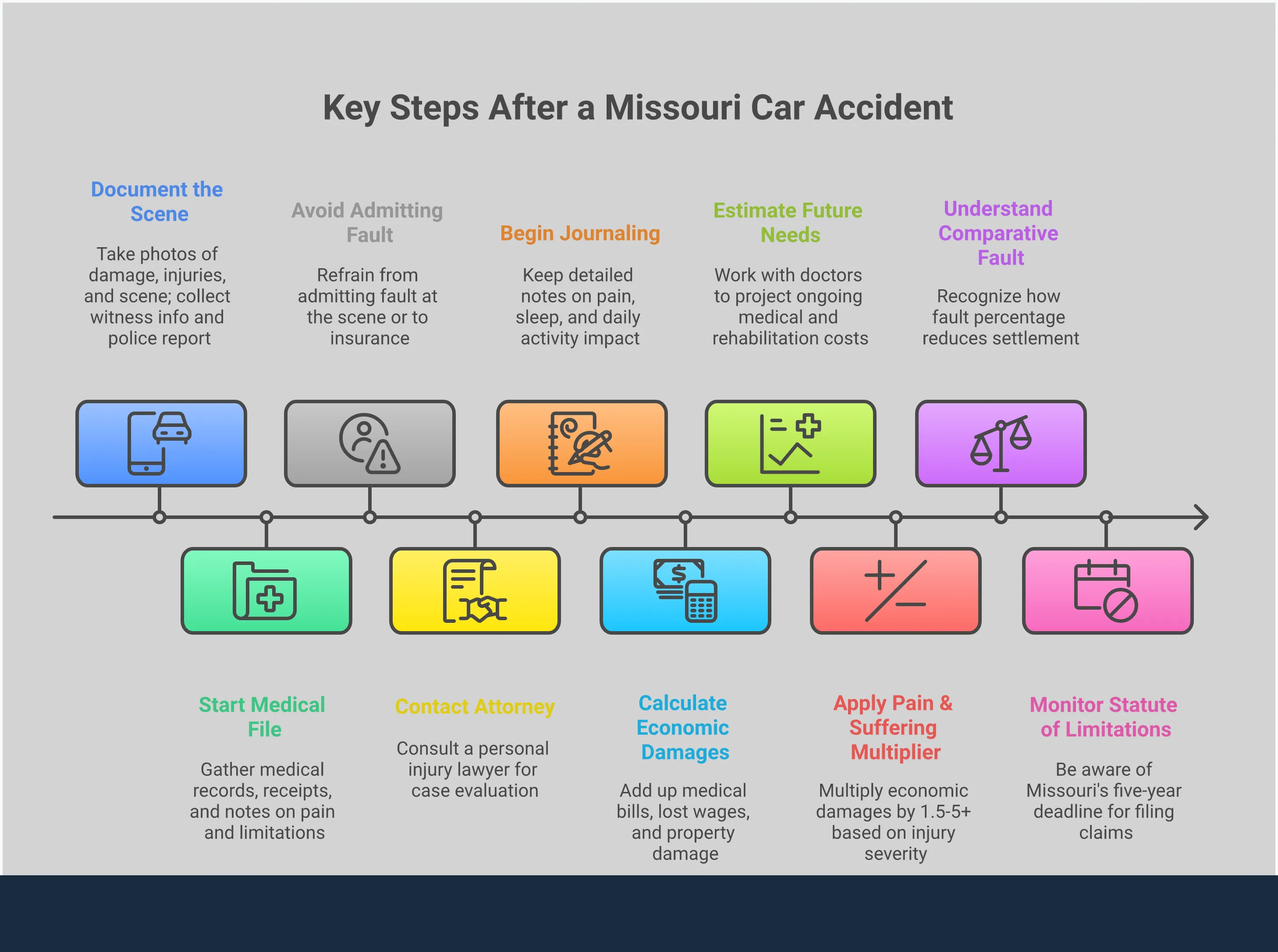
Steps to Protect Your Claim’s Value Immediately After an Accident
The moments following a car accident can feel chaotic. While your first priority is safety, the actions you take right after the crash can significantly impact your claim’s value. By staying calm and following a few key steps, you can protect both your health and your legal rights, laying the groundwork for a fair settlement from the very beginning.
Get Medical Attention Right Away
Even if you feel fine, see a doctor as soon as possible. Some serious injuries don’t show symptoms immediately, and delays can hurt your health and your case. An insurance adjuster might argue your injuries weren’t caused by the accident if you wait too long. Getting checked out right away creates a clear medical record linking your injuries to the crash. Be sure to follow all of your doctor’s advice, from attending follow-up appointments to completing physical therapy. This shows you’re committed to your recovery and helps build a strong case for your automobile accident claim.
Document the Scene Thoroughly
Evidence from a car accident disappears quickly. If you are physically able, use your phone to take photos and videos of everything: damage to all vehicles, skid marks, traffic signals, and the surrounding area. Also, capture photos of any visible injuries. Beyond photos, start a file to keep detailed records of all your medical treatments, receipts, time missed from work, and any other costs related to the accident. This documentation is essential for calculating the full value of your claim. If you have questions about what to save, don’t hesitate to contact our office for guidance.
Collect Witness Info and the Police Report
Always call 911 after an accident. This brings police and medical help to the scene and ensures an official police report is filed. This report is a crucial piece of evidence that provides an objective account of the incident. While you wait, look for anyone who saw what happened and politely ask for their name and phone number. Witness statements can be incredibly powerful. You should also exchange insurance and contact information with the other driver, but be careful what you say. Stick to the facts and avoid apologizing or admitting any fault. An experienced attorney can help you handle these communications properly.
When Should You Hire a Missouri Car Accident Attorney?
Deciding to hire an attorney can feel like a big step, especially when you’re already dealing with the stress of an accident. While you might handle a minor fender-bender on your own, certain situations make legal representation essential. An experienced attorney protects your rights and manages the complex legal process, allowing you to focus on your recovery. If you find yourself in any of the following situations, it’s time to consider getting professional legal help.
For Serious or Complex Injury Cases
The most important factor in a settlement’s value is how severe your injuries are. If you’ve suffered more than minor bruises, you should speak with an attorney. Serious injuries like traumatic brain injuries (TBIs) or spinal cord damage have long-term consequences, and your compensation must cover future surgeries, therapy, and long-term care. An attorney works with medical experts to accurately calculate these future costs to ensure your settlement is sufficient. Cases involving severe injuries can result in significant settlements, and you need an advocate to fight for the full amount you deserve for your automobile accident.
When the Insurance Company Plays Hardball
Remember that the other driver’s insurance company is not on your side. Their goal is to protect their bottom line by paying out as little as possible. Adjusters often pressure you into accepting a quick, lowball offer before you know the full extent of your injuries. Never accept the first offer without reviewing it with a lawyer; once you settle, you can’t ask for more money later. An attorney understands these tactics and will handle all communications with the insurer, negotiating for a fair settlement that reflects your losses. If you feel you’re being treated unfairly, contact our office for guidance.
How an Attorney Can Increase Your Settlement
Think of hiring an attorney as bringing a professional negotiator to your side. Insurance companies have teams of people working to protect their profits, and you deserve the same level of advocacy. Studies consistently show that accident victims who hire a personal injury lawyer typically receive significantly higher settlements than those who go it alone. A skilled attorney knows how to evaluate your case by looking past the initial bills to account for future medical care, lost earning potential, and the real-world impact of your pain and suffering. They take over the stressful negotiations and build a powerful case based on solid evidence, fighting to make sure your settlement truly covers everything you’ve lost.
Don’t Miss the Statute of Limitations
After an accident, you have a limited time to take legal action. This deadline is called the statute of limitations. In Missouri, you generally have five years from the accident date to file a personal injury claim. For tragic cases involving a wrongful death, that window is shortened to three years. If you miss this deadline, you lose your right to seek compensation through the courts forever, no matter how strong your case is. An attorney will manage all paperwork and filing requirements, ensuring every deadline is met so your rights are protected while you focus on healing.
What Is the Timeline for a Missouri Car Accident Settlement?
One of the first questions on everyone’s mind after a car accident is, “How long will this take?” It’s a completely valid question. You want to get back on your feet, and waiting for a settlement can feel like being in limbo. The honest answer is: it varies. Most car accident cases in Missouri are settled out of court, but the timeline can range from a few months to more than a year. The key is to focus on a fair outcome, not just a fast one. Several factors will influence how long it takes to resolve your claim, and understanding them can help you set realistic expectations for the road ahead.
Factors That Can Delay Your Settlement
The timeline for your settlement isn’t random; it’s shaped by the specific details of your case. A straightforward claim with minor injuries might resolve relatively quickly. However, certain things can slow the process down. For instance, if there’s a dispute over who was at fault for the accident, it will take longer to sort out. The severity of your injuries also plays a huge role. It’s crucial to wait until you’ve reached what doctors call “maximum medical improvement” before settling. This ensures you understand the full extent of your injuries and future medical needs, so you don’t settle for less than you deserve. Finally, the insurance company’s willingness to negotiate in good faith can either speed up or stall the process.
Settlement vs. Lawsuit: Which Is Right for You?
At some point, you’ll face a decision: accept the insurance company’s settlement offer or prepare to take your case to court. It’s tempting to accept the first offer just to be done with it, but this is often a mistake. Once you accept an offer, you can’t ask for more money later, even if your injuries turn out to be worse than you initially thought. It’s always best to get legal advice before signing anything. If the insurance company refuses to offer a fair amount, filing a lawsuit may be the only way to get them to take your claim seriously. Remember, Missouri’s comparative fault rule means your compensation can be reduced by your percentage of fault, which is another reason why having a professional evaluate your case is so important.
How to Prepare Your Case for the Best Outcome
You have more power in this process than you might think, and it starts with good preparation. From day one, keep detailed records of everything related to the accident. This includes all your medical treatments, receipts for prescriptions, records of time you missed from work, and any other costs you’ve incurred. This documentation is the evidence that substantiates your claim and can help move the settlement process along. Another key step is working with an attorney who is ready and willing to take your case to trial if needed. Insurance companies are more likely to offer a better settlement when they know you have a serious legal advocate on your side who isn’t afraid to fight for you in court. An experienced lawyer can handle the negotiations and ensure your rights are protected throughout your automobile accident claim.
The Settlement Payout Process: What Happens After You Agree?
Reaching a settlement agreement is a huge milestone. It means the negotiations are over, and you have a clear number for your compensation. But the process isn’t quite finished. The money doesn’t instantly appear in your bank account; there are a few important steps that happen behind the scenes to finalize everything. This final phase ensures that all the financial obligations related to your case, from legal fees to medical bills, are properly handled. Understanding this payout process helps you know exactly what to expect as your case comes to a close and you prepare to move forward.
How Are Settlements Typically Paid?
After you agree to a settlement, the at-fault party’s insurance company doesn’t send you a check directly. Instead, they issue a single, lump-sum payment for the full settlement amount. This check is made out to both you and your attorney and is sent to your law firm. This is the standard way most car accident settlements are paid. This single payment is the starting point for the final accounting of your case. From this total amount, any outstanding costs, such as legal fees and medical bills that were covered by a lien, will be deducted before the remaining funds are disbursed to you.
The Role of Your Attorney’s Trust Account
Once your attorney receives the settlement check, they will deposit it into a special bank account called a trust account, sometimes known as an escrow account. This is a highly regulated account that is kept separate from the law firm’s operating funds. This step is a critical part of the legal process and is designed to protect you. Holding the funds in trust ensures that all the financial details are handled ethically and transparently. It allows your attorney to accurately pay off any outstanding case expenses and medical liens before calculating your final net payment, making sure every dollar is accounted for properly.
Paying for Legal Fees and Case Expenses
Most personal injury attorneys work on what’s called a contingency fee basis. This means you don’t pay any attorney fees unless and until you win your case. The fee is a pre-agreed-upon percentage of the total settlement. This percentage, often around 33%, is taken from the settlement funds held in the trust account. In addition to the legal fee, there are also case expenses. These are the direct costs associated with building your case, such as court filing fees, the cost of obtaining medical records, or fees for expert witnesses. These expenses are also reimbursed from the settlement before your final payout is calculated.
What Are Medical Liens and How Do They Affect Your Payout?
A medical lien is a legal claim that a healthcare provider or insurance company places on your settlement. It’s their way of ensuring they get repaid for the medical care they provided you after the accident. Before you can receive your portion of the settlement, all valid liens must be paid. This is one of the most valuable services a skilled attorney provides. A significant part of our work in any personal injury claim is negotiating with these lienholders to reduce the amount you have to pay back. Every dollar we can get a medical provider to reduce from their bill is another dollar that goes directly into your pocket.
Related Articles
- Average Car Accident Settlement – What You Can Expect
- Missouri Personal Injury Settlements — How to Calculate
- Missouri Car Accident Laws: Key Facts You Need to Know
If you need experienced legal representation, our auto accident injury attorney can help protect your rights and fight for the compensation you deserve. Call (417) 842-8679 for a free consultation.
Frequently Asked Questions
What happens if the at-fault driver’s insurance isn’t enough to cover all my bills? This is a stressful but common situation. When your medical bills and other losses exceed the at-fault driver’s policy limits, their insurance will only pay up to that maximum amount. An experienced attorney can help you explore other avenues for compensation, such as filing a claim through your own Underinsured Motorist (UIM) coverage, which is designed for exactly this scenario.
Can I still get a settlement if I was partly to blame for the crash? Yes, you can. Missouri follows a “pure comparative fault” rule, which means you can still recover damages even if you were partially responsible for the accident. However, your final settlement amount will be reduced by your percentage of fault. For example, if you are found to be 20% at fault, your total compensation will be reduced by 20%.
Why shouldn’t I take the first settlement offer from the insurance company? Insurance companies often make a quick, low offer hoping you’ll accept it before you understand the full extent of your injuries and financial losses. Accepting that first offer closes your claim for good, meaning you can’t ask for more money later if you need additional medical treatment. It’s always best to have a full picture of your damages before agreeing to any amount.
How long does a typical car accident settlement take in Missouri? There’s no single answer, as the timeline depends entirely on your case. A straightforward claim with minor injuries might resolve in a few months. However, cases involving serious injuries or disputes over fault can take a year or longer. The priority is to wait until you have reached maximum medical improvement so that all your future medical needs can be included in the final settlement.
Do I really need an attorney if my injuries seem minor? Even seemingly minor injuries like whiplash can lead to chronic pain and unexpected medical bills down the road. An attorney can protect you from accepting a lowball offer that doesn’t account for these future costs. If the insurance company is disputing fault or you feel pressured in any way, getting legal advice is a smart move to protect your rights.