


The phrase “light duty” gets thrown around a lot after a workplace accident, but what does it really mean? Often, it’s a temporary fix. What happens when that temporary position ends, but you still have medical restrictions? Does your employer’s responsibility just disappear? This uncertainty is stressful, but you have more rights than you might think. The key is knowing what law protects worker accommodations following injury on a more permanent basis. The Americans with Disabilities Act (ADA) requires your employer to engage in a good-faith conversation to find a lasting solution, not just a short-term patch. This guide will explain your rights under the ADA and how to request the support you need to continue working.
Key Takeaways
- ADA Protection Depends on Impact, Not Injury: A work injury only qualifies for ADA protection if it significantly limits a major life activity, like walking or concentrating. The focus is on the long-term effect on your daily life, not just the medical diagnosis.
- Accommodation is a Collaborative Dialogue: When you request an accommodation, your employer is legally required to start a conversation with you to find a workable solution. They cannot simply ignore your request or deny it without a valid reason.
- A Denial Isn’t the Final Answer: An employer can only refuse a request if it causes an “undue hardship”—a high legal standard. You are protected from retaliation for making a request, and you have clear options if you feel your rights have been violated.
What is the Americans with Disabilities Act (ADA)?
If you’ve been injured at work, you might hear people mention the ADA. The Americans with Disabilities Act (ADA) is a federal civil rights law that protects qualified individuals with disabilities from discrimination in the workplace. Think of it as a law that ensures everyone gets a fair shot at doing their job, regardless of a physical or mental disability. It applies to private employers with 15 or more employees, as well as state and local government employers.
The core of the ADA’s power in the workplace comes from its requirement that employers provide “reasonable accommodations.” This simply means an employer must make logical adjustments to a job or work environment to allow an employee with a disability to perform their essential job duties. The goal isn’t to lower standards or excuse poor performance, but to remove barriers and create equal opportunity. Understanding how this law works is the first step in protecting your job and your health after a workplace injury. If you believe your rights have been violated, it’s important to understand the legal services available to you.
Your Rights as an Injured Worker Under the ADA
It’s a common misconception that any injury you get on the job is automatically covered by the ADA. That’s not quite how it works. To be protected, your work-related injury must meet the ADA’s specific definition of a “disability.” This means the injury must cause a physical or mental impairment that substantially limits one or more major life activities. These activities include basic things like walking, standing, lifting, sleeping, concentrating, and thinking. A short-term injury with minor, temporary effects—like a sprained ankle that heals completely in a few weeks—usually won’t qualify. The law is designed to protect those with more significant or long-lasting conditions.
Understanding Workplace Accommodations
So, what exactly is a “reasonable accommodation”? It’s any change in the work environment or in the way things are usually done that helps a person with a disability perform their job. An accommodation is considered “reasonable” as long as it seems possible and doesn’t create an “undue hardship” or significant expense for the employer. It also has to be “effective,” meaning the change must actually help you do your work. This could involve restructuring your job, modifying your schedule, or providing special equipment. If you have questions about your specific situation, it’s always best to contact a legal professional.
Does Your Work Injury Qualify as a Disability Under the ADA?
It’s a common question after a workplace accident: Does my injury mean I’m protected by the Americans with Disabilities Act (ADA)? The answer isn’t always straightforward. Just because you have a work injury that qualifies for workers’ compensation doesn’t automatically mean you have a disability under the ADA. The key difference lies in how the injury affects your life.
The ADA defines a disability as a physical or mental impairment that substantially limits one or more major life activities. This is a broad definition, and it’s not about the name of your injury or condition. Instead, it’s about the real-world impact it has on your ability to function. Think of it this way: workers’ comp addresses the injury itself and the immediate medical needs and lost wages. The ADA, on the other hand, focuses on ensuring you have equal opportunity in the workplace despite the limitations your impairment may cause. Understanding this distinction is the first step in knowing your rights and what to ask for from your employer. If you’re dealing with a serious personal injury from a workplace incident, it’s important to see if your situation fits this definition.
Physical Injuries That Limit Daily Activities
So, what does it mean to have an injury that “substantially limits a major life activity”? Major life activities are the basic tasks an average person can perform with little to no difficulty. This includes things like walking, standing, lifting, bending, seeing, hearing, and even sleeping and concentrating.
A work injury qualifies as a disability if it makes one of these fundamental activities significantly harder for you to do. For example, a severe back injury that prevents you from lifting more than ten pounds or sitting for long periods would likely be covered. However, a minor sprain that heals completely in a few weeks with no lasting effects probably wouldn’t. The focus is on the severity and persistence of the limitation, not just the injury itself.
Mental Health Conditions After a Workplace Accident
Disabilities aren’t always visible. The trauma of a workplace accident can cause significant mental and emotional harm, and the ADA recognizes this. Conditions like post-traumatic stress disorder (PTSD), anxiety, or depression that develop after an incident can qualify as disabilities if they substantially limit a major life activity.
For instance, if post-accident anxiety makes it difficult for you to concentrate, interact with others, or regulate your emotions, it could be considered a disability under the ADA. The law protects employees from discrimination based on both physical and mental impairments. It’s crucial to pay attention to your mental well-being after an injury and seek help if you need it, as these conditions are just as valid when it comes to requesting workplace accommodations.
Does the ADA Cover Temporary Injuries?
Many people assume the ADA only applies to permanent or long-term conditions, but that’s not always the case. A temporary injury can be considered a disability if it is severe enough. While minor issues like the common cold or a sprained ankle typically don’t count, a more serious temporary condition—like a broken leg that requires surgery and several months of recovery—could qualify because it substantially limits a major life activity (walking) for a significant period.
Importantly, your employer cannot require you to be “100% healed” before you can return to work. According to guidance from the Equal Employment Opportunity Commission, employers must consider if you can perform your job with or without reasonable accommodations, regardless of whether your recovery is complete.
What is a “Reasonable Accommodation”?
After an injury, you might hear the term “reasonable accommodation” a lot. So, what does it actually mean? Simply put, a reasonable accommodation is any change or adjustment to your job or work environment that allows you to perform the essential duties of your position despite your disability. It’s not about getting special treatment; it’s about getting an equal opportunity to succeed at your job. The goal is to remove workplace barriers for individuals with disabilities so you can continue to contribute your skills and experience.
The U.S. Equal Employment Opportunity Commission explains that this can include “changes to the job application process, the work environment (so someone can do their job’s main tasks), or changes so an employee can enjoy the same benefits and privileges as other employees.” The key word here is “reasonable.” The request shouldn’t cause an “undue hardship”—meaning a significant difficulty or expense—for your employer. This is meant to be a collaborative conversation, not a demand. You and your employer should work together to find a solution that helps you do your job without disrupting the business. The EEOC provides detailed guidance on reasonable accommodation that outlines these rights and responsibilities for both parties, making it a great resource to understand the specifics.
Examples: Flexible Schedules and Modified Duties
One of the most common types of accommodation involves adjusting your work schedule. If your injury requires frequent doctor’s appointments or physical therapy, a flexible schedule can make a world of difference. This could mean changing your start and end times, working a compressed week, or taking more frequent but shorter breaks to manage pain or fatigue. Your employer should allow these changes unless they create a significant operational problem.
Modifying your duties is another practical solution. This doesn’t mean you stop doing your job, but rather that non-essential tasks might be temporarily reassigned. For example, if your job as a clerk primarily involves data entry but occasionally requires lifting heavy boxes of paper, that lifting task could be given to another employee while you recover. The focus remains on enabling you to perform the core functions of your role.
Examples: Assistive Tools and Workspace Changes
Sometimes, the solution is a physical change to your workspace or the tools you use. These accommodations are designed to make your work environment more accessible and help you complete your tasks safely and efficiently. This could be as simple as providing an ergonomic chair and keyboard to help with a back or wrist injury, or raising your computer monitor to eye level to prevent neck strain.
For more significant limitations, it might involve installing screen-reading software on your computer, providing a headset for hands-free phone calls, or even moving your desk to a quieter area of the office to help with concentration issues following a head injury. The goal is to adapt the environment so you can perform your job’s main tasks and enjoy the same privileges as your colleagues.
Examples: Taking Leave or Changing Roles
Taking time off for medical reasons is another form of reasonable accommodation. The ADA allows an employee to use “paid or unpaid leave for disability-related reasons,” which can include time needed for medical treatment, recovery from surgery, or even training a new service animal. Your employer is generally required to hold your job for you while you are on leave, unless doing so would cause them an undue hardship.
In some cases, an injury may be severe enough that you can no longer perform the essential duties of your original job, even with accommodations. If this happens, your employer has a responsibility to consider reassigning you to a vacant position that you are qualified for. This is often seen as an accommodation of last resort, but it’s a critical protection that helps keep injured employees in the workforce.
What Does the ADA Require From Your Employer?
When you’re recovering from an injury, the last thing you need is uncertainty at work. The Americans with Disabilities Act (ADA) provides a crucial safety net, establishing clear responsibilities for your employer. The law requires them to provide “reasonable accommodations” to qualified employees with disabilities, which can include injuries that limit major life activities. This isn’t about your employer doing you a favor; it’s about ensuring you have the support needed to perform your job successfully.
An employer’s duty begins the moment they are aware of your disability and your need for an adjustment at work. This awareness triggers a legal obligation to engage with you and explore potential solutions. They can’t simply ignore your request or dismiss it without consideration. The entire process is designed to be a collaborative effort, not a conflict. Understanding these requirements is the first step in advocating for yourself and protecting your rights. If you believe your employer is not meeting their obligations under the law, exploring your legal options can provide clarity and a path forward. The ADA is a powerful tool, but knowing how it works is key to using it effectively.
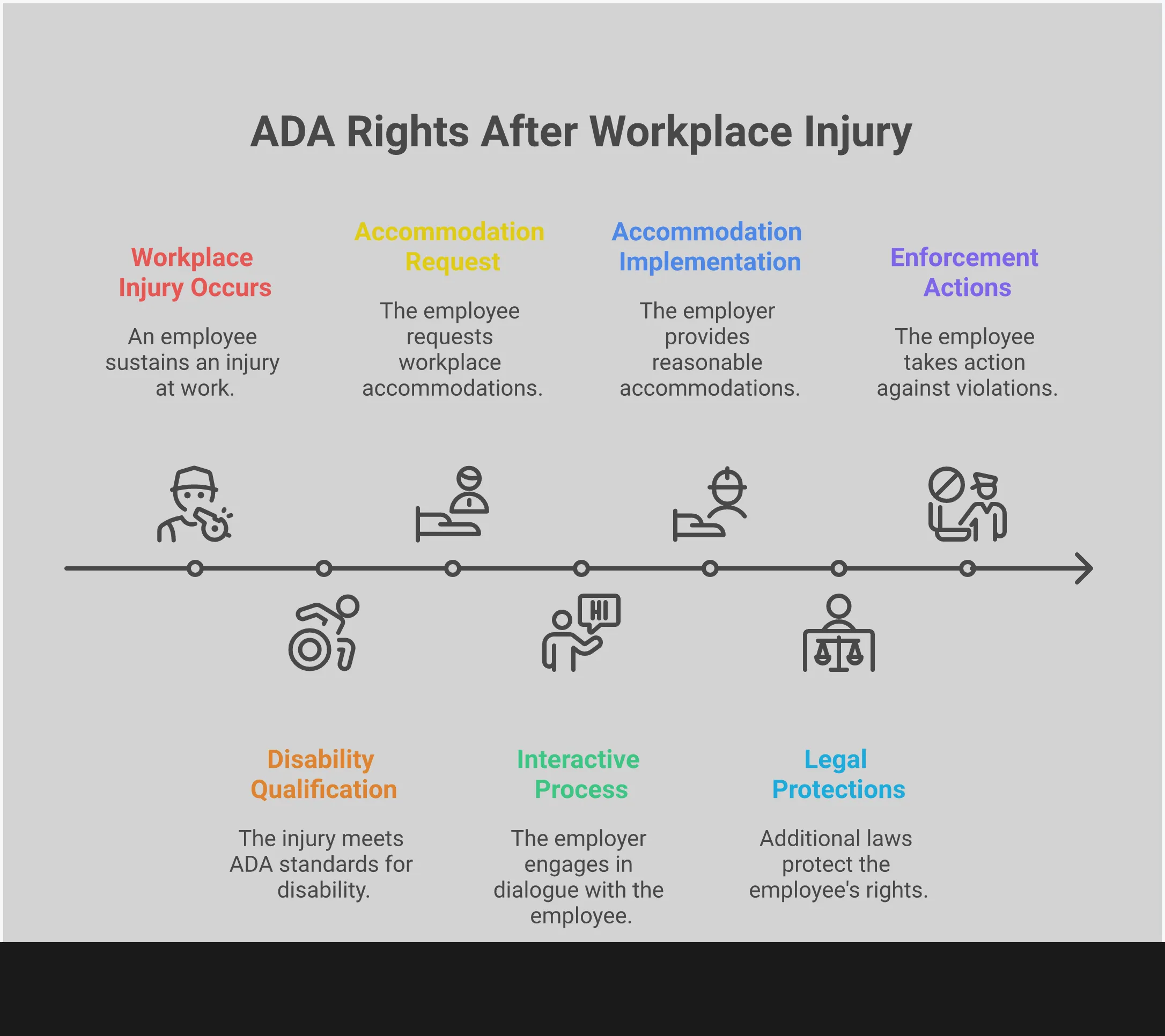
The “Interactive Process” Explained
Once you request an accommodation, the ADA requires you and your employer to start a conversation. This is officially called the “interactive process.” Think of it as a practical, good-faith discussion to figure out your specific limitations and what changes could help you perform your job. This isn’t a one-sided demand; it’s a collaborative effort. You might discuss your medical restrictions, and your employer might suggest different accommodations. The goal is to work together to find an effective solution that doesn’t cause the business an undue hardship. The U.S. Equal Employment Opportunity Commission (EEOC) emphasizes this dialogue as a mandatory step for employers.
How Long Does Your Employer Have to Respond?
While the ADA doesn’t give a specific deadline, like 15 or 30 days, it does require employers to act promptly. According to the EEOC, an unnecessary delay in responding to or providing an accommodation can be considered a violation of the law. What counts as “unnecessary” depends on the situation. For example, if you request a special chair that needs to be ordered, a short wait is reasonable. However, if your manager simply ignores your emails and requests for weeks without a good reason, that could be an unlawful delay. If you feel your request is being stalled, it’s important to document everything and consider getting professional advice on how to proceed.
Keeping Your Medical Information Private
It’s natural to worry about privacy when discussing your health at work. The ADA sets clear boundaries on what your employer can ask. If your disability and need for accommodation are not obvious, your employer is allowed to request reasonable medical documentation to confirm both. However, this does not give them access to your entire medical history. The documentation should be limited to verifying your disability and explaining why an accommodation is necessary for you to do your job. Your employer cannot ask for unrelated medical records. Furthermore, any medical information you provide must be kept confidential and stored in a separate file from your regular personnel records.
How Do Workers’ Comp and the ADA Work Together?
After a work injury, you might find yourself dealing with two different sets of laws: workers’ compensation and the Americans with Disabilities Act (ADA). While they serve different purposes, their protections can overlap, and understanding how they interact is key to protecting your rights. Think of workers’ comp as the system that provides immediate medical and wage benefits, while the ADA ensures you get a fair shot at returning to work with the support you need.
Overlapping Benefits and Protections
Workers’ compensation is a state-mandated insurance program that provides benefits to employees who get hurt or sick because of their job. In exchange for these benefits, you generally cannot sue your employer for the injury. On the other hand, the ADA is a federal civil rights law that protects people with disabilities from discrimination in the workplace. It requires employers to provide reasonable accommodations so that qualified employees with disabilities can perform their jobs. A serious work injury can qualify as a disability under the ADA, meaning you could be protected by both laws at the same time.
Your Rights After Workers’ Comp Benefits End
Many people assume their employer’s obligations end once their workers’ comp benefits stop, but that isn’t the case. Your employer’s duty to accommodate you under the ADA is ongoing. Even if your injury is classified as “permanent and stationary” in the workers’ comp system, your employer must still engage with you to find a reasonable accommodation that allows you to work. Importantly, your employer cannot require you to be “100% healed” or free of all medical restrictions before letting you return. If you’re facing challenges returning to work after an injury, understanding your personal injury rights is the first step toward a solution.
Is “Light Duty” the Same as an Accommodation?
The terms “light duty” and “reasonable accommodation” are often used interchangeably, but they aren’t the same thing. “Light duty” typically refers to temporary positions with less physically demanding tasks, often created for employees recovering from an injury under workers’ comp. While an employer might offer a vacant light-duty job as a reasonable accommodation, the ADA does not require them to create a new one for you. A reasonable accommodation is a broader concept that could include modifying your existing job, providing special equipment, or adjusting your work schedule—it’s about finding a workable solution, not just a temporary, easier job.
When Can an Employer Deny an Accommodation Request?
While the ADA provides strong protections, your employer can deny a request for accommodation, but only for a very specific reason. They can’t simply say no because it’s inconvenient or because they don’t want to make changes. The only legally acceptable reason for an employer to deny a reasonable accommodation is if it would cause an “undue hardship” on the business.
This isn’t a loophole they can easily use. “Undue hardship” has a specific legal meaning that goes far beyond minor costs or logistical challenges. Your employer must be able to prove that your requested accommodation would create a significant difficulty or expense for their operations. This is a high standard to meet, and the burden of proof is on them, not you. Before they can deny a request, they are still required to talk with you to see if another effective accommodation is possible. Understanding what qualifies as a true hardship can help you know when a denial might be legitimate and when it might be a violation of your rights.
Defining “Undue Hardship” for a Business
So, what exactly does “undue hardship” mean? According to the U.S. Equal Employment Opportunity Commission, it refers to any accommodation that would cause significant difficulty or expense for the employer. This isn’t just about the price tag of a piece of equipment. The assessment includes the nature of the cost in relation to the company’s size and financial resources, as well as any changes that would fundamentally alter the nature or operation of the business. For example, asking a small coffee shop to install an elevator might be an undue hardship, but providing a stool to sit on during shifts likely would not be.
How Accommodations Affect Business Operations
When your employer evaluates your request, they must consider its specific impact on their business. This is a case-by-case analysis—what’s reasonable for one company might not be for another. They will look at how the accommodation would affect the workplace, including its impact on the operation of the business and the ability of other employees to do their jobs. However, the fact that other employees might grumble or prefer not to change their routines is not enough to prove undue hardship. The disruption must be significant and directly related to the company’s ability to function effectively.
Does the Size of the Company Matter?
Yes, the size and financial resources of your employer absolutely matter. The concept of “undue hardship” is relative. A large, multinational corporation with thousands of employees and substantial revenue will have a much more difficult time arguing that an accommodation is too expensive or disruptive. On the other hand, a small, family-owned business with only a handful of employees and limited funds may be able to legitimately claim that the same accommodation would cause an undue hardship. The size of the employer can play a significant role in the analysis, but it doesn’t give them a free pass. Every employer, regardless of size, has a duty to explore potential accommodations.
What Other Laws Protect Injured Workers?
When you’re injured on the job, it can feel like you’re trying to piece together a complicated puzzle. While the ADA and workers’ compensation are major pieces, they aren’t the only ones. Several other federal and state laws offer a safety net, providing additional layers of protection for your job, your health, and your rights. These laws work together to ensure you have the support you need to recover without sacrificing your career. Understanding these additional protections can make a huge difference, as you might be entitled to extended leave or specific state-level protections.
Your Rights Under the Family and Medical Leave Act (FMLA)
If your work injury qualifies as a “serious health condition,” you may be protected by the Family and Medical Leave Act (FMLA). This federal law allows eligible employees to take up to 12 weeks of unpaid, job-protected leave per year. The key here is “job-protected”—it means that while you’re recovering, your employer can’t give your job away. When you’re medically cleared to return, they must give you back the same or an equivalent position. This law provides crucial breathing room, allowing you to focus on healing without the added stress of imminent job loss.
Missouri’s Laws on Disability Discrimination
In addition to federal laws, Missouri has its own protections. The Missouri Human Rights Act (MHRA) makes it illegal for employers to discriminate against employees with disabilities. Much like the ADA, this law requires employers to provide reasonable accommodations that help you perform your job duties after an injury, such as a modified work schedule or ergonomic equipment. The MHRA ensures that workers in our state have a clear path to seek accommodations and are protected from unfair treatment based on their medical condition. It’s a powerful local tool that reinforces your rights.
How the Occupational Safety and Health Act (OSHA) Protects You
The Occupational Safety and Health Act (OSHA) is a proactive law designed to prevent workplace injuries from happening in the first place. It requires employers to provide a work environment free from known health and safety hazards. If you are injured, OSHA mandates that your employer report the incident and keep detailed records. Most importantly, OSHA protects you from retaliation. You have the right to report unsafe conditions or file a complaint without fear of being fired, demoted, or otherwise punished by your employer. This protection ensures safety remains a priority.
How to Request a Workplace Accommodation
Asking for help at work can feel daunting, but it’s a protected right you have when recovering from an injury. The process is designed to be a conversation, not a confrontation. Your goal is to communicate your needs so your employer can work with you to find a solution that keeps you on the job safely. Remember, you don’t have to figure this out alone. The key is to be clear, direct, and understand the steps involved.
Step-by-Step: Making a Formal Request
You don’t need to use specific legal terms to start the process. According to the U.S. Equal Employment Opportunity Commission (EEOC), you can simply tell your employer in “plain English” that you need a change at work because of a medical condition. You can have this conversation with your direct supervisor, an HR representative, or whoever your company designates for these requests. While a verbal request is valid, it’s always a good idea to follow up with a simple email. This creates a written record of when you made the request and what you discussed. Keep it straightforward: state your limitation and suggest how an accommodation could help you perform your job.
What Paperwork Will You Need?
If your injury and the need for an accommodation aren’t obvious, your employer can ask for medical documentation. This is a standard part of the process. They may ask for a note from your doctor that confirms your condition and explains why an accommodation is necessary to do your job. The EEOC’s guidance on reasonable accommodations clarifies that the request for paperwork must be reasonable. Your employer isn’t entitled to your entire medical history—just the information needed to understand your limitations and find an effective accommodation. Think of it as providing the necessary information so they can help you succeed.
What to Do if You Don’t Hear Back
Your employer should respond to your request promptly. Unreasonable delays can be a violation of the law. If a week or two goes by without any acknowledgment, it’s appropriate to follow up. Send a polite email to the person you originally spoke with, referencing your initial request and asking for an update on the process. If you are still met with silence or feel your request is being ignored, it may be time to get some help. Understanding your rights in these situations is critical, and an experienced attorney can explain your options and ensure your employer meets their legal obligations. If you’re facing this challenge, we’re here to help you understand your next steps.
What to Do if Your Employer Denies Your Request
Hearing “no” from your employer after you’ve asked for a reasonable accommodation can be incredibly disheartening. It might feel like you’ve hit a wall, but it’s important to know that a denial is not the end of the road. The law provides clear pathways for you to follow to ensure your rights are protected. Your employer is required to engage in a good-faith conversation with you to find a workable solution, and simply dismissing your request without proper consideration may not be lawful.
If your request has been denied, your first step is to understand why. Ask your employer for a reason in writing. This documentation can be crucial later on. From there, you have several options to consider, from filing a formal complaint to seeking legal advice. It’s about taking a calm, measured approach to stand up for your needs and hold your employer accountable to their legal obligations. You don’t have to accept an unfair denial, and there are resources available to help you challenge it.
How to File a Complaint with the EEOC
When you request an accommodation, your employer is supposed to start a conversation with you to figure out what you need. This is called the “interactive process,” and they should respond to your request promptly. If they denied your request without a real discussion, or if they took an unreasonably long time to get back to you, they may have violated the law.
In this case, you can file a charge of discrimination with the U.S. Equal Employment Opportunity Commission (EEOC). The EEOC is the federal agency responsible for enforcing laws against workplace discrimination. Filing a charge is the first formal step in holding your employer accountable and seeking a resolution.
When to Contact a Personal Injury Lawyer
A work injury often creates a situation where different laws overlap, including workers’ compensation and disability rights under the ADA. Understanding how these protections work together can be confusing, especially when you’re focused on your recovery. An employer has duties under both sets of laws, and they can’t ignore your disability rights just because you were hurt at work.
This is where getting legal advice becomes so important. An experienced attorney can help you understand your rights and ensure your employer is meeting all of their legal responsibilities. If you’re in Southwest Missouri and feel lost after an accommodation denial, our team at The Law Office of Chad G. Mann can review your case and help you decide on the best path forward. Please contact us for guidance.
Understanding Your Protection from Retaliation
It is illegal for your employer to punish you or treat you unfairly for having a disability, filing for workers’ compensation, or requesting a reasonable accommodation. This is known as retaliation, and the law takes it very seriously. Retaliation can look like being fired, demoted, receiving a pay cut, or being assigned to a less desirable shift.
It also includes being punished for refusing to perform work that goes against your doctor’s medical restrictions. You have a right to advocate for your health and safety without fear of losing your job. If you believe you are facing retaliation, it’s crucial to document everything and seek legal help immediately to protect yourself and your livelihood.
Common Myths About the ADA for Injured Workers
When you’re recovering from a workplace injury, figuring out your rights can feel overwhelming. There’s a lot of misinformation out there, especially when it comes to the Americans with Disabilities Act (ADA). It’s easy to make assumptions that could affect your ability to return to work safely and with the support you need. Let’s clear up a few of the most common myths so you can understand your protections and advocate for yourself with confidence. Knowing the facts is the first step toward securing the accommodations you’re entitled to.
Myth: The ADA Automatically Covers Any Injury
It’s a common belief that if you get hurt at work and are covered by workers’ compensation, you’re automatically protected by the ADA. This isn’t quite right. While your injury is serious, it only receives ADA protection if it meets the law’s specific definition of a disability. This means the injury must substantially limit one or more major life activities. A broken arm that heals in six weeks might not qualify, but a back injury that causes chronic pain and limits your ability to lift, stand, or walk could. The key is how the injury impacts your daily life, not just that it happened at work.
Myth: You Must Be “100% Healed” to Return to Work
Many people think they can’t go back to their job until they are completely recovered and have no medical restrictions. However, your employer can’t legally require you to be “100% healed” before allowing you to return. Instead, they must assess your individual situation. The law requires them to consider whether you can perform the essential functions of your job, either with or without a reasonable accommodation. This is a critical distinction in personal injury law, as it prevents employers from sidelining capable employees who just need some adjustments to do their work safely.
Myth: Your Employer’s Duty Ends When You Return
Some employers—and employees—believe that once a temporary accommodation or light-duty assignment ends, the company’s obligation is over. This is false. An employer’s duty to provide reasonable accommodations is ongoing. Your need for support doesn’t just disappear when your workers’ comp benefits change or your injury is classified as “permanent and stationary.” Your employer must continue to provide necessary accommodations unless doing so would cause them an undue hardship. If your employer suddenly stops providing support or refuses to continue the conversation, it may be time to contact an attorney to discuss your rights.
Related Articles
- A Guide to Workers Compensation Lawyers in Springfield MO
- How to Pick a Workmans Comp Lawyer Springfield MO
- How to Choose a Work Comp Attorney in Springfield, MO
Frequently Asked Questions
Do I have to tell my employer my specific medical diagnosis when I ask for an accommodation? No, you are not required to share your specific diagnosis or your entire medical history. While your employer can ask for medical documentation to confirm that you have a disability and need an accommodation, the information should be limited to your functional limitations and how they impact your ability to do your job. A note from your doctor explaining your restrictions is usually all that is needed.
What if my employer suggests an accommodation that I don’t think will work for me? The process of finding an accommodation is meant to be a collaborative conversation, not a one-sided decision. If your employer proposes a solution that you don’t believe will be effective, you should explain why and suggest an alternative. The goal is to work together to find a solution that allows you to perform your essential job duties, so keep the lines of communication open and be prepared to discuss different options.
Can my employer fire me while I’m on leave for a work-related injury? Generally, no. Laws like the Family and Medical Leave Act (FMLA) and the ADA provide significant job protection. If you qualify for FMLA, you are entitled to up to 12 weeks of unpaid, job-protected leave. The ADA also considers leave a form of reasonable accommodation. Firing you for taking legally protected leave or for having a disability would be considered unlawful retaliation.
Does my employer have to create a new ‘light-duty’ job for me? The ADA does not require an employer to create a new position for you. While they might offer a vacant light-duty role as an accommodation, their primary responsibility is to see if you can perform your original job with adjustments. This could include modifying your current duties, changing your schedule, or providing assistive tools. If that isn’t possible, they must then consider reassigning you to an existing vacant position you are qualified for.
My injury is temporary. Can I still be protected by the ADA? Yes, a temporary injury can absolutely be covered by the ADA if it is severe enough to substantially limit a major life activity. While a minor sprain that heals quickly likely wouldn’t qualify, a serious condition like a broken leg requiring surgery and months of recovery would. The focus is on the severity of the limitation, not just whether the condition is permanent.