


We all know airbags are there to save our lives, but many people don’t realize they are essentially controlled explosions. An airbag deploys with tremendous force, moving at speeds up to 200 mph in a fraction of a second. If you’re sitting in the wrong spot, the very device designed to protect you can cause serious harm. This is why understanding the proper distance from your steering wheel isn’t just a minor detail—it’s a critical part of road safety. Knowing how close to airbag deployment is safe is one of the most important things you can do to protect yourself before you even turn the key.
Key Takeaways
- Create Your 10-Inch Buffer: The most important safety habit is ensuring there are at least 10 inches between your breastbone and the airbag cover. This space is critical for allowing the airbag to become a protective cushion instead of a source of high-speed impact.
- Your Posture is a Safety Feature: How you sit is just as important as where you sit. Adjust your seat, steering wheel, and head restraint to create a safe driving posture that allows your seatbelt and airbag to protect you as intended during a crash.
- Understand Liability When an Airbag Injures You: An airbag causing harm can point to a defective product or impact your personal injury claim through concepts like comparative fault. Seeking legal advice is the best way to determine who is responsible and protect your right to compensation.
The Lifesaving Impact of Airbags: A Look at the Data
How Many Lives Have Airbags Saved?
Airbags are one of the most significant safety innovations in automotive history, and the numbers back it up. We often take them for granted, but their impact is undeniable. According to the National Highway Traffic Safety Administration (NHTSA), frontal airbags have saved an incredible 50,457 lives over the last three decades. This statistic is a powerful reminder of how crucial this technology is for protecting drivers and passengers during a collision. While we hope never to need them, knowing they are there provides a vital layer of security every time we get behind the wheel, turning potentially fatal situations into survivable ones.
However, for an airbag to do its job correctly, you have to do yours. The protection it offers depends on giving it enough space to deploy safely. The NHTSA recommends keeping a minimum distance of 10 inches between your breastbone and the airbag cover. This isn’t an arbitrary number; it’s the buffer zone that allows the airbag to inflate and act as a soft cushion. If you’re too close, the airbag’s explosive force can cause serious injuries instead of preventing them. Thinking about your posture and seat position isn’t just about comfort—it’s a critical safety measure.
How Close to the Airbag is Too Close?
We all know airbags are there to save our lives, and they do an incredible job of it. But here’s something many people don’t realize: an airbag is a controlled explosion happening in a fraction of a second. It deploys with tremendous force, and if you’re sitting too close, the device designed to protect you can cause serious harm. That’s why understanding the proper distance between you and your airbag isn’t just a minor detail—it’s a critical part of staying safe on the road.
Think of it as creating a personal safety bubble inside your car. This bubble gives the airbag enough room to inflate fully and start deflating before it reaches you. When you’re positioned correctly, the airbag cushions you. When you’re too close, you collide with it as it’s still expanding at speeds up to 200 mph. The injuries from this kind of impact can be severe, and unfortunately, they are often preventable. If you’ve been in an automobile accident, you know how quickly things can go wrong. Taking a moment to check your seating position is one of the easiest and most effective things you can do to protect yourself.
What is the “10-Inch Rule”?
The most important guideline to remember is the “10-inch rule.” Safety experts, including the National Highway Traffic Safety Administration (NHTSA), recommend keeping at least 10 inches between the center of your breastbone and the airbag cover on your steering wheel. This isn’t an arbitrary number; it’s the minimum distance needed for the airbag to deploy safely without striking you with its full, explosive force. When an airbag inflates, it travels toward you at an incredible speed. The 10-inch gap ensures that by the time you make contact with it, the bag is already a soft, protective cushion, not a high-speed projectile.
Are You a Safe Distance Away? Here’s How to Check
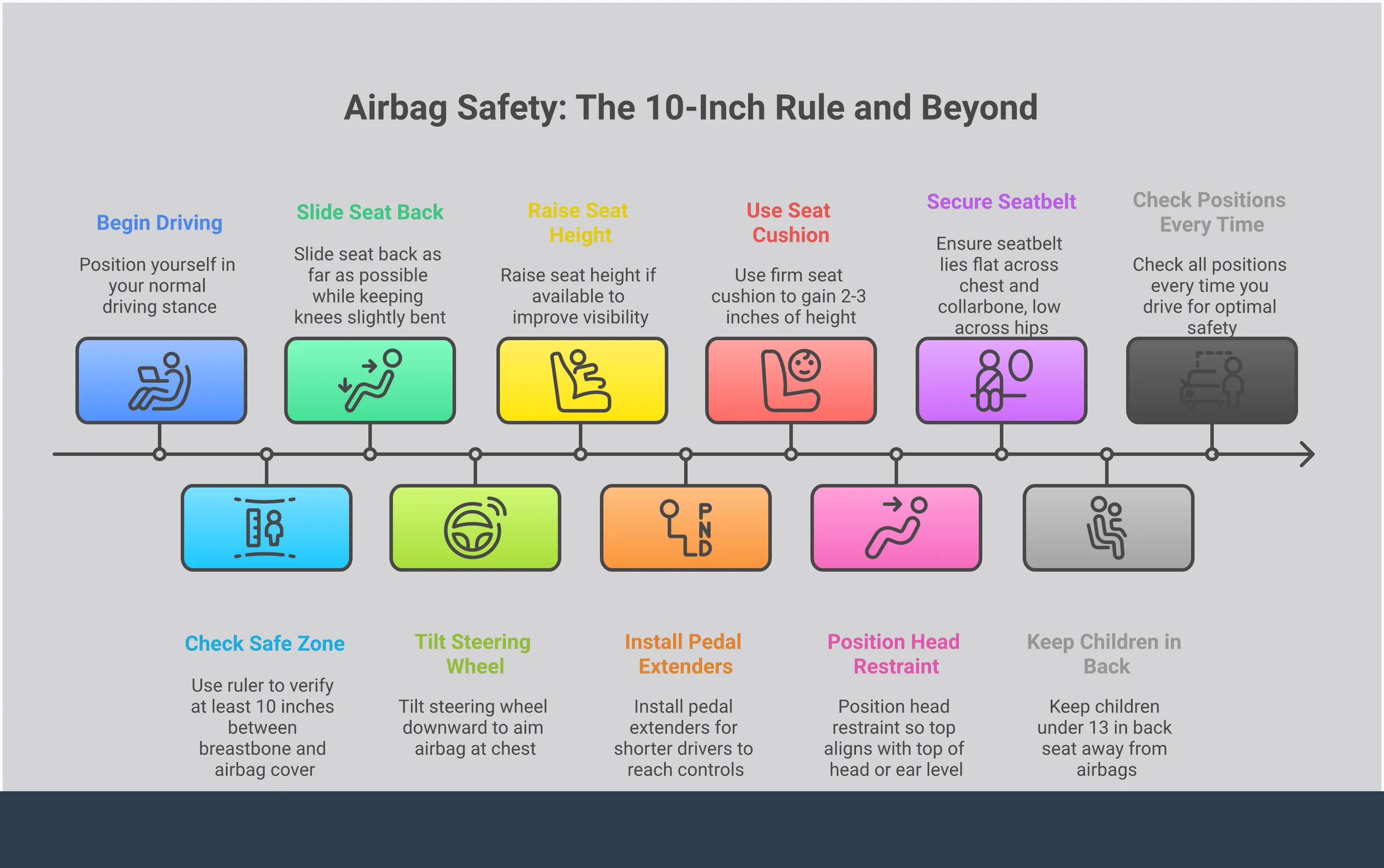
So, how do you know if you’re 10 inches away? It’s easier to check than you might think. Sit in your normal driving position with your seatbelt on. Then, grab a ruler or a tape measure and have a friend measure the distance from your breastbone to the center of the steering wheel. If you’re by yourself, a standard sheet of paper is 11 inches long, which can give you a good rough estimate. If you find you’re closer than 10 inches, you need to make some adjustments. Start by moving your seat back as far as you can while still comfortably reaching the pedals. You can also try tilting your steering wheel downward, away from your head and chest.
Does Airbag Type Change the Safe Distance?
Your steering wheel isn’t the only place an airbag is hiding. Modern cars are equipped with multiple airbags, and distance matters for all of them. For the front passenger, the 10-inch rule also applies to the distance from the dashboard. This is also why you should never put your feet up on the dash—it puts you directly in the airbag’s deployment path. For side-impact airbags located in your seat or door, the best practice is to sit upright and avoid leaning against the window or door. While there isn’t a specific measurement, proper posture ensures these airbags can protect your torso and head as intended, rather than deploying into you at a dangerous angle.
Finding Your Safe Seating Position
We all know airbags are there to protect us, but for them to work correctly, you need to give them space. Sitting too close to the steering wheel or dashboard can turn a life-saving device into a source of serious injury during a crash. The key is finding that sweet spot—far enough for the airbag to deploy safely, but close enough that you can still drive comfortably and control your vehicle. It’s a simple adjustment that can make a world of difference in an accident. Understanding the proper distance and how to set it up in your car is a fundamental part of driver safety.
Applying the 10-Inch Guideline
The most straightforward guideline comes from the National Highway Traffic Safety Administration (NHTSA), and it’s called the “10-inch rule.” This rule recommends maintaining a minimum of 10 inches between the center of your chest (your breastbone) and the airbag cover on your steering wheel. Think of it as the length of a standard ruler. This distance is critical because it gives the airbag enough room to inflate fully before it reaches you. When an airbag deploys, it does so with incredible force. The 10-inch buffer ensures you get the soft cushion you need, not a forceful blow from the bag itself. Proper airbag safety starts with this simple measurement.
A Simple Way to Measure Your Distance
You don’t need to keep a tape measure in your car to check your distance. There’s a much easier way to see if you’re sitting a safe distance from the steering wheel. First, get into your normal driving position with your back fully against the seat. Next, extend your arms straight out in front of you. Your wrists should be able to rest comfortably on the top of the steering wheel without you needing to lean forward or stretch. If you have to move your shoulders off the seat to reach, you’re likely sitting too far back. If your arms are significantly bent, you’re probably too close. Adjust your seat until you find that perfect spot.
Frontal vs. Side Airbags: Know the Difference
While the 10-inch rule is a great minimum, the ideal safe distance is generally between 10 and 12 inches. This applies to most standard driver-side airbags. The reason this distance is so important comes down to physics. Airbags are designed to deploy very quickly—at speeds up to 200 mph—to protect you in a collision. If you are sitting too close, the airbag can strike you while it is still inflating, delivering a powerful impact that can cause severe injuries to your head, neck, and chest. Giving the airbag that 10 to 12 inches of space allows it to do its job by becoming a protective cushion just as your body moves forward from the crash impact.
The Link Between Seating and Side-Impact Fatalities
Your seating position is just as critical when it comes to side-impact collisions. While we often focus on the steering wheel airbag, the ones in your doors and seats are designed to protect your torso and head from severe injury. However, they can only do their job if you’re sitting correctly. Studies have shown that a shocking 30% of deaths in side-impact crashes are linked to bad seating positions. Leaning against the door or window can put you directly in the path of the deploying airbag, causing it to strike you at a dangerous angle instead of cushioning the blow. Maintaining an upright posture ensures that these safety features can work as intended, creating a protective barrier during a collision. The aftermath of any automobile accident is difficult, and taking this simple step can significantly reduce your risk of serious harm.
The Dangers of Sitting Too Close to the Airbag
Airbags are incredible safety devices, but they work by deploying with explosive force. While they save countless lives, being in the wrong position during a crash can mean the airbag itself becomes a source of serious injury. Understanding the risks involved is the first step toward making sure you and your passengers are as safe as possible every time you get in the car.
What a 200 MPH Deployment Really Means
It’s hard to picture just how fast an airbag deploys. In the blink of an eye—literally, faster than you can blink—it inflates with incredible force, moving at speeds up to 200 miles per hour. This speed is necessary to create a protective cushion between you and the hard surfaces of your car during a collision.
However, if you’re sitting too close, the airbag doesn’t have enough space to inflate fully before it reaches you. Instead of meeting a soft, fully deployed cushion, your body is struck by a rapidly expanding bag. This concentrated impact can cause severe harm, turning a feature designed to protect you into a dangerous projectile. The resulting injuries can complicate any personal injury claim.
Common Injuries Caused by Airbags
When an airbag strikes a person who is too close, the injuries can be significant and wide-ranging. The sheer force can lead to facial fractures, broken noses, and serious eye injuries. The rapid inflation also releases hot gases and chemicals, which can cause burns to the face, arms, and chest.
Beyond direct impact injuries, the force can be strong enough to cause whiplash or other trauma to the neck and spine. Chest trauma, including bruised or broken ribs, is also common. In some cases, the loud explosion of the deployment can even result in temporary or permanent hearing damage. These are serious consequences that can arise from even a minor automobile accident if you aren’t positioned safely.
The Dangers of Sitting Too Far Away
While the risks of sitting too close are well-known, moving too far back creates its own set of problems. Your car’s safety features are designed to work together as a system, and your seating position is a key part of that equation. If you’re too far from the steering wheel, your seatbelt may not restrain you as effectively in a crash. This extra distance can allow your body to build up more momentum before the belt catches, increasing the force of impact and the risk of serious head and chest injuries. It also makes it more likely that you could slide underneath the lap belt in a collision, a dangerous situation known as “submarining.”
How Improper Distance Reduces Vehicle Control
Your seating position doesn’t just affect your safety during a crash—it impacts your ability to avoid one in the first place. When you sit too far back, you often have to stretch to reach the pedals and the steering wheel. This can lead to poor posture, which causes fatigue and can slow down your reaction time when you need to brake or swerve suddenly. Being able to comfortably press the brake pedal to the floor without fully extending your leg is crucial for maximum braking force. Proper positioning gives you better leverage and control over the vehicle, helping you make the quick, precise movements necessary to handle unexpected hazards on the road.
Can an Airbag Do More Harm Than Good?
An airbag should never do more harm than the crash itself. When it does, it’s often due to improper seating distance or, in some cases, a defect in the airbag system. Injuries like broken ribs, damage to internal organs, and severe head trauma can occur when the airbag’s force is misdirected.
Legally, injuries caused by an airbag are typically handled within a personal injury claim. However, if evidence suggests the airbag was defective—perhaps it deployed too aggressively or without reason—the case may also involve product liability. Proving that a safety device failed in its duty to protect you is complex. If you believe an airbag caused or worsened your injuries, it’s important to contact a lawyer to understand your rights and explore your options.
How Do Airbags Actually Work?
An airbag is one of the most important safety features in your car, but it only works correctly when you give it the space it needs. To understand why sitting a safe distance away is just as important as buckling up, you need to know what happens in the moments during a collision. It’s not just a soft pillow that pops out to greet you; it’s a precisely engineered, explosive event designed to save your life. Understanding the science behind it can help you make safer choices every time you get behind the wheel. When these systems fail or cause unexpected harm, it can complicate an already stressful automobile accident claim. Let’s break down how your car’s airbags function and why that 10-inch rule is so critical.
From Crash to Cushion in Milliseconds
When your car’s sensors detect a crash, they trigger the airbag system instantly. We’re not talking about seconds—we’re talking about milliseconds. In less time than it takes to blink, an airbag can fully deploy. This rapid inflation is a critical part of the engineering behind automotive airbags, as the cushion needs to be in place before your body lurches forward from the impact. The system is designed to work within the small space between you and the steering wheel or dashboard. There is no time to think or react; the entire process is automated and over before you even realize what’s happened. This incredible speed is what makes it an effective lifesaver.
Understanding the Force of an Airbag
The reason an airbag can inflate so quickly is because it deploys with tremendous force. The bag erupts from the steering wheel or dashboard at speeds up to 200 mph. Imagine something moving toward you at that speed—it’s faster than a big league fastball. This force is necessary to cushion you from hitting hard surfaces like the steering wheel, dashboard, or windshield. However, if you are sitting too close, you are in the direct path of that explosive force. Instead of meeting a fully inflated cushion, your body is struck by the airbag as it’s still expanding, which can lead to severe injuries to the face, neck, and chest.
The Most Dangerous Phase of Deployment
The most critical moment in an airbag’s deployment is the first few milliseconds as it erupts from its housing. This is the most dangerous phase because the bag is expanding with its maximum explosive force. If you are sitting too close, you are essentially in the blast zone. The 10-inch rule is designed to keep you out of this zone, giving the airbag the space it needs to transform from a high-speed projectile into a protective cushion. When you’re positioned in that initial deployment path, the airbag can strike you while it is still inflating, delivering a powerful impact that can cause severe injuries to your head, neck, and chest. The difference between safety and injury is often just a few inches of space.
Are Newer Airbags Safer?
Car manufacturers are well aware of the potential dangers of airbags and are constantly working to make them safer. Modern vehicles often come equipped with advanced or “smart” airbag systems. These systems use sophisticated sensors to gather information about the crash and the occupants. They can detect the severity of the impact, whether a passenger is wearing a seatbelt, and even the passenger’s weight and seating position. This data allows the airbag to deploy with varying levels of force. In a low-speed crash, for example, it might deploy with less pressure to minimize the risk of airbag-induced injury. These advancements in airbag deployment technology provide more tailored protection, but they don’t eliminate the need for you to maintain a safe distance.
How Advanced Sensors Adjust Deployment Force
“Smart” airbag systems are designed to be more discerning than their older counterparts. Using a network of sophisticated sensors, your car can now gather a surprising amount of information in the split second before deployment. These sensors can determine the severity of the crash, whether you’re wearing your seatbelt, and even your weight and how you’re positioned in the seat. This data is then used to adjust the deployment force accordingly. For instance, in a lower-speed collision, the airbag might inflate with less force to reduce the risk of injury from the bag itself. While this technology adds a crucial layer of tailored protection, it doesn’t change the fundamental rules of safety. Even with the smartest system, maintaining that 10-inch buffer is still the most reliable way to ensure the airbag helps, rather than harms, you in an accident.
How to Sit Safely in Your Car
Getting behind the wheel is such a routine part of our day that it’s easy to overlook the small adjustments that make a huge difference in our safety. Creating the right amount of space between you and the airbag isn’t just about comfort; it’s a critical step in preventing serious injuries if you’re ever in an automobile accident. The good news is that setting up your driver’s seat for optimal safety is straightforward. By focusing on your seat, steering wheel, and posture, you can ensure your car’s safety features work for you, not against you.
The Right Way to Adjust Your Seat
The first step is to check the distance between your chest and the steering wheel. The National Highway Traffic Safety Administration (NHTSA) recommends keeping at least 10 inches between your breastbone and the center of the steering wheel, where the airbag is housed. An easy way to measure this is to sit all the way back in your seat and extend your arms straight out. Your wrists should rest on top of the steering wheel without you having to lean forward. If you have to stretch to reach, you’re too far. If your arms are bent significantly, you’re likely too close. This simple adjustment ensures the airbag has enough room to deploy safely.
Finding the Right Seat Recline Angle
Your seat’s recline angle is just as important as its distance from the steering wheel. While it might be tempting to lean back for comfort, reclining too much can be dangerous in a crash. For your airbag and seatbelt to work together effectively, you should keep your backrest in a mostly upright position, between 90 and 100 degrees. This posture ensures that the airbag deploys to protect your torso and head as intended. If you’re too reclined, the force of the airbag can push your body upward toward the roof of the car or cause you to slide underneath the lap belt, a dangerous situation known as “submarining.” Keeping your seat upright helps you stay securely in place, allowing the safety systems to do their job correctly.
Using Cushions to Add Height Safely
For shorter drivers, finding a safe seating position can feel like a compromise between reaching the pedals and staying far enough away from the airbag. If moving your seat back makes it hard to see over the steering wheel or comfortably use the pedals, a simple solution can help. Using a firm cushion can give you the extra height you need to see clearly while still maintaining that critical 10-inch buffer. According to safety experts, this adjustment allows you to sit further back from the airbag without sacrificing visibility or control. Just make sure the cushion is firm and stays in place; a soft pillow that shifts around won’t provide stable support in a collision.
Positioning Your Steering Wheel for Safety
Once your seat is in the right place, fine-tune your steering wheel and pedal access. If your steering wheel is adjustable, tilt it downward to ensure that the airbag aims at your chest rather than your head and neck. This directs the force of a deploying airbag to your body’s stronger core area, reducing the risk of head and neck injuries. Next, check your feet. You should be able to press the pedals fully to the floor while keeping a slight bend in your knees. Driving with locked knees or on your tiptoes reduces your control and reaction time. These small tweaks give you better command of the vehicle and help maintain that crucial safe distance.
Proper Hand Placement on the Steering Wheel
Your driving instructor probably told you to keep your hands at the “10 and 2” positions on the steering wheel. For decades, this was the standard advice, and it’s a hard habit to break. However, with the universal adoption of airbags, that old rule is not only outdated—it’s dangerous. The explosive force of a deploying airbag can throw your hands and arms back into your face, causing serious injuries to your wrists, arms, and head. Proper hand placement is now less about tradition and more about working safely with your car’s most important safety features. It’s a small change that can prevent a lot of unnecessary harm in an accident.
Why “9 and 3” or “8 and 4” is the New Standard
Safety experts and organizations like the National Highway Traffic Safety Administration (NHTSA) now recommend placing your hands at the “9 and 3” or “8 and 4” positions. Think of the steering wheel as a clock face. Holding the wheel this way gives you excellent control while keeping your arms out of the airbag’s direct deployment path. If a collision occurs, the airbag can inflate without striking your hands or forcing them into your head and chest. This simple adjustment dramatically reduces your risk of broken bones and facial injuries. Adopting this safer way of driving is one of the most effective steps you can take to protect yourself from airbag-related harm.
Safe Turning Techniques to Avoid Injury
Just as important as where you hold the wheel is how you turn it. The old hand-over-hand method, where you cross your arms over the steering wheel’s center, is no longer recommended for the same reason “10 and 2” is out. If an airbag deploys while your arm is crossing over it, the force can cause severe fractures and other trauma. Instead, practice the “push-pull” (or “shuffle”) steering method. To turn right, your right hand pushes the wheel up while your left hand slides up to meet it, and vice versa for turning left. Your hands never cross the midline of the wheel, ensuring they stay out of the airbag’s path. It might feel a little strange at first, but mastering this technique is crucial for modern driving safety.
Why Good Driving Posture is a Safety Feature
Finally, let’s talk about posture. It might sound like advice from your mom, but sitting correctly is essential for safety. Sit up straight with your back firmly against the seat and your shoulders relaxed. Slouching or leaning to one side can change how your body interacts with the seatbelt and airbag during a crash. Good posture keeps you in the ideal position to react quickly in an emergency and ensures you’re properly aligned with the car’s safety systems. It also helps reduce fatigue on longer drives, keeping you more alert and focused on the road ahead. This simple habit is one of the easiest ways to protect yourself every time you drive.
Airbag Safety Tips for Shorter Drivers
If you’re a shorter driver, finding that sweet spot between reaching the pedals and keeping a safe distance from the steering wheel can feel like a real challenge. The good news is that you don’t have to compromise on safety. With a few adjustments and tools, you can create a driving environment that is both comfortable and secure. Taking these proactive steps can make all the difference in the event of a collision. If you’ve been injured in a crash, understanding these safety principles can be crucial, which is why our team is experienced in handling automobile accident cases.
Should You Use Pedal Extenders or Cushions?
One of the most direct ways to create more space is by bringing the controls closer to you. Pedal extenders do exactly what their name suggests: they attach to your car’s existing gas and brake pedals, reducing the distance you need to reach. This simple modification allows you to slide your seat back to a safer position while maintaining full control. Similarly, a high-quality seat cushion can give you a height lift, improving your visibility over the dashboard without forcing you to move closer to the steering wheel. These tools are designed to help you achieve a proper driving posture, ensuring you’re protected, not put at risk, by your car’s safety features.
Considering Power-Adjustable Pedals
If your vehicle is equipped with them, or if you’re in the market for a new car, power-adjustable pedals are a fantastic safety feature. This technology allows you to move the gas and brake pedals closer to you with the push of a button, eliminating the need to slide your seat too far forward. For shorter drivers, this feature can be a true game-changer. It directly solves the common dilemma of having to choose between comfortably reaching the pedals and maintaining the critical 10-inch safety distance from the airbag. By bringing the pedals to you, you can position your seat for optimal safety and visibility without compromising control.
Do You Need an Airbag On-Off Switch?
For some drivers, particularly those 4 feet 6 inches or shorter, achieving the recommended 10-inch distance from the airbag is physically impossible, even with modifications. In these specific situations, the National Highway Traffic Safety Administration (NHTSA) may authorize the installation of an airbag on-off switch. Because the force of a deploying airbag can cause serious injury if you’re too close, this switch provides a last-resort safety measure. You can learn more about the requirements and find an authorized installer by visiting the NHTSA’s website. This isn’t a DIY project; it’s a federally regulated process designed to protect drivers who have no other way to stay safe.
NHTSA Guidelines for On-Off Switches
Getting an airbag on-off switch isn’t a simple request; it’s a formal process with strict federal oversight. The NHTSA doesn’t approve these modifications lightly, as they are reserved for specific situations where the airbag poses a greater risk than the crash itself. Generally, you must have a documented medical condition or be physically unable to maintain the 10-inch safety distance to qualify. The process requires you to submit a request form explaining your circumstances and certifying that you understand the risks. If your request is approved, the NHTSA will send an authorization letter that you must take to a certified technician for the installation. You can find the official forms and locate an authorized installer on the NHTSA’s website. This is a regulated safety modification, not a simple car accessory.
More Ways to Get a Safer Fit Behind the Wheel
Beyond special equipment, a few simple adjustments can significantly improve your safety. First, always aim for that 10- to 12-inch gap between your breastbone and the center of the steering wheel. Use a ruler to check if you’re unsure. Next, if your steering wheel is adjustable, tilt it downward. This simple change ensures that if the airbag deploys, it’s aimed at your chest and not your head or neck, which are far more vulnerable. Combining these adjustments with proper seat positioning creates a much safer environment and allows the airbag to function exactly as it was designed—to protect you.
Does Your Vehicle Type Change the Rules?
It’s easy to assume that safety rules are one-size-fits-all, but the car you drive plays a big role in how you should approach airbag safety. The distance, height, and design of your vehicle’s interior can change the dynamics of a collision and how safety features respond. Whether you’re in a compact sedan, a large SUV, or a heavy-duty truck, understanding these differences is key to keeping yourself and your passengers as safe as possible.
Sedans vs. SUVs vs. Trucks: What’s Different?
When it comes to vehicle size, there are trade-offs. Many people feel safer in a larger truck or SUV, and it’s true that their longer front ends can offer more protection in a frontal crash. However, their sheer weight and size create other risks. Heavier vehicles require a longer distance to come to a complete stop, which can make it harder to avoid a collision in the first place. In an impact, that extra mass can also lead to more severe outcomes. The physics of automobile accidents are complex, and a vehicle’s design is just one piece of the puzzle. It’s crucial to remember that no single feature makes a vehicle inherently “safe”—it’s how all the systems work together with safe driving habits.
Adjusting Your Position for Your Vehicle Type
The driver’s seat in an SUV is typically higher than in a sedan, giving you a better view of the road but also changing your position relative to the airbag. This height difference affects the angle and distance of airbag deployment. Think about it: in a lower-slung car, the airbag deploys more horizontally toward your chest. In a taller vehicle, the angle might be slightly different. While auto manufacturers design their safety systems with these variations in mind, your personal adjustments are still critical. The 10-inch rule applies no matter what you drive, but you might need to be more mindful of how you adjust your seat and steering wheel to achieve it in a vehicle with a higher or lower profile.
What About Passenger Airbag Safety?
We often focus on the driver, but passenger safety is just as important. The same differences in seating height and vehicle design affect those in the front passenger seat. In a sedan, a passenger sits lower to the ground, which can mean they absorb the force of a crash more directly. In an SUV, the higher seating position may distribute that force differently across the body. This can influence how effective the passenger-side airbag is in preventing injury. Regardless of the vehicle, passengers should always sit upright, wear their seatbelt properly, and keep their feet on the floor—never on the dashboard. If you or a loved one has been injured by an airbag deployment, it’s important to understand your rights. Feel free to contact our office to discuss your situation.
Common Airbag Safety Myths, Busted
When it comes to car safety, what you don’t know can hurt you. Airbags are a standard feature in modern vehicles, but they’re also surrounded by a lot of misinformation. Believing these myths can lead to serious injuries in a crash. Let’s clear up some of the most common and dangerous misconceptions about how airbags work and how to stay safe around them. Understanding the truth is the first step toward protecting yourself and your passengers on the road.
Myth #1: Sitting Closer is Safer
Some drivers believe that sitting closer to the steering wheel gives them better control of the vehicle. While feeling in command is important, getting too close puts you directly in the path of a deploying airbag. The safest distance is at least 10 inches between your chest and the steering wheel. This space allows the airbag to fully inflate and cushion you during a collision. If you’re too close, the airbag can strike you with immense force before it’s fully open, leading to severe injuries to your head, neck, and chest. Always prioritize creating that 10-inch buffer for your safety.
Myth #2: You Can Control the Deployment
An airbag deploys with incredible speed—up to 200 mph—in a fraction of a second. The system is triggered by sensors that detect the sudden deceleration of a moderate to severe crash. There is absolutely no time to react, brace yourself, or move out of the way. The entire process is automated and instantaneous. The idea that you can somehow anticipate or control the deployment is a dangerous fantasy. Your only control is proactive: sitting the proper distance away from the airbag and always wearing your seatbelt correctly. This ensures you’re in the safest possible position if a crash occurs.
Myth #3: Airbags Work Perfectly in Any Crash
Airbags are a “supplemental restraint system,” which means they are engineered to work alongside your seatbelt, not as a replacement for it. The engineering behind automotive airbags is precise; the system is designed to protect an occupant who is properly seated and buckled up. If you’re not wearing a seatbelt, you could be thrown forward during braking, causing you to hit the airbag as it inflates, which can be catastrophic. If you are injured in an accident caused by another driver’s negligence, whether from the crash itself or a resulting airbag injury, you may be entitled to compensation. Understanding your rights is a critical step in your recovery, and a personal injury lawyer can help you with the process.
Beyond Airbags: Other Critical Safety Steps
Maintaining a safe distance from your airbag is a great start, but it’s just one part of staying safe on the road. Your car’s safety features are designed to work together as a system. By taking a few extra moments to check your setup before you drive, you can significantly reduce your risk of injury in a crash. Think of it as creating your own personal safety bubble every time you get behind the wheel. Here are a few other critical adjustments you should make a habit of checking.
How to Wear Your Seatbelt the Right Way
Your seatbelt is your first and best line of defense in a collision. While airbags provide crucial cushioning, your seatbelt does the heavy lifting of keeping you in place. For it to work properly, it has to be worn correctly. Make sure the lap belt fits snugly across your hips and pelvis, not your stomach. The shoulder belt should lie flat across your chest and collarbone, away from your neck. An improperly worn seatbelt can cause serious internal injuries in a crash. Remember, airbags are a supplemental restraint system; they are designed to work with your seatbelt, not replace it. In fact, proper seat and seatbelt use can lower the risk of fatal injuries by over 45% in a serious car crash.
Is Your Head Restraint Adjusted Correctly?
That thing behind your head isn’t just a headrest for comfort; it’s a critical safety device called a head restraint. Its job is to prevent whiplash by catching your head as it snaps backward during a rear-end collision. But it can only do its job if it’s positioned correctly. The top of the head restraint should be about level with the top of your head, or at least as high as your ears. It should also be as close to the back of your head as possible, ideally less than four inches away. Taking a second to check this adjustment in your car, and any car you drive, is a simple step that can save you from a debilitating and painful neck injury.
Airbag Rules for Child Passengers
When it comes to car safety, children have unique needs. Their smaller bodies are more vulnerable, which is why their seating position is so important. The safest place for any child under the age of 13 is in the back seat, away from the force of a deploying front airbag. Always use a car seat, booster seat, or seatbelt that is appropriate for your child’s age and size, and follow the manufacturer’s instructions carefully. If a child must ride in the front seat in an emergency, move the seat as far back as possible. In some rare cases, like for children with specific medical needs, an airbag on-off switch may be an option, but this requires special authorization. If you ever have questions about protecting your family after an accident, understanding your legal options is an important step.
Injured by an Airbag? When to Call a Lawyer
Airbags are designed to save lives, but when they cause an injury, the path forward can feel confusing. You might be dealing with medical bills and time off work, all while wondering if the injury could have been prevented. Was the airbag defective? Did the force of the impact make the injury worse? These are complex questions, and the answers can have a big impact on your recovery.
Determining liability in these situations isn’t always straightforward. The fault could lie with another driver, the vehicle manufacturer, or the company that made the airbag. This is where seeking legal advice becomes so important. An experienced personal injury attorney can investigate the details of your accident, from the police report to the vehicle’s maintenance records, to figure out what went wrong. They can help you understand your options and handle the complicated process of filing a claim, so you can focus on healing. If you’ve been hurt by an airbag, you don’t have to sort through the aftermath alone.
Was a Defective Airbag to Blame?
Car and airbag manufacturers have a legal responsibility to produce safe, reliable products. When they fail, the results can be devastating. An airbag might not deploy during a crash, deploy when it shouldn’t, or explode with too much force, sending shrapnel into the vehicle. These are all examples of potential defects. If a faulty airbag caused or worsened your injuries, you have the right to seek compensation from the manufacturer. Proving a product defect requires a thorough investigation and often involves expert testimony. A lawyer who handles personal injury cases can manage this complex process and build a strong case to hold the responsible company accountable for the harm their product caused.
What Are Your Rights in an Airbag Injury Case?
If you were injured by a defective airbag, you may be able to file a product liability claim. This type of claim allows you to seek compensation for your losses, including medical expenses, lost wages from being unable to work, and your pain and suffering. It’s important to understand that your right to compensation isn’t just about the immediate bills. It also covers future medical care, long-term impacts on your ability to earn a living, and the emotional toll the injury has taken. An attorney can help you calculate the full extent of your damages to ensure you are asking for a fair settlement that covers all aspects of your recovery.
What is “Comparative Fault” and How Does it Affect You?
In Missouri, the concept of “pure comparative fault” can play a role in personal injury claims. This rule means that if you are found to be partially at fault for your own injuries, your compensation can be reduced by your percentage of fault. For example, an insurance company might argue that you were sitting too close to the steering wheel and are therefore partially responsible for the severity of your airbag injury. They use this tactic to try and pay out less. An experienced attorney can anticipate these arguments and gather evidence to protect your claim, ensuring that you aren’t unfairly blamed. If you have questions about your specific situation, it’s always best to schedule a consultation to discuss the details.
Related Articles
- How Far From the Steering Wheel Should You Sit?
- Safe Following Distance – The Law Office of Chad G. Mann, LLC
Frequently Asked Questions
Why is 10 inches the magic number for airbag safety? Think of it as a timing issue. An airbag deploys with incredible force, and that 10-inch gap gives it just enough space and time to fully inflate and begin to soften before your body makes contact with it. If you’re any closer, you risk colliding with the airbag while it’s still expanding at high speed, which is what causes serious injuries.
I’m a shorter driver and can’t reach the pedals if I sit 10 inches back. What should I do? This is a really common concern, and you definitely don’t have to choose between safety and control. Look into getting pedal extenders, which bring the pedals closer to you so you can slide your seat back. You can also try a firm seat cushion to give you a bit more height. Tilting your steering wheel downward is another great adjustment that helps aim the airbag toward your chest instead of your head.
Does the 10-inch rule apply to front-seat passengers, too? Yes, absolutely. The front passenger needs to maintain at least 10 inches of space between their chest and the dashboard where their airbag is housed. This is also why it is incredibly dangerous for anyone to put their feet up on the dash. In a crash, that position puts their legs and hips directly in the path of the deploying airbag, which can lead to catastrophic injuries.
Can an airbag really hurt me more than the crash itself? It certainly can if you are not positioned correctly. The force of an airbag is strong enough to cause facial fractures, serious eye injuries, burns, and chest trauma if you are sitting too close. The goal is to be cushioned by a fully inflated airbag, not struck by it as it explodes outward. Proper positioning and seatbelt use ensure the airbag helps you as intended.
My airbag injured me in an accident. Do I have a legal case? It’s possible, and it really depends on the specifics of your situation. If another driver caused the crash, your airbag-related injuries would typically be included as part of your personal injury claim against them. However, if the airbag itself was faulty—for instance, if it deployed with excessive force or without reason—you might have a product liability claim against the manufacturer. The best way to understand your options is to discuss the details with an attorney.