


For many people, the finality of divorce feels too absolute, especially when there’s still a glimmer of hope for reconciliation or when personal beliefs make ending a marriage a difficult choice. Legal separation offers a structured alternative. It’s not just an informal trial run; it’s a court-ordered process that provides the space and legal protections of living apart without permanently dissolving the marriage. This path allows you to establish clear boundaries for finances and parenting while leaving the door open for the future. Exploring the difference between divorce and legal separation Missouri is crucial for couples who need a pause button, not a stop button.
Key Takeaways
- Your Marital Status Is the Main Difference: A divorce legally ends your marriage, making you single and free to remarry. A legal separation establishes a court-ordered plan for living apart but keeps you legally married.
- Separation Can Preserve Key Financial Benefits: For practical reasons, some couples choose legal separation to maintain one spouse’s health insurance coverage or to meet the 10-year marriage requirement for Social Security benefits.
- Both Are Formal Legal Processes: Neither option is an informal break. Both divorce and legal separation are official court proceedings in Missouri that require the division of property, a plan for child custody, and arrangements for financial support.
Divorce vs. Legal Separation: What’s the Difference in Missouri?
When a marriage is facing serious challenges, it’s common to think that divorce is the only option. However, in Missouri, you also have the choice of legal separation. Understanding the key distinctions between these two paths is the first step in making a clear-headed decision about your future. Both processes involve the court and address critical issues like finances and children, but they lead to very different outcomes for your marital status.
What a Divorce Legally Means
In Missouri, a divorce legally dissolves your marriage. It’s a final, permanent end to the marital contract. A court will grant a divorce, officially called a “dissolution of marriage,” when it finds that the marriage is “irretrievably broken”—a legal way of saying there is no chance of reconciliation. Once the divorce decree is finalized, you are no longer married. This process involves settling all aspects of your shared life, including dividing property and debt, determining child custody and support, and addressing any potential spousal support. It provides a clean break, allowing both individuals to move forward independently and, if they choose, to remarry in the future. It’s a significant step, and one that our family law practice can guide you through.
How Legal Separation Works
Legal separation offers a different route. In Missouri, this process is officially known as “separate maintenance.” Unlike a divorce, a legal separation does not end your marriage. You and your spouse remain legally married, but you live separate lives under a court-ordered agreement. A judge grants a legal separation when there’s a belief that a “reasonable likelihood that the marriage can be preserved” still exists. This court order addresses the same critical issues as a divorce—child custody, support, property division, and debt—but it keeps the legal marriage intact. This can be a practical option for couples who need space and structure but aren’t ready or willing to divorce for personal, religious, or financial reasons.
The Core Differences You Need to Know
It’s easy to get confused, but the differences between divorce and legal separation are significant. Simply living in different houses doesn’t count as a legal separation; both processes require a formal court order to be legally recognized. A judge will rule on key matters like property division, child custody, and support in both scenarios.
The fundamental distinction comes down to your marital status:
- Divorce: Your marriage is legally terminated. You are single again and free to remarry.
- Legal Separation: You are still legally married to your spouse. Because your marriage is still intact, you cannot marry someone else.
Choosing between these two paths is a deeply personal decision. An experienced attorney can help you understand the full implications of each option. If you’re trying to figure out the best approach for your situation, learning more about a lawyer’s background and approach on our About Me page can be a helpful next step.
How Do You File for Divorce or Separation in Missouri?
Starting the process of divorce or legal separation can feel overwhelming, but understanding the basic steps makes it much more manageable. In Missouri, the procedure is straightforward, whether you’re ending your marriage or just taking a formal step back. It all begins with meeting a few key requirements and filing the right paperwork with the court. From there, the path involves a series of legal steps designed to ensure everything is handled fairly. Let’s walk through what you can expect.
Meeting Missouri’s Residency Rules
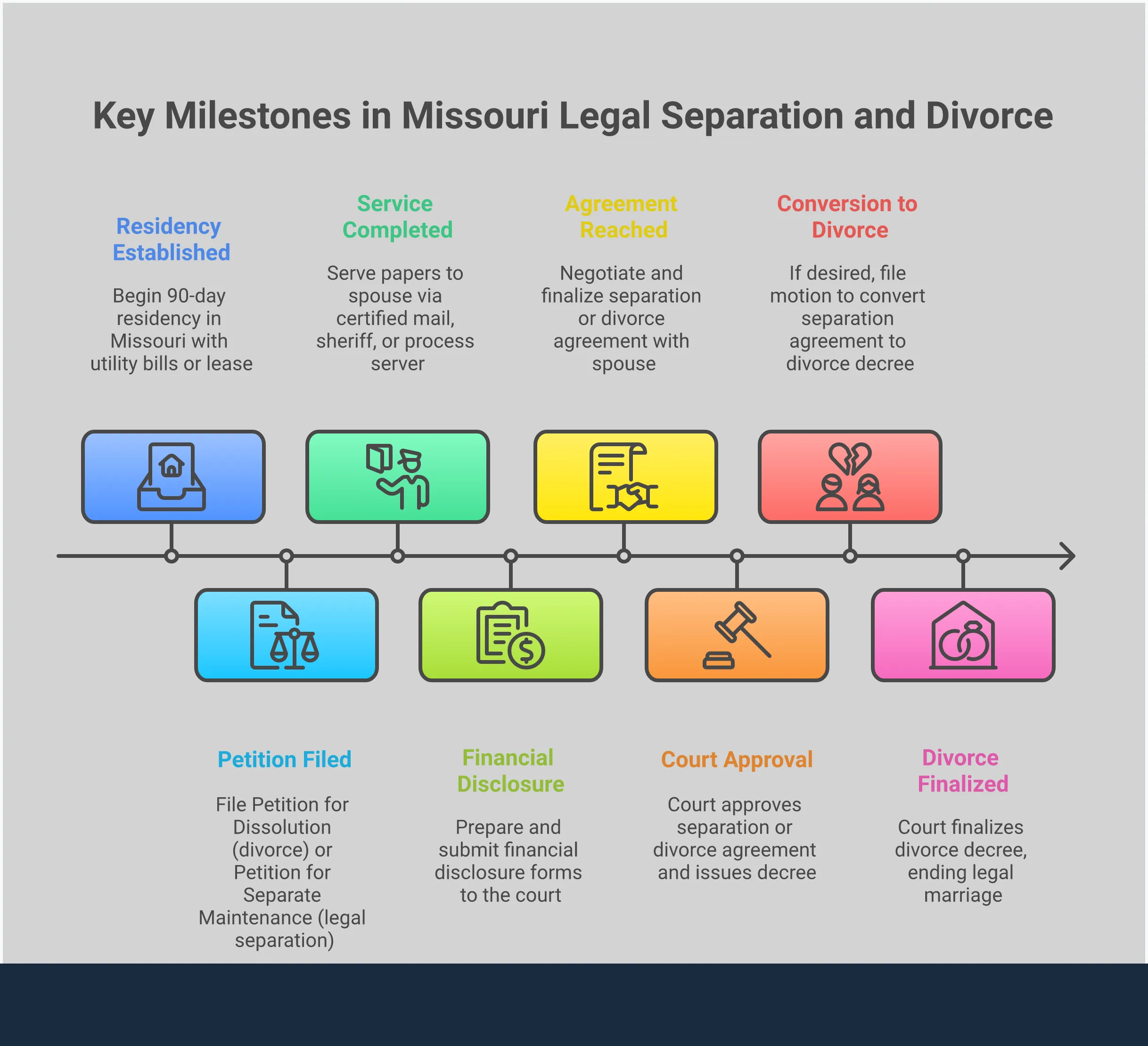
Before you can file any paperwork, you need to make sure Missouri is the right place to do it. The state has a simple residency rule: either you or your spouse must have lived in Missouri for at least 90 days right before you file. This requirement ensures that the state has the proper authority to handle your case. It doesn’t matter where you were married, only where you live now. Only one of you needs to meet this 90-day rule, which can be helpful if one spouse has recently moved out of state. This is the very first box you’ll need to check before moving forward with any family law proceedings.
The Filing Process, Step by Step
Once you’ve met the residency requirement, the next step is to file a formal request with the court. This is done by submitting a document called a “Petition for Dissolution of Marriage” if you’re seeking a divorce. For a legal separation, a similar petition is filed. This document outlines your request and provides the court with essential information about your marriage. After filing, the papers must be officially delivered, or “served,” to your spouse. This step ensures they are formally notified of the proceedings. Navigating this paperwork is often the first point where having an experienced attorney can provide clarity and peace of mind.
How Long Does It Take?
Many people wonder how quickly the process can be completed. In Missouri, there’s a mandatory waiting period. After you file the petition, the law requires you to wait at least 30 days before a judge can finalize your divorce or legal separation. Think of this as a cooling-off period. It’s important to remember that this is the absolute minimum timeframe. If you and your spouse disagree on issues like property division or child custody, the process can take much longer. An uncontested case will always move faster than a contested one, which is why clear communication and solid legal guidance are so valuable. If you have questions about your specific situation, it’s always a good idea to contact a lawyer to discuss your options.
Are You Still Married? How Each Option Affects Your Status
One of the biggest points of confusion between legal separation and divorce is your marital status. While both create distance, only one officially ends your marriage. This distinction has major effects on your personal life, from your ability to remarry to your rights regarding shared property and inheritance. Understanding these differences is crucial as you decide which path is right for your future. Let’s break down what being “still married” means during a legal separation.
Can You Remarry?
Here’s the bottom line: if you are legally separated, you are still legally married. This means you cannot marry someone else. A legal separation allows you to live separate lives with court-ordered arrangements for finances and child custody, but it doesn’t dissolve the marriage. If you want the freedom to remarry, a divorce is the only option that will legally terminate your current marriage. A final divorce decree is what officially makes you single again in the eyes of the law.
What It Means to Stay Legally Married
A legal separation doesn’t end a marriage; it reorganizes it. In Missouri, a court grants a legal separation when it believes there’s a “reasonable likelihood that the marriage can be preserved.” You and your spouse will live apart with a formal agreement, but your legal connection remains. This is the fundamental difference. A divorce is final—it severs the legal bond completely. A separation, on the other hand, hits the pause button, providing structure while leaving the door open for reconciliation.
How It Affects Inheritance and Property
Because you are still married during a legal separation, the financial ties are more complex. For instance, you may still have a legal right to inherit your spouse’s property if they pass away without a will, unless your separation agreement says otherwise. Any property or income you acquire during the separation could still be considered marital property, and you might remain responsible for your spouse’s new debts. This is why having a detailed agreement, drafted with the help of an experienced family law attorney, is essential to protect your interests.
How Divorce and Separation Affect Your Finances
Going through a separation or divorce is emotionally taxing, and the financial side of things can add another layer of stress. Both paths require you to untangle your shared financial life, but they do so in different ways that can have long-term consequences. From health insurance to taxes and retirement benefits, the choice you make will shape your financial future. Understanding these key differences is the first step toward making a decision that protects your stability and sets you up for what comes next. It’s not just about dividing what you have now; it’s about planning for the years ahead.
Keeping Your Health Insurance
One of the most significant financial advantages of a legal separation is the potential to keep your health insurance. If you are covered under your spouse’s employer-sponsored health plan, a legal separation often allows you to remain on that plan because you are still legally married. This can be a critical lifeline, saving you from the high costs of COBRA or marketplace plans. In a divorce, the final decree legally ends the marriage, which is a qualifying life event that terminates your eligibility for your ex-spouse’s benefits. For anyone with chronic health issues or who simply can’t afford a new policy, this single factor can make legal separation a much more practical option.
Protecting Social Security and Retirement
Your marital status can directly impact your eligibility for certain long-term benefits, like Social Security and pensions. To claim Social Security benefits based on your spouse’s work record, you must have been married for at least 10 years. If you are nearing that milestone, a legal separation allows you to remain married and reach the 10-year mark, preserving that option for the future. Similarly, some pension plans and retirement accounts offer survivor benefits that are only available to a legal spouse. A divorce would sever these rights completely, but a legal separation can keep them intact while you and your spouse live apart and decide on the future of your relationship.
How It Changes Your Taxes
Your tax situation will change whether you legally separate or divorce. Once you have a decree of legal separation, you can no longer file your taxes as “married filing jointly.” You will have to file as “married filing separately,” which often results in a higher tax bill and fewer deductions. After a divorce is finalized, you will file as “single” or “head of household,” depending on your custody arrangement. It’s also important to think about debt. While marital debts are divided in both scenarios, a divorce provides a cleaner break. After a divorce is final, you are generally not responsible for any new debts your ex-spouse takes on.
Dividing Property and Debt
Many people think a legal separation is an informal trial run, but in Missouri, it’s a formal court process. Just like in a divorce, a legal separation requires the full division of all marital property and debt. The court will help you reach an equitable distribution of everything from the family home and cars to credit card balances and loans. The process is nearly identical to that of a divorce, with the primary difference being that you remain legally married at the end. If you need guidance on how Missouri law applies to your specific situation, our team has extensive experience in family law and can help you understand your options.
Why Choose Legal Separation Over Divorce?
Deciding to separate is a deeply personal choice, and the right path forward isn’t the same for everyone. While divorce offers a final end to a marriage, legal separation provides a structured alternative that allows you and your spouse to live apart while remaining legally married. For some couples, this option makes more sense financially, personally, or emotionally. Understanding the specific reasons why people choose this route can help you see if it might be the right fit for your situation.
For Personal or Religious Reasons
For some people, divorce simply isn’t an option because it goes against their core personal or religious beliefs. They may not feel it’s morally right to dissolve the marriage vows, but they also recognize the need to live separate lives. Legal separation offers a practical solution that honors these convictions. It allows a couple to formalize new living arrangements, divide assets, and create a parenting plan, all while the marriage itself remains legally intact. This path provides the necessary legal protections and clarity for moving forward without forcing anyone to compromise their deeply held beliefs.
When You’re Hoping to Reconcile
If you and your spouse are uncertain about the future of your marriage, divorce can feel too final. Legal separation can act as a structured pause button. It gives you the space to live independently and work through your issues without the pressure of a permanent decision. This process allows you to establish clear, court-ordered rules for finances, property, and child custody during your time apart. This clarity can reduce conflict and create a healthier environment to decide if reconciliation is possible. Our firm handles all aspects of family law and can help you create an agreement that works for this transitional period.
To Preserve Important Benefits
Practical matters often play a huge role in the decision to separate. A legal separation allows you to maintain certain benefits that would be lost in a divorce. For example, one spouse may be able to remain on the other’s employer-sponsored health insurance plan, which can be a critical financial safety net. It can also help you meet the 10-year marriage requirement for certain Social Security benefits. For couples weighing these financial realities, staying legally married through a separation is a strategic choice that provides stability while they build their separate futures.
Clearing Up Common Misconceptions
It’s important to understand that legal separation is not a mandatory waiting period for divorce in Missouri. Many people mistakenly believe you have to legally separate first, but that isn’t the case. Legal separation is a distinct, court-ordered status that lets couples live apart with formal terms for property, support, and custody, but it does not end the marriage. It’s a legally binding agreement, not just an informal trial separation. Because the legal distinctions are so important, it’s wise to get clear guidance. If you have questions about your options, we encourage you to contact our office to discuss your specific circumstances.
What Happens with Kids and Support?
When you and your spouse decide to separate, your immediate concerns often turn to your children and your finances. A legal separation in Missouri addresses these critical issues head-on, much like a divorce. The court will establish clear, legally binding orders for custody and financial support to provide stability for everyone involved during this transition.
Deciding on Child Custody and Support
If you have children, the court’s top priority during a legal separation is their well-being. A judge will create a formal parenting plan that outlines child custody, visitation schedules, and child support obligations. The process is nearly identical to what happens in a divorce, with every decision guided by the “best interest of the child” standard. This means the court will establish a stable and supportive framework for your children, regardless of whether you choose separation or divorce. These are complex family law matters, and having clear guidance can make all the difference.
Arranging for Spousal Support (Alimony)
Financial stability is another major piece of the puzzle. In Missouri, a court can order one spouse to pay spousal support (also known as alimony or maintenance) during a legal separation. This isn’t just reserved for divorce. The goal is to ensure the receiving spouse can maintain a reasonable standard of living and cover necessary expenses, especially if there’s a significant income difference between you and your partner. The court will review your financial situations to determine if support is appropriate and, if so, for how much and for how long.
Turning a Separation Agreement into a Divorce
One of the practical benefits of a legal separation is that it can serve as a stepping stone to divorce if you eventually decide to end the marriage permanently. The detailed agreements you create for custody, support, and property division during the separation often become the basis for your final divorce decree. This can make the divorce process much simpler, faster, and more cost-effective down the road, as most of the major decisions have already been made. If you need help understanding your options, you can always get in touch with our team for guidance.
How to Decide Which Path Is Right for You
Making the choice between legal separation and divorce is deeply personal, and there’s no one-size-fits-all answer. The best path forward depends entirely on your unique circumstances, your relationship, and your goals for the future. While it can feel overwhelming, thinking through a few key areas can bring a lot of clarity. This isn’t just about ending a chapter; it’s about carefully planning the next one. By considering your financial, personal, and family needs, you can make an informed decision that feels right for you.
Key Questions to Ask Yourself
Before you move forward, take some time to reflect on what you truly want and need. Start by asking yourself a few honest questions. Is there any possibility of reconciliation, or is the end of the marriage certain? Some couples use legal separation as a trial period. Are there practical reasons to remain legally married, such as maintaining health insurance coverage or other benefits? For others, personal or religious beliefs may make divorce a less desirable option. Thinking through these questions will help you understand your own motivations and guide you toward the path that aligns with your values and long-term well-being in family law.
Is Legal Separation the Right Move?
It’s important to understand that a legal separation in Missouri isn’t just an informal break. It’s a formal court proceeding that addresses all the same issues as a divorce, including dividing property and debt, creating a child custody plan, and setting child support. The key difference is you remain legally married. This can be a strategic choice if you need to protect yourself from your spouse’s future debts while keeping the door open for reconciliation. It also preserves certain legal rights, like inheritance, that are terminated by a divorce decree. For many, it provides structure and legal protection without the finality of a divorce.
When to Talk to a Family Law Attorney
While articles like this can provide a great starting point, they can’t replace advice tailored to your specific situation. The nuances of Missouri law and how they apply to your finances and family are complex. This is the point where speaking with an experienced family law attorney becomes essential. A lawyer can help you understand the full implications of both legal separation and divorce, ensuring you don’t overlook critical details. Making this decision with confidence comes from having clear, accurate information. If you’re ready to explore your options, please contact our office to schedule a consultation.
Related Articles
- Filing for Divorce in Missouri | Step-by-Step Legal Guide
- UNDERSTANDING DIVORCE LAW IN MISSOURI – The Law Office of Chad G. Mann, LLC
Frequently Asked Questions
Do I have to get a legal separation before I can get a divorce in Missouri? That’s a common misconception, but the answer is no. You can file for divorce directly without ever going through a legal separation. Think of them as two separate paths you can choose from the start, not sequential steps. Legal separation is an alternative for couples who need legal structure but aren’t ready or willing to end the marriage itself.
What’s the most common reason people choose legal separation instead of divorce? While personal and religious beliefs are important factors, a major practical reason is to maintain benefits. For instance, a legal separation often allows one spouse to remain on the other’s employer-sponsored health insurance plan, which can be a huge financial relief. A divorce, on the other hand, immediately terminates that eligibility.
If we legally separate, can we change our minds and get back together? Yes, you can. Since a legal separation doesn’t end your marriage, you can reconcile at any time without needing to get remarried. To undo the legal separation agreement, you would typically file a motion with the court to dismiss the orders that were put in place, officially resuming your life as a married couple without the court-ordered separation.
How is child custody decided in a legal separation? Is it different from a divorce? The process for determining child custody and support is virtually the same in both a legal separation and a divorce. The court’s primary focus is always the best interest of the child. A judge will establish a formal parenting plan that covers custody, visitation schedules, and support obligations to ensure your children have consistency and stability, regardless of which path you choose.
Can our legal separation agreement be converted into a divorce later on? Absolutely. If you decide later that you want to end the marriage, you can file a motion with the court to convert your legal separation into a dissolution of marriage. Because you’ve already done the hard work of dividing property and creating a parenting plan, this process is often much faster and more straightforward than starting a divorce from scratch.