


A truck accident can change your life in seconds. If you have been hit by a commercial truck in Springfield, Missouri, the steps you take in the hours and days that follow will directly affect your health, your legal rights, and the compensation you may recover. This guide walks you through exactly what to do after a truck accident, with specific guidance for Missouri law and the Springfield area.
In short: Call 911, get medical care, document everything, do not speak to the trucking company’s insurance adjuster, preserve evidence, and contact a Springfield truck accident attorney as soon as possible.
Why Truck Accidents Are Different from Car Crashes
Not all motor vehicle accidents are created equal. A fully loaded commercial truck can weigh up to 80,000 pounds, roughly 20 times the weight of a standard passenger car. That size difference translates to far more destructive collisions, more severe injuries, and a significantly more complicated legal process.
Several factors make truck accident cases uniquely complex:
- Multiple liable parties. Unlike a typical car wreck, a truck accident may involve the truck driver, the trucking company, a maintenance contractor, the cargo loading crew, or even the truck manufacturer. Each party may share responsibility.
- Federal regulations. Commercial trucks are governed by the Federal Motor Carrier Safety Administration (FMCSA), which imposes strict rules on driver hours, vehicle maintenance, cargo securement, and more. Violations of these rules can establish negligence.
- Electronic data. Modern commercial trucks carry electronic control modules (ECMs), sometimes called "black boxes," that record speed, braking patterns, and engine data. This evidence is critical, but it can be overwritten if not preserved quickly.
- Higher insurance stakes. Federal law requires commercial trucks to carry at least $750,000 in liability coverage, and many carry $1 million or more. The higher dollar amounts mean trucking companies and their insurers fight harder to minimize payouts.
Understanding these differences is essential because the approach that works for a minor fender-bender will not protect your rights after a truck collision.
Step 1: Check for Injuries and Get to Safety
Your health comes first. Immediately after the collision:
- Assess yourself for injuries. Check for pain, bleeding, dizziness, or difficulty breathing. Adrenaline may mask serious injuries, so do not assume you are fine.
- Check on your passengers. If anyone in your vehicle is injured, keep them still and wait for emergency responders. Do not attempt to move someone with a potential spinal injury.
- Move to a safe location if you can. If your vehicle is in a travel lane and you are physically able, move to the shoulder or a safe area away from traffic. Turn on your hazard lights.
- Do not leave the scene. Missouri law requires you to remain at the scene of an accident involving injury or significant property damage.
Springfield sits at the intersection of Interstate 44 and U.S. Highway 65, two of the busiest corridors for commercial truck traffic in Southwest Missouri. If your accident occurs on one of these high-speed roadways, staying out of active traffic lanes is especially important for your safety.
Step 2: Call 911 and Get a Police Report
Call 911 immediately, even if your injuries seem minor. Under Missouri law, any accident involving injury, death, or property damage exceeding $500 must be reported to law enforcement.
The police report is one of the most important pieces of evidence in a truck accident claim. When officers arrive, they will:
- Document the positions of the vehicles
- Record statements from drivers and witnesses
- Note road conditions, weather, and visibility
- Cite any traffic violations
- Identify the trucking company and the truck's Department of Transportation (DOT) numbers
Before you leave the scene, ask the responding officer for the report number and the police department where you can obtain a copy. In Springfield, you can typically request accident reports from the Springfield Police Department or the Greene County Sheriff's Office, depending on where the crash occurred.
Step 3: Document Everything at the Scene
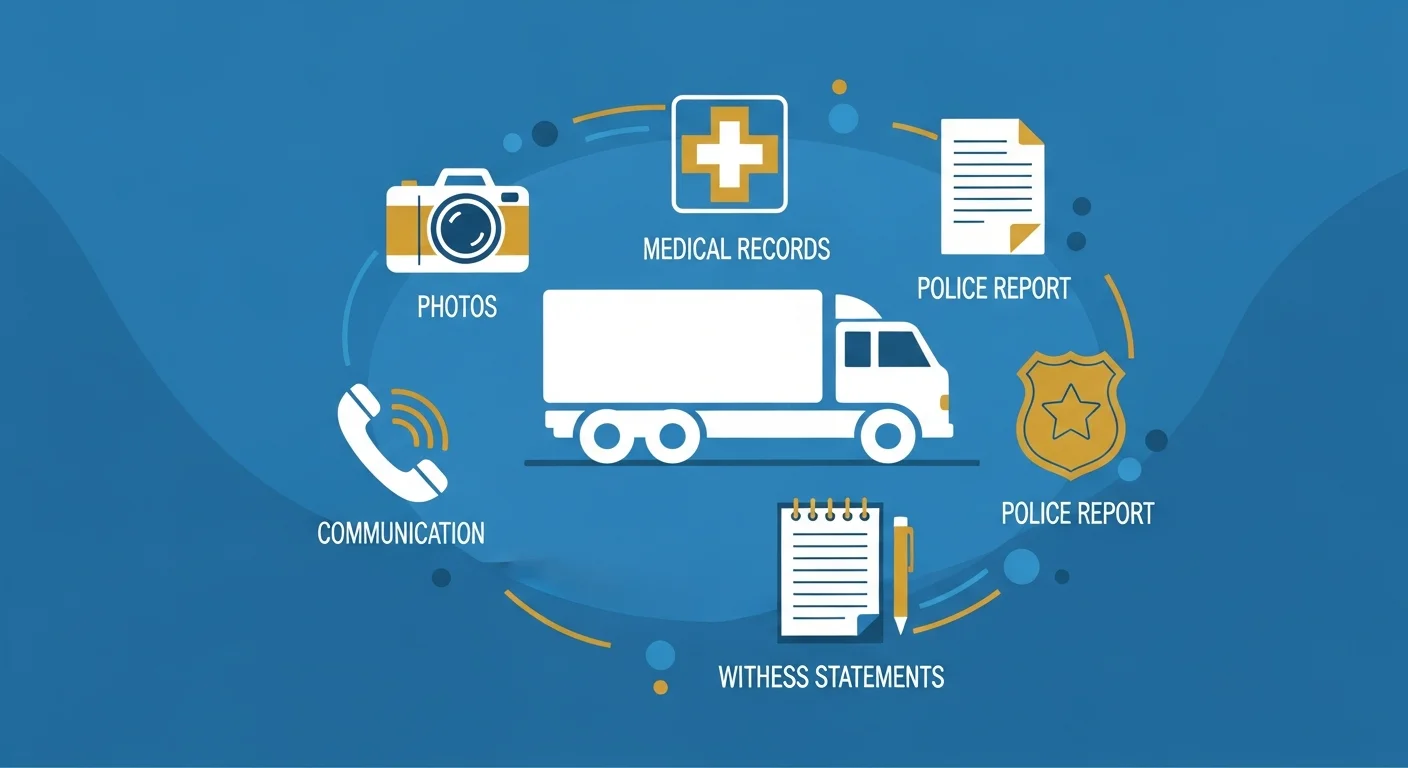
If you are physically able, gather as much evidence as possible before you leave the accident scene. Your smartphone is a powerful tool here.
Take photographs of:
- All vehicles involved, from multiple angles
- Damage to your vehicle, inside and out
- The truck's company name, logo, and USDOT number (usually displayed on the cab door)
- The truck's license plate and trailer number
- Skid marks, debris, and road damage
- Traffic signals, signs, and road conditions
- Your visible injuries
Collect information from the truck driver:
- Full name and contact information
- Driver's license number
- Insurance company and policy number
- Trucking company name and address
- The truck's USDOT and MC (Motor Carrier) numbers
Gather witness details:
- Names and phone numbers of anyone who saw the accident
- Ask if any nearby businesses may have security camera footage
Write down your own account of what happened while the details are fresh. Include the time, direction of travel, weather conditions, and anything unusual you noticed about the truck before the collision, such as erratic driving, speeding, or the truck crossing lane lines.
Step 4: Seek Medical Attention Immediately
Even if you feel relatively fine after the crash, see a doctor as soon as possible. Truck accident injuries are frequently more severe than they initially appear, and some of the most dangerous conditions may not produce obvious symptoms right away.
Injuries commonly seen in truck accidents include:
- Traumatic brain injuries (TBI). A concussion or more severe brain injury may not show symptoms for hours or days.
- Internal bleeding. Blunt force trauma from a truck collision can cause internal organ damage that is not visible externally.
- Spinal cord injuries. Herniated discs, vertebral fractures, and spinal cord damage can worsen without prompt treatment.
- Broken bones and crush injuries. The force of an 80,000-pound truck can cause fractures that need immediate surgical intervention.
- Whiplash and soft tissue injuries. Neck and back injuries may feel like mild soreness at first but can become chronic conditions.
A thorough medical examination creates a documented record linking your injuries directly to the truck accident. This medical documentation is essential evidence if you pursue a personal injury claim. If you delay treatment, the trucking company's insurer may argue that your injuries were not caused by the crash or are not as serious as you claim.
In the Springfield area, facilities like CoxHealth and Mercy Hospital Springfield provide emergency and trauma care. For non-emergency evaluations, urgent care centers throughout Greene County can provide initial assessments and referrals.
Step 5: Do NOT Speak to the Trucking Company's Insurance Adjuster
This is one of the most important steps, and it is the one people most often get wrong.
Within hours or days of your truck accident, you will likely receive a phone call from an insurance adjuster representing the trucking company. They will sound sympathetic and helpful. They may tell you they just want to "get your side of the story" or help you "settle this quickly."
Do not be deceived. The adjuster's job is to minimize the trucking company's financial liability. Everything you say in that conversation can and will be used to reduce your compensation. For more on how insurance companies handle accident claims in Missouri, see our guide to navigating insurance claims after an accident.
Common insurance adjuster tactics include:
- Requesting a recorded statement. Anything you say on record can be taken out of context and used against your claim.
- Offering a quick, lowball settlement. The initial offer is almost always far below the actual value of your claim, especially before the full extent of your injuries is known.
- Asking leading questions. Questions like "You're feeling better now, right?" are designed to undermine your injury claims.
- Shifting blame. The adjuster may subtly suggest the accident was partially your fault to reduce the payout under Missouri's comparative fault system.
If an insurance adjuster contacts you, it is perfectly acceptable to say: "I am not comfortable discussing this without my attorney present. Please direct all communication to my lawyer."
Having worked alongside major insurance companies before opening his own practice, attorney Chad G. Mann understands these tactics from the inside. That firsthand knowledge of how insurers operate is a significant advantage when building a strong truck accident claim.
Step 6: Preserve Critical Evidence
Truck accident cases are won or lost on evidence, and some of the most important evidence is time-sensitive. Acting quickly, ideally through an attorney, can make the difference between a strong case and one that falls apart.
Key evidence to preserve:
- Electronic control module (ECM) data. The truck's "black box" records speed, braking, engine RPM, and other data from the moments surrounding the crash. This data can be overwritten by subsequent trips if not preserved promptly. Your attorney can send a spoliation letter to the trucking company demanding they retain this information.
- Driver logs and hours-of-service records. Federal law limits truck drivers to 11 hours of driving within a 14-hour window after 10 consecutive hours off duty. Electronic logging devices (ELDs) track compliance, but records can be altered or lost without a preservation demand.
- Maintenance and inspection records. If brake failure, tire blowouts, or other mechanical issues contributed to the crash, the truck's maintenance history becomes critical evidence.
- Dashcam and surveillance footage. Request footage from your own dashcam, the truck's forward-facing camera (if equipped), and nearby businesses or traffic cameras. Video evidence degrades or is overwritten on short cycles.
- Your medical records and bills. Keep organized copies of all medical treatment, prescriptions, therapy appointments, and associated costs.
- A recovery journal. Document your daily pain levels, emotional state, activities you can no longer perform, and how your injuries affect your work and family life. This contemporaneous record supports claims for pain and suffering.
The sooner you engage an attorney, the sooner they can issue preservation letters and begin an independent investigation before critical evidence disappears.
Step 7: Contact a Springfield Truck Accident Attorney
Truck accident claims involve layers of complexity that go far beyond a standard auto accident case. You will be going up against the trucking company's legal team, their insurance carrier, and potentially multiple corporate defendants, all of whom have significant resources and experience in minimizing payouts.
A qualified truck accident attorney will:
- Investigate the crash and identify every liable party
- Preserve electronic data and maintenance records before they are lost
- Handle all communication with insurance adjusters
- Calculate the full value of your claim, including future medical costs, lost earning capacity, and pain and suffering
- Navigate Missouri's legal requirements and deadlines
- Take your case to trial if a fair settlement cannot be reached
Missouri's Comparative Fault System
Missouri follows a pure comparative fault system. This means you can recover compensation even if you were partially at fault for the accident, but your award will be reduced by your percentage of responsibility. For example, if you are found to be 20% at fault and your damages total $500,000, your recovery would be reduced to $400,000.
Insurance companies regularly try to assign a higher percentage of fault to the injured person to reduce their payout. An experienced attorney can push back against these tactics and protect your share of the recovery.
Statute of Limitations
Under Missouri Revised Statutes § 516.120, you generally have five years from the date of the accident to file a personal injury lawsuit. For a deeper look at filing deadlines, read our article on understanding the statutes of limitations for personal injury cases in Missouri. While five years may sound like a long time, evidence degrades, witnesses forget details, and building a strong case takes time. Starting the process early is always in your best interest.
If you have been injured in a truck accident in Springfield or anywhere in Southwest Missouri, The Law Office of Chad G. Mann is ready to help you understand your options. Call (417) 842-8679 to discuss your case.
Need legal guidance now? Review your next steps with Chad G. Mann or call (417) 842-8679.
Understanding Missouri Truck Accident Laws
Missouri's legal landscape adds several important layers to a truck accident claim:
- Federal insurance minimums. Commercial trucks hauling general freight must carry at least $750,000 in liability coverage. Trucks carrying hazardous materials must carry between $1 million and $5 million depending on the cargo. These higher policy limits mean there is more available compensation, but also more aggressive defense.
- FMCSA regulations. Violations of federal trucking regulations, such as exceeding hours-of-service limits, failing to conduct pre-trip inspections, or operating with defective equipment, can establish negligence per se, meaning the violation itself proves the trucker or trucking company was negligent.
- Vicarious liability. Under Missouri law, a trucking company can be held liable for the negligent actions of its drivers under the doctrine of respondeat superior. This is important because trucking companies typically have far deeper pockets than individual drivers.
- Multiple defendant claims. Beyond the driver and trucking company, potential defendants include maintenance contractors, parts manufacturers, cargo loaders, and even government entities responsible for road design or maintenance.
Navigating these overlapping state and federal rules requires an attorney with specific experience in commercial vehicle litigation.
Frequently Asked Questions
How much is the average truck accident settlement in Missouri?
There is no single "average" because every case depends on the severity of injuries, the number of liable parties, the strength of the evidence, and the available insurance coverage. However, truck accident settlements are generally significantly higher than car accident settlements due to the severity of injuries and the higher insurance minimums. Settlements can range from tens of thousands of dollars for minor injuries to several million dollars for catastrophic injuries or wrongful death.
How long does a truck accident case take to settle?
Most truck accident cases in Missouri take between 6 months and 2 years to resolve, depending on complexity. Cases involving severe injuries, disputed liability, or multiple defendants tend to take longer. While a quick settlement may be tempting, accepting an early offer before you fully understand the extent of your injuries can cost you significantly.
What if I was partially at fault for the truck accident?
Missouri's pure comparative fault system allows you to recover compensation even if you share some responsibility. Your award will be reduced by your percentage of fault. For instance, if you are 30% at fault, you can still recover 70% of your total damages. An attorney can help minimize the fault percentage assigned to you.
Can I sue the trucking company, not just the driver?
Yes. In many cases, the trucking company is liable for its driver's actions through vicarious liability. The company may also be directly liable if it failed to properly screen, train, or supervise the driver, or if it pressured the driver to violate safety regulations. Your attorney will investigate the company's practices to identify all potential sources of liability.
What should I do if the truck driver's company contacts me?
Do not provide a statement, sign any documents, or accept any payment. Direct all communication to your attorney. The company's representatives are working to protect the company's interests, not yours.
Protect Your Rights After a Springfield Truck Accident
A truck accident can leave you dealing with painful injuries, mounting medical bills, lost income, and uncertainty about the future. The steps you take in the immediate aftermath will shape the outcome of your recovery, both physically and financially.
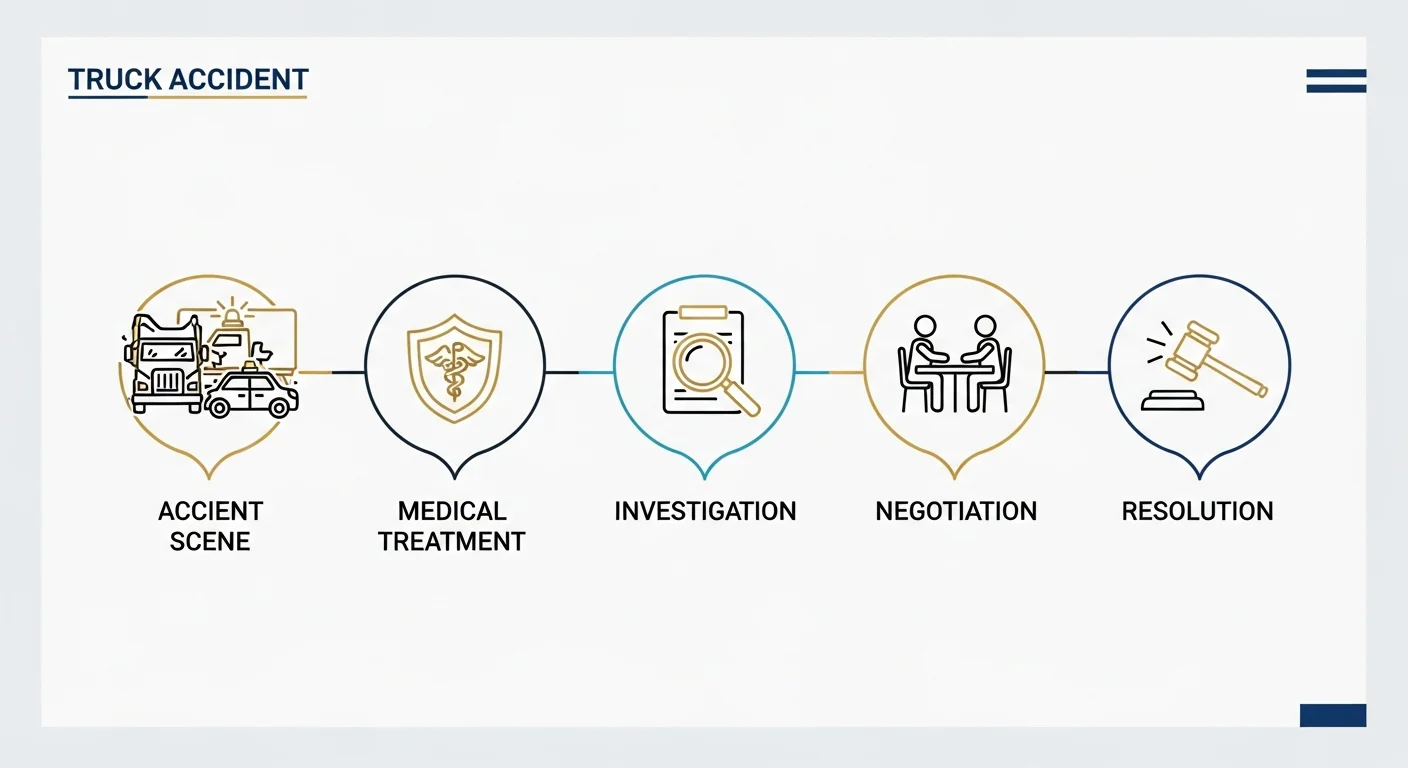
To recap the critical steps:
- Check for injuries and get to safety
- Call 911 and obtain a police report
- Document everything at the scene
- Seek medical attention immediately
- Do not speak to the trucking company's insurance adjuster
- Preserve critical evidence
- Contact a Springfield truck accident attorney
If you or a loved one has been injured in a truck accident in Springfield, Missouri, or anywhere in Southwest Missouri, do not try to handle the insurance companies and legal process alone. Contact The Law Office of Chad G. Mann at (417) 842-8679 for a consultation about your truck accident case.