

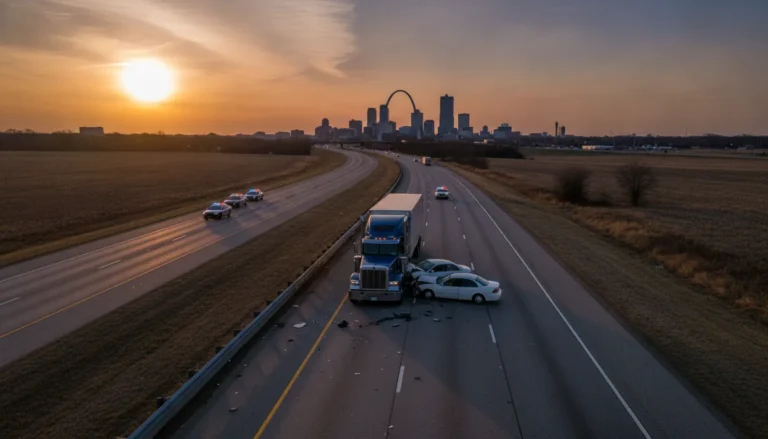
A fully loaded commercial truck can weigh up to 80,000 pounds, while a typical passenger vehicle weighs about 4,000. When those vehicles collide, the injuries, medical needs, and insurance issues can be far more serious than in an ordinary crash. St. Louis freight routes and congested interchanges add another layer of risk, but the legal path is not always obvious.
A truck accident attorney St. Louis victims trust can investigate the crash, identify whether federal or Missouri trucking rules were violated. Preserve records before they disappear, and challenge the way trucking insurers evaluate a claim. Missouri follows pure comparative fault, has no damage caps for personal injury cases. And generally gives injured people five years to bring a claim, although important exceptions may apply. See the Missouri statute of limitations guide for more detail.
Understanding how St. Louis traffic patterns, commercial regulations, and insurance practices intersect is the first step toward protecting a claim and making informed decisions about what happens next.
Truck Accident Attorney St. Louis: Why St. Louis Truck Accidents Require Specialized Legal Knowledge
St. Louis truck accidents do not happen in an ordinary traffic environment. The region is a major freight hub where I-70, I-44, I-55, and I-64 carry local traffic alongside trucks moving goods across Missouri and the country. That combination creates complicated collision scenes, multiple potential sources of evidence, and insurance claims that may involve a driver, carrier, broker, shipper, or vehicle manufacturer.
A high-volume freight network creates distinct risks
Commercial vehicle density is especially important around the I-64 and I-55 interchange at I-44, which transportation researchers identify as a significant freight bottleneck. Congestion, lane changes, merging traffic, and tight delivery schedules can increase the risk of rear-end and merging collisions in this corridor. A crash investigation must account for the roadway design, traffic conditions, truck route, cargo, driver hours. And the actions of every vehicle involved, rather than treating the event as a simple two-car accident.
The numbers also show why location matters. In one recent year, St. Louis County recorded 2,679 commercial vehicle accidents, compared with 1,413 in the City of St. Louis. Those figures come from a third-party compilation and should not be treated as a prediction of any individual claim. But they illustrate the scale of commercial traffic in the metropolitan area. They also reinforce the need to identify precisely where a collision occurred, which law enforcement agency investigated it, and which court or venue may handle related claims.
Missouri law affects how a claim is evaluated
Missouri provides important protections for injured people, but those protections still require careful legal analysis. Missouri follows pure comparative fault, so an injured person may recover damages even when they share some responsibility for a crash. The award can be reduced according to that percentage of fault. Missouri also has no damage caps for personal injury cases, although the amount supported by a claim depends on the evidence, injuries, losses, and applicable law.
Most Missouri personal injury claims, including truck accident claims, are subject to a five-year statute of limitations. That deadline is not a reason to delay investigation. Trucking evidence can be dispersed among several companies, and relevant records may require prompt preservation. A truck accident claim in Missouri may share general legal principles with a Springfield case, but a St. Louis investigation must address this metro area’s freight routes, bottlenecks, traffic patterns, and City-versus-County setting.
Federal Trucking Regulations That Govern Missouri Commercial Drivers
Commercial trucking is governed by detailed federal safety rules, and those rules often provide a roadmap for investigating a Missouri crash. The Federal Motor Carrier Safety Administration (FMCSA) sets standards for driver work hours, electronic logs, vehicle condition, qualification records, and drug and alcohol testing. When a carrier or driver ignores those requirements, the violation may help establish negligence per se. Or serve as strong evidence that the defendant failed to use reasonable care. The violation still must be connected to the crash and the resulting injuries.
Hours of service and electronic logs
Hours-of-service rules generally limit a property-carrying commercial driver to 11 hours of driving after 10 consecutive hours off duty, within a 14-hour on-duty window. These limits are intended to reduce fatigue, particularly when a driver faces long routes or demanding delivery schedules. Electronic logging devices (ELDs) record driving activity and help investigators compare the driver’s claimed schedule with the vehicle’s actual operation. FMCSA data identifies ELD compliance as an important part of monitoring hours-of-service requirements. And inaccurate or missing logs can be a significant red flag in a truck accident investigation.
An attorney may compare ELD records with dispatch messages, fuel purchases, GPS information, toll records, inspection reports, and witness accounts. That comparison can reveal whether a driver was pressured to continue driving, whether logs were altered, or whether the carrier failed to respond to obvious fatigue concerns.
Vehicle maintenance, qualification, and testing duties
Federal rules also require motor carriers to operate and maintain safe equipment. Maintenance and inspection records may show whether the carrier knew about worn brakes, defective tires, lighting problems, steering defects, or other dangerous conditions. Driver qualification files can contain licensing, experience, medical certification, and required background information. Drug and alcohol testing records may help determine whether a driver was properly screened and whether a post-crash test was completed when required.
These records are rarely limited to the driver’s account. A truck accident attorney St. Louis victims trust may seek the carrier’s complete file, rather than accepting a summary prepared after the collision. Missing records, unexplained gaps, or inconsistent entries can raise additional questions about supervision and recordkeeping.
Crash registers and building the liability case
Under 49 CFR 390.5T, motor carriers must maintain a register of qualifying crashes from the previous three years. The FMCSA describes this crash register as part of a carrier’s safety records. Reviewing it may help identify prior collisions, recurring equipment problems, or patterns that warrant closer investigation. See the FMCSA safety guidance on crash registers.
By preserving these materials promptly and comparing them with the physical evidence, a truck accident attorney St. Louis can use FMCSA violations to develop a focused liability theory against the driver, carrier, or both. Early action matters because electronic records and other safety data may not remain available indefinitely.
Common Causes of Semi-Truck Accidents in Missouri
Semi-truck crashes rarely result from one isolated mistake. Investigators may need to examine the driver’s conduct, the carrier’s policies, the truck’s condition, and the way cargo was loaded. The FMCSA Large Truck Crash Causation Study provides important context for this work. While current crash investigations can also reveal operational choices that are not obvious at the scene.
Driver fatigue and delivery pressure
Long shifts, insufficient rest, and pressure to meet a delivery window can cause a driver to lose focus, react slowly, or fall asleep. Electronic logging device records can help show whether the driver’s hours of service matched the records reported by the carrier. A failure to maintain accurate ELD logs can be a significant red flag in a liability investigation. Tight schedules and repeated assignments may also point to decisions made by supervisors, not just the individual behind the wheel.
Distraction and speeding
Looking at a phone, adjusting equipment, reaching for paperwork, or focusing on a dispatch message can take a driver’s attention away from traffic. Speeding compounds the danger because a fully loaded truck needs more time and distance to stop. In St. Louis freight corridors, congestion and merging traffic can leave little room to recover from either mistake.
Improper maintenance and brake failures
Commercial carriers have an ongoing responsibility to inspect and maintain their vehicles. Worn brake components, defective tires, failed lights, or other neglected equipment can contribute to a collision or make its consequences worse. Maintenance records, inspection reports, repair invoices, and prior complaints may help establish whether the problem was sudden or had been ignored.
Overloaded or poorly distributed cargo
Cargo that exceeds safe limits or is distributed unevenly can affect steering, braking, and stability. Shifting freight may cause a trailer to sway or jackknife, while unsecured materials can strike other road users. The investigation may need to include loading records, bills of lading, weight documentation, and the identity of the shipper or loading contractor.
How hidden causes are uncovered
An insurance insider perspective can help identify evidence that a quick claim review might overlook. Chad Mann understands how carriers evaluate losses, investigate policy compliance, and frame responsibility. That perspective can help direct attention to delivery-pressure policies, inadequate supervision, prior safety concerns, and incomplete records. Common commercial truck accident causes include fatigue, distraction, speeding, and improper cargo loading, but the underlying responsibility may extend beyond the driver. Research on common truck accident causes provides additional context for that broader review.
Who Is Liable After a Truck Accident in Missouri?
Liability after a truck collision is not always limited to the person behind the wheel. A commercial trucking case may involve employment records, delivery contracts, maintenance histories, cargo documents, and insurance policies. Identifying the responsible parties early can help preserve evidence before it is lost and clarify which claims should be pursued.
The trucking company may be responsible for its driver
When a driver is an employee acting within the scope of the job, the motor carrier may be legally responsible for the driver’s negligent conduct. The carrier may also face separate questions about hiring, training, supervision, scheduling, vehicle inspection, or compliance with federal safety requirements. Electronic logging device data, driver qualification records, dispatch communications, and the carrier’s accident history can help show what the company knew and whether it acted reasonably.
Independent contractor and owner-operator arrangements can make the analysis more complicated. A carrier may argue that a driver was not its employee, but labels in a contract do not necessarily answer every liability question. The nature of the working relationship, control over the driver and vehicle, carrier operating authority, and responsibility for maintenance and dispatch may all matter. A careful investigation is needed before accepting an insurer’s description of the relationship.
Other parties may share responsibility
Depending on the facts, potential defendants can include:
- A motor carrier that owned, leased, dispatched, or controlled the truck
- A broker that arranged transportation, when its own conduct contributed to the collision
- A shipper or loading company if cargo was overloaded, unsecured, or improperly distributed
- A manufacturer if a defective part contributed to the crash
- A maintenance or repair provider whose work left a safety-critical defect unresolved
Missouri follows pure comparative fault. An injured person may still recover damages even if that person was partially responsible, although the recovery can be reduced according to the assigned share of fault. This makes a thorough investigation important when an insurer tries to shift blame to the injured driver. The differences between truck accident claims and ordinary car accident claims often include the number of parties, records, and regulations involved.
| Factor | Truck Accident | Car Accident |
|---|---|---|
| Regulatory framework | FMCSA federal rules + state law | State law only |
| Potential defendants | Driver, carrier, broker, shipper, manufacturer, maintenance provider | Other driver(s) primarily |
| Key evidence types | ELD data, ECM/EDR, maintenance logs, driver qualification files, dispatch records, cargo docs | Photos, police report, witness statements |
| Insurance complexity | Layered policies (primary, excess, umbrella) from multiple entities | Single auto policy per driver |
| Evidence urgency | ELD/EDR data overwritten in hours; spoliation letter needed immediately | Less time-sensitive evidence |
Insurance coverage may exist in layers
Truck cases can involve a carrier’s primary commercial policy, excess coverage, or an umbrella policy. Additional policies may apply through a broker, shipper, leased vehicle arrangement, or another business relationship. Insurers may investigate quickly and develop a liability position before all the evidence is available. Chad Mann’s experience inside the insurance industry helps him understand how carriers evaluate responsibility, coverage. And claim value, while an early investigation can protect the facts needed to test those positions.
Missouri generally allows five years to file most personal injury claims, but waiting can still make a case harder to prove. Review the five-year statute of limitations for truck accidents, and consider speaking with a truck accident attorney St. Louis victims can turn to before records, vehicle data, or witness memories become harder to obtain.
The Critical Evidence Window After a St. Louis Truck Accident
Evidence in a trucking case can disappear before an injured person understands what happened. Electronic control module (ECM) and event data recorder (EDR) information may be overwritten within hours. Dashcam footage may be automatically recorded over within 48 to 72 hours. Electronic logging device (ELD) records can also be incomplete or altered. A prompt preservation effort can protect information that may show how the collision occurred and whether a carrier violated safety rules.
- Get medical care and document the scene. Follow your treatment plan, photograph visible injuries and vehicle damage, and preserve clothing or damaged personal property. Do not give a recorded statement to the trucking company’s insurer before obtaining advice about your rights.
- Send a spoliation letter. A truck accident attorney St. Louis victims trust can promptly notify the carrier, driver, insurer, and other responsible parties that relevant evidence must be preserved. The letter should identify the collision and request that electronic data, video, paper records, and physical evidence not be destroyed, overwritten, or altered.
- Request the carrier’s operational records. Important evidence may include ELD logs and supporting hours-of-service records, dispatch messages, delivery schedules, driver qualification files. Training records, maintenance and inspection logs, drug and alcohol testing results, cargo and loading documentation, and communications about the crash.
- Preserve the accident register. Federal Motor Carrier Safety Administration rules require motor carriers to maintain a register of crashes defined under 49 CFR 390.5T for the preceding three years. That register can reveal prior incidents and help investigators evaluate the carrier’s safety history. FMCSA guidance explains the accident-register requirement.
- Investigate before the evidence changes. An attorney can work with qualified investigators to inspect vehicles, secure downloads, identify witnesses, and compare records for inconsistencies. Early investigation is especially important because ELD data and other trucking records may be central to proving fatigue, hours-of-service violations, inadequate maintenance, improper loading, or another regulatory failure.
Do not wait for the carrier to complete its internal investigation. Preserving evidence early gives your legal team a better opportunity to understand the facts and respond to the insurance company’s position with documented information.
How Chad Mann’s Insurance Background Strengthens Your Truck Accident Case
Trucking insurers begin evaluating a serious collision quickly. Their claims professionals may review the crash report, driver records, vehicle data, photographs, medical information, and early statements while the injured person is still focused on treatment. The purpose is to assess liability and potential exposure, then determine how much authority should be available for settlement.
How insurers evaluate a commercial vehicle claim
Insurers commonly examine whether the driver, carrier, maintenance provider, shipper, or another party may share responsibility. They also consider the available policy limits, the severity and duration of injuries, proof of lost income, future medical needs, and whether evidence supports the claimed damages. In a trucking case, those questions can involve multiple policies and layers of coverage rather than one ordinary auto policy.
Settlement authority is usually tiered. A claims adjuster may have authority to resolve smaller amounts, while a supervisor or regional manager must approve a larger offer. A serious injury claim may require review at still higher levels. Knowing that process helps an attorney evaluate whether an offer reflects the evidence or merely the adjuster’s current authority.
Recognizing delay and denial tactics
Delay can take several forms: requesting the same records repeatedly, waiting for medical treatment to conclude before meaningfully evaluating the claim. Disputing whether symptoms came from the collision, or shifting attention to minor inconsistencies in an injured person’s statement. An insurer may also argue that another party is responsible or make an early settlement offer before the full impact of the injury is known.
Chad Mann worked for major insurance companies before becoming a personal injury attorney. He understands how carriers set reserves, route claims for additional settlement authority, assess weaknesses, and frame denial positions. That perspective helps him anticipate the strategy behind a request or offer. Identify what evidence is missing, and respond before a temporary insurance position hardens into a broader dispute.
His background does not guarantee an outcome, but it provides practical insight that can matter when a commercial insurer controls the information flow. For readers comparing truck and rideshare accident insurance complexities, the same principle applies: understanding the insurer’s process is part of protecting the claim.
Frequently Asked Questions
How long do I have to file a truck accident claim in Missouri?
Most Missouri personal injury claims, including truck accident claims, have a five-year statute of limitations. That deadline does not mean you should wait. Evidence such as electronic logging device data, vehicle records, and crash documentation may become harder to obtain as time passes. Review your specific deadline with a qualified attorney. Missouri statute of limitations guidance provides additional context.
What if I was partially at fault for the collision?
Partial fault does not automatically prevent recovery in Missouri. The state follows pure comparative fault, so an injured person may recover damages even when they contributed to the crash. The award is reduced according to that person’s share of responsibility. Insurance companies may still try to assign more fault than the evidence supports, which makes a careful investigation important.
How much is a Missouri truck accident case worth?
No reliable estimate can be made from the collision alone. Value depends on the severity and permanence of injuries, medical treatment, lost income, future care, fault, available insurance coverage, and how the evidence supports each loss. Missouri does not impose damage caps on personal injury cases, but that does not guarantee a particular result. A case should be evaluated using documented damages and likely future needs, not a general settlement formula.
What should I do immediately after a truck accident?
Get emergency medical care, call 911, follow medical instructions, and avoid giving a recorded statement to an insurer before understanding your rights. If you can do so safely, preserve photographs, witness information, vehicle details, and relevant messages. Trucking evidence can include ELD data, maintenance records, dispatch records, and the carrier’s crash register, so early preservation is important.
How is truck accident liability different from a car accident?
A truck claim may involve more than the driver. Depending on the facts, potential parties can include the motor carrier, an owner-operator, a broker, a shipper, or a vehicle or equipment manufacturer. Federal safety rules, layered insurance policies, cargo records, and electronic logs can also affect the investigation. Preserving this evidence early helps determine who may be legally responsible.
Ready to Discuss Your St. Louis Truck Accident Case?
Truck accident claims can involve complex evidence and insurance questions. A conversation with Chad Mann can help you understand your options and the next steps for your situation. To schedule a free consultation, contact The Law Office of Chad G. Mann online. You can discuss your circumstances directly and learn how the firm’s insurance experience may help guide the claim process.