


A collision with a commercial truck can change a family’s life in seconds. Severe injuries may require emergency care, months of rehabilitation, and time away from work, while the trucking company and its insurer begin protecting their own interests. The early evidence can also disappear or become harder to obtain if no one acts promptly.
Truck accident lawyers investigate the crash, preserve electronic logging device data and other records. Identify every potentially responsible party, and build a claim that accounts for medical expenses, lost income, pain, and suffering. In Missouri, that may include claims against the driver, trucking company, vehicle owner, or manufacturer, depending on the evidence.
Unlike a typical car crash, a truck case may involve federal safety rules, carrier policies. Driver qualifications, maintenance records, multiple insurance policies, and more than one legal theory of liability. Both the driver and the trucking company may be responsible under theories such as vicarious liability or negligent hiring, training, and supervision. A careful investigation therefore looks beyond the immediate impact and examines how the carrier hired, trained, dispatched, supervised, and insured the driver. Understanding that broader structure is the first step toward seeing why these claims require a different legal approach.
Why Truck Accident Claims Are Different from Ordinary Car Crashes
A collision with a commercial truck is not simply a larger version of an ordinary car crash. The investigation may involve the truck driver, a motor carrier, a vehicle owner, maintenance providers, and other businesses connected to the trip. Each party may have separate insurance coverage, records, and legal responsibilities. That structure can make it harder to identify who caused the crash and which parties should be included in a claim.
| Consideration | Ordinary Car Crash | Commercial Truck Accident |
|---|---|---|
| Parties involved | Usually one driver and one insurer | Driver, trucking company, vehicle owner, and possibly a manufacturer |
| Evidence | Police report, photos, eyewitnesses | Electronic logging device data, driver logs, maintenance and compliance files, black box records |
| Rules that apply | State traffic laws | State law plus federal FMCSA safety regulations |
| Insurance limits | Lower state-required minimums | Higher commercial policy limits, often with multiple layers of coverage |
| Investigation | Often resolved on surface facts | Requires a deeper review of carrier policies, training, and record keeping |
The physical consequences can also be severe. Commercial trucks are substantially larger and heavier than passenger vehicles, so a crash can cause catastrophic injuries, long-term disabilities, or death. The resulting claim may involve extensive medical treatment, lost earning capacity, home modifications, and ongoing care. Those losses need to be documented carefully rather than reduced to the first medical bills or an early settlement offer.
Truck accident cases also require proving liability against commercial carriers, which is fundamentally different from proving fault in a typical passenger-vehicle collision. Commercial carriers operate within a regulated industry, and the available evidence may include company policies, driver qualification materials, dispatch records, maintenance files, and electronic data. A careful investigation considers whether the driver acted negligently and whether the company contributed through hiring, training, supervision, scheduling, or other decisions.
Under Missouri law, potentially responsible parties may include the driver, the trucking company, the vehicle owner, and sometimes the manufacturer. The right parties depend on the facts, contracts, ownership records, and evidence from the crash. For a fuller explanation of how these questions are evaluated, see this guide to truck accident liability.
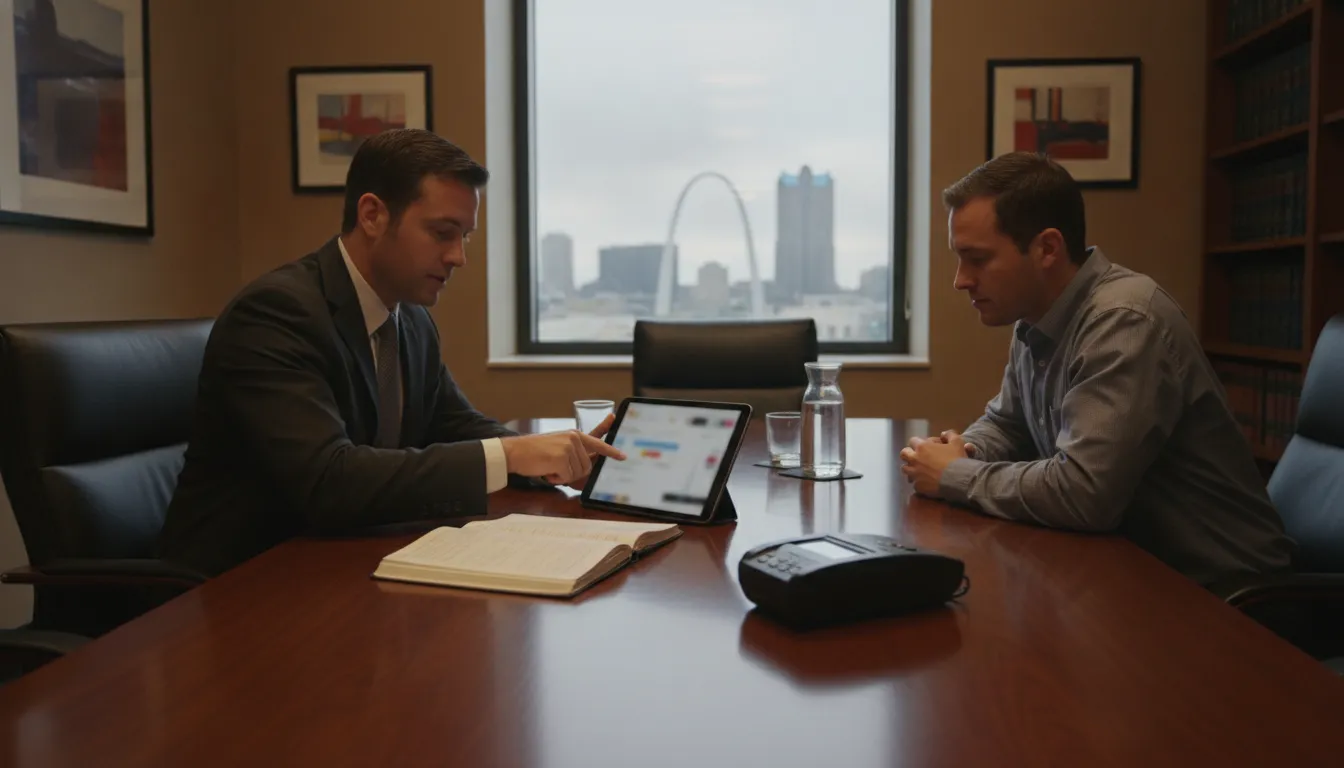
Insurance negotiations add another layer of complexity. Commercial carriers and their insurers commonly have experienced claims personnel who begin assessing responsibility soon after a crash. They may examine statements, photographs, medical records, and vehicle data while important evidence is still being preserved. Truck accident lawyers can help protect the claim by identifying the potentially liable parties, requesting relevant records, and evaluating whether an insurer’s account matches the available evidence.
That does not mean every truck claim should be treated as a lawsuit from the outset. It means the claim deserves an investigation proportionate to its stakes. Early attention to liability, evidence, and the full scope of injury can help prevent a complicated commercial crash from being handled like a routine fender-bender.
How a Truck Accident Lawyer Investigates a Commercial Crash
A commercial truck crash investigation begins with preserving evidence before the carrier’s records become difficult to obtain. The truck, driver, trucking company, and other involved businesses may each hold information that helps explain what happened. A focused investigation connects those records to the physical evidence, witness accounts, medical findings, and roadway conditions.
Preserving ELD data and driver logs
Electronic logging device (ELD) data can show when a driver was driving, off duty, on duty, or resting. Attorneys also seek the driver’s paper or electronic logbooks, dispatch messages, fuel records, bills of lading, and delivery schedules. Comparing these sources may reveal inconsistencies that are not apparent from a single log.
These records should be requested promptly. Electronic data may be subject to retention periods, routine system changes, or overwriting, while paper records can be misplaced or altered. A preservation letter can instruct the carrier and other custodians to retain relevant information, including native electronic files and audit histories. The goal is not to assume misconduct, but to protect the evidence needed for a fair reconstruction of the driver’s activities before and after the collision.
Analyzing the truck’s electronic systems
Many commercial vehicles contain an event data recorder or engine control module, sometimes referred to as a truck’s black box. Depending on the vehicle and the available system, the data may help show speed, braking, throttle activity, engine conditions, or other information surrounding an impact. A qualified investigator or technician should collect and interpret that data because the format, limits, and meaning can vary by manufacturer.
Black box information is most useful when analyzed alongside scene measurements, photographs, vehicle damage, surveillance video, and eyewitness statements. One record rarely answers every question. The investigation should test whether the electronic data is consistent with the physical evidence and with the driver’s account.
Reviewing FMCSA compliance records
Federal Hours of Service rules are found in 49 CFR 395. These rules establish limits on driving and on-duty time, along with required rest periods, to help drivers remain awake and alert. Reviewing HOS records can show whether fatigue or an hours violation may have contributed to the crash.
An investigation may also seek the carrier’s driver qualification file, training records, inspection and maintenance documents, drug and alcohol testing records, disciplinary history, and safety policies. Those materials can help identify whether the company followed applicable compliance procedures and whether concerns about the driver or vehicle were known before the collision.
Chad Mann’s insurance industry background adds a practical perspective to this process. He understands that a trucking insurer may focus early on disputed facts, missing records, or arguments that shift responsibility to the injured person. Anticipating those tactics helps ensure that preservation requests and evidence analysis address the issues likely to matter during claim evaluation.
Proving Liability Against the Trucking Company and Its Insurer
A commercial truck crash is not always explained by asking whether the driver made a mistake. The investigation may also need to determine what the trucking company knew, what it required, and whether it met its responsibilities before the vehicle ever entered the roadway. Truck accident lawyers may open claims against the driver, the trucking company, the vehicle owner, and, in some cases, the manufacturer. Identifying every potentially liable party helps keep the investigation focused on the full circumstances of the collision.
When Is a Trucking Company Responsible for Its Driver?
Under Missouri law, both a truck driver and the trucking company may be held liable under theories of vicarious liability and negligent hiring, training, or supervision. Vicarious liability generally concerns the company’s responsibility for an employee’s conduct while performing work for the company. The facts matter, including the driver’s work relationship, the assignment being performed, and whether the driver was acting within the scope of that work.
Separate negligence theories examine the company’s own conduct. A claim may require reviewing whether the company hired a qualified driver, provided appropriate training, monitored performance, and responded to warning signs. Relevant records can include employment and driving histories, training materials, safety policies, disciplinary records, dispatch communications, and inspection or maintenance files. The purpose is not to assume that a company is responsible simply because it owns or operates the truck. It is to establish, through evidence, whether the carrier’s decisions contributed to the crash or the resulting injuries.
This broader inquiry is one reason a truck collision can differ substantially from a standard passenger-vehicle claim. For additional background, see our discussion of truck accident liability.
How Does the Insurer Evaluate the Claim?
The trucking company’s insurer may begin assessing fault, causation, and the extent of damages shortly after the collision. Commercial carriers often have established claim procedures, access to defense counsel, and adjusters experienced in challenging liability. The evidence needs to be preserved and organized before important records become difficult to obtain or the claim’s facts are framed solely by the carrier’s investigation.
Chad Mann’s background in the insurance industry gives him firsthand insight into how insurers evaluate claims and look for grounds to deny or limit responsibility. That perspective can help anticipate the questions an adjuster may ask, the weaknesses an insurer may emphasize, and the records needed to respond to those positions. It does not guarantee a particular result, but it supports a careful, evidence-based approach to negotiations and litigation.
For an injured person and family already managing medical care, lost income, and uncertainty, this process can feel overwhelming. A thorough investigation allows the legal team to address the driver’s conduct and the carrier’s independent responsibilities without losing sight of the human impact of the injuries.
How Missouri’s No-Damage-Caps and Comparative Fault Rules Help Truck Accident Lawyers Maximize Recovery
Missouri’s damages and fault rules can materially affect the value of a truck accident claim. Understanding them helps keep the discussion focused on the full harm caused, rather than on an insurer’s preferred starting point. Missouri has no statutory cap on compensation in personal injury cases. Recoverable losses may include medical expenses, lost income, pain and suffering, and other damages supported by the evidence.
That does not mean every claim automatically receives its full potential value. The amount must still be established through medical records, employment information, testimony, expert analysis, and other proof. A careful evaluation considers both the losses already incurred and the likely effect of the injuries on future treatment, work, independence, and quality of life.
How does pure comparative fault affect a Missouri truck accident claim?
Missouri follows a pure comparative fault approach. A person may recover damages even when that person shares some responsibility for the crash, but the recovery is reduced in proportion to the assigned fault. For example, if a jury finds a claimant 20 percent responsible, the award would generally be reduced by 20 percent. The precise allocation depends on the facts and the evidence presented.
This rule makes a thorough liability investigation especially important. An insurer may emphasize a claimant’s conduct, such as speed, following distance, or lane position, while giving less attention to the truck driver’s conduct and the carrier’s responsibilities. Truck accident lawyers can analyze the available evidence, identify each contributing act, and present a complete account instead of allowing one disputed fact to define the entire claim.
Why does insurance experience matter during negotiations?
Commercial trucking insurers often have experienced adjusters and established methods for evaluating and contesting claims. Chad Mann’s background in the insurance industry provides insight into how insurers assess liability, value losses, and use liability-denial tactics. That perspective can help anticipate requests for recorded statements, challenges to medical treatment, and arguments that minimize the consequences of an injury.
The goal is not to inflate a claim. It is to support each component with reliable evidence and respond to weaknesses before they become the basis for a reduced offer. When Missouri’s pure comparative fault rule and lack of a statutory personal injury damages cap are applied to a well-documented claim. The legal analysis can reflect the claimant’s actual losses while accounting fairly for any shared responsibility.
What to Do After a Truck Accident and the Deadlines That Apply
The moments and days after a truck collision can be confusing, especially when injuries are painful or symptoms have not fully appeared. A commercial crash may also involve several potentially responsible parties and evidence that is controlled by the trucking company or its insurer. These steps can help protect your health and preserve information while you decide what to do next.

- Seek medical care promptly. Call 911 when emergency treatment is needed, and follow up with a healthcare provider even if pain seems manageable. Some injuries become more apparent over time. Medical records also document the relationship between the collision, your symptoms, treatment, and recovery needs. Tell providers that the symptoms followed the truck accident and follow their treatment instructions.
- Document the scene if you safely can. Take photographs or video of the vehicles, roadway, traffic signals, weather, visible injuries, and property damage. Gather names and contact information for witnesses, the truck driver, the trucking company, and responding officers. Keep the police report information and avoid arguing about fault at the scene. If your injuries prevent you from collecting this information, ask a trusted person to help.
- Preserve evidence and avoid giving recorded statements without advice. Save photographs, medical bills, discharge papers, wage records, damaged personal property, and messages related to the crash. Do not repair or discard damaged items before they are documented. Electronic logging device data and driver logs can be important evidence in a truck case, but those records may be maintained by the carrier. A formal preservation request can help prevent relevant information from being lost or overwritten.
- Contact a lawyer before accepting a settlement. Truck accident lawyers can investigate the driver, trucking company, vehicle owner, and other potentially liable parties. They can also evaluate records and communications from the insurer before you sign a release that may end your claim. Missouri generally allows five years to file a personal injury case under RSMo 516.120. A wrongful death claim generally has a three-year limit under RSMo 537.100. These deadlines can be affected by the facts, so do not assume that waiting is harmless.
Early legal guidance does not require you to decide immediately whether to file a lawsuit. It gives you a clearer way to protect evidence, understand the applicable deadline, and make informed decisions about medical care and your claim.
Frequently Asked Questions
How do I sue a trucking company after a crash in Missouri?
Your attorney can open claims against the driver, trucking company, vehicle owner, or another responsible party, then preserve records and file a personal injury lawsuit when appropriate. Important evidence may include electronic logging device data, driver logs, vehicle records, and company compliance files.
Can I sue both the truck driver and the trucking company?
Yes. The driver may be responsible for negligent conduct, while the company may be liable for the driver’s actions or for negligent hiring, training, or supervision. The employment relationship and evidence from the investigation determine which theories apply.
How long do I have to file a truck accident lawsuit in Missouri?
Most Missouri personal injury claims generally have a five-year statute of limitations under RSMo 516.120. A wrongful death claim generally has a three-year limit under RSMo 537.100. Early investigation also helps preserve evidence that may otherwise be lost.
How much is my Missouri truck accident case worth?
No fixed amount applies to every case. Potential damages may include medical expenses, lost income, pain and suffering, and other losses. Missouri uses pure comparative fault, so partial responsibility does not automatically prevent recovery, and personal injury damages have no statutory cap.
What evidence can help prove a truck driver’s negligence?
Records such as electronic logging device data, driver logs, black box information, and compliance files may help show whether the driver or carrier violated safety requirements. Interstate commercial carriers and drivers generally must follow the federal Hours of Service rules in 49 CFR 395: FMCSA Hours of Service regulations.
If you or a loved one has been injured in a truck accident in Missouri. The decisions made in the first days of the case can shape everything that follows. Trucking companies and their insurers often act quickly to investigate, and an experienced attorney can help protect evidence. Identify every responsible party, and build a case designed around Missouri law.
Our firm understands how these claims work from both sides of the insurance table. We take a measured, compassionate approach and will explain your options clearly, answer your questions, and lay out a realistic path forward. There is no pressure and no obligation when you reach out.
Contact the Law Office of Chad G. Mann today to schedule your confidential consultation.