


After a serious commercial truck crash, important evidence may sit with a trucking company, driver, vehicle owner, insurer, or another business. A truck accident evidence preservation letter is a written request asking a recipient to keep relevant records and physical evidence rather than discard, alter, or overwrite them. It can help put the recipient on notice, but it does not automatically force disclosure or guarantee that every item will be retained. If you or a family member was hurt in Missouri, focus first on safety and medical care, then consider how to protect information that may explain what happened.
Discuss your truck crash concerns
What is a truck accident evidence preservation letter?
It is a specific written request to preserve evidence connected to a particular collision. Lawyers may also call it a preservation notice or litigation hold request. The letter identifies the crash and asks the recipient to take reasonable steps to keep materials that could matter to an investigation or claim. Depending on the facts, recipients might include a motor carrier, a truck owner, a driver’s employer, a maintenance contractor, or an insurer that possesses relevant material.
A preservation request is different from a demand for copies. It asks the recipient not to lose or change evidence; it does not, by itself, give the sender access to the records. A voluntary response, an agreement, formal discovery in a filed case, or a court process may be needed to obtain materials. Nor does sending a letter prove that the recipient received it, that the recipient controls every requested item, or that a particular legal duty or remedy applies. Those issues depend on the circumstances and applicable law.
Truck cases can involve multiple companies and electronic systems. A carrier may use outside vendors for cameras, dispatch software, maintenance, or fleet tracking. A well-focused letter helps describe the incident and the kinds of evidence to preserve without assuming one company holds everything.
Why can timing matter?
Some evidence is physical and can be moved, repaired, or returned to service. Some is electronic and may be overwritten through ordinary system practices. The timing and retention process varies by item and organization. Do not assume that a record has already been erased, or that it will be kept indefinitely. The practical point is to identify potentially relevant materials promptly and send a clear request to the parties likely to control them.
Timing should not distract from immediate needs. Get emergency care when required, follow medical advice, and keep records of treatment and expenses. If it is safe, photograph visible injuries, vehicle damage, road conditions, and identifying information. Do not put yourself in danger to collect evidence at a crash scene. A preservation letter is one part of an investigation, not a substitute for medical care, a police investigation, or timely legal advice.
It may help to separate what is known now from what still needs to be checked. For example, you may know the crash date and truck markings but not the carrier’s legal name or who owns the vehicle. Record the known facts, label estimates as estimates, and leave uncertain details open for follow-up. That makes it easier to refine a request later without treating an early guess as confirmed.
What evidence might the letter identify?
The request should be tailored to the collision. A broad demand for “all evidence” may be less useful than identifying categories connected to the people, vehicles, route, and time involved. The examples below are possibilities, not a statement that every truck or company has each item.
| Evidence category | Examples to identify | Why preservation may matter |
|---|---|---|
| Vehicle data | Electronic control module information, event data, diagnostic records, and onboard system data | May help investigators assess vehicle operation or events around the collision, depending on the system and available data. |
| Video and images | Forward- or cabin-facing camera footage, nearby fleet video, and photographs | May show roadway conditions, vehicle movement, or events before and after impact. |
| Driver and trip records | Electronic logging device information, dispatch messages, trip details, and delivery documents | May help establish the route, timing, communications, or work activity relevant to the event. |
| Vehicle condition | Inspection, repair, maintenance, and post-crash examination records | May help document the truck’s condition and any work performed after the crash. |
| Company records | Policies, relevant training records, and communications about the collision | May help explain responsibilities and how the incident was handled. |
| Scene and physical items | Vehicle parts, cargo or load records, scene photographs, and measurements | May preserve details that could change as vehicles are repaired or the scene changes. |
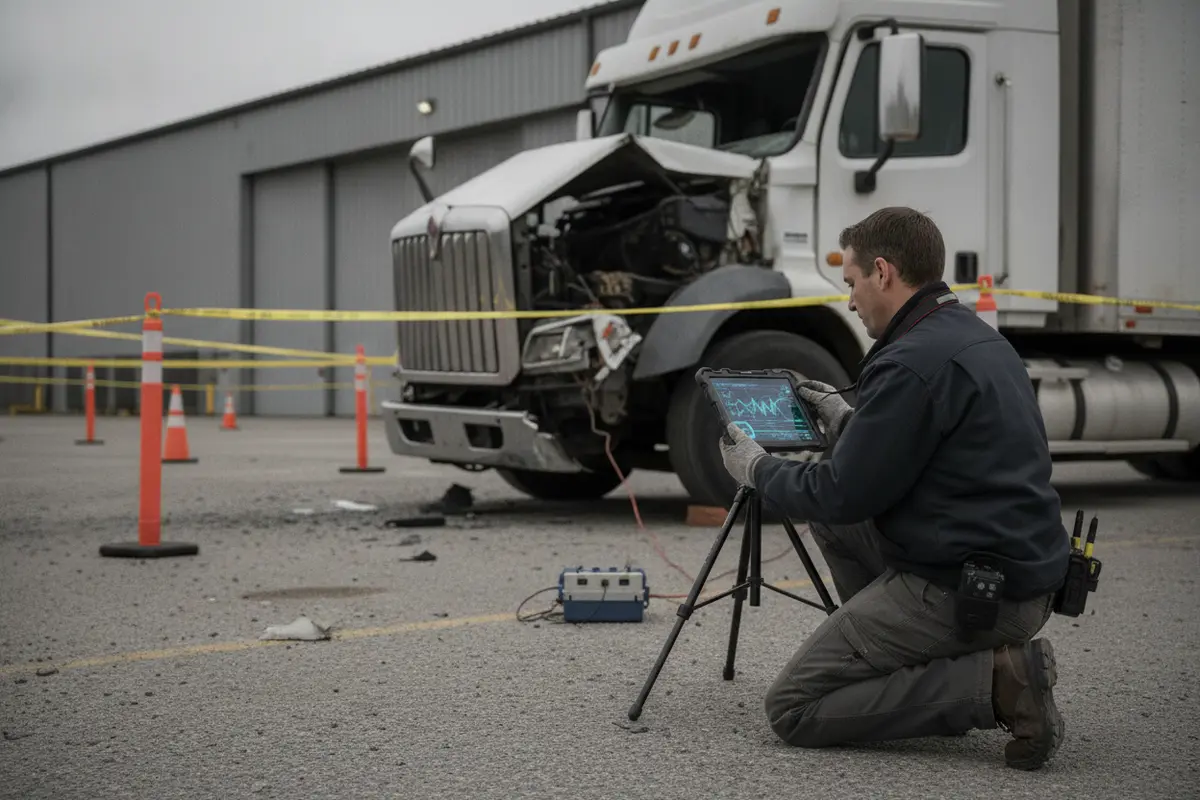
Electronic information can be especially sensitive to how it is collected. A request should identify the vehicle and incident and ask that relevant data be preserved in its original form, along with information about how it was downloaded or maintained when appropriate. Do not try to access a commercial truck’s systems yourself. Data collection can require specialized equipment and should be handled by qualified people.
Think about the evidence categories in relation to a specific question. If the issue is what happened immediately before impact, camera footage and vehicle data may be pertinent possibilities. If the truck was taken for repairs, inspection and repair records may help document what was examined or changed afterward. If the route or timing is unclear, dispatch, trip, and delivery materials may be worth identifying. These are investigative leads, not conclusions about fault or proof that a particular record exists.
How should a preservation letter be prepared?
A lawyer can help identify the right recipients and frame a request around the available facts. If you are organizing information before speaking with counsel, these steps can make that discussion more productive:
- Write down the basic crash details. Record the date, approximate time, location, direction of travel, names of involved people if known, and any police report or incident number.
- Identify the truck and businesses. Save photographs of the truck, trailer, company name, license plate, USDOT number if visible, and any paperwork exchanged. The truck’s appearance or trailer branding may not identify every responsible or evidence-holding business, so note what you know without guessing.
- List the types of evidence that could be relevant. Consider vehicle data, video, driver and dispatch records, maintenance information, cargo records, and communications. Tie each category to a question raised by the crash rather than requesting unrelated material.
- Identify each likely custodian. A motor carrier may not own the truck; an owner may not operate it; a contractor may maintain it; and an insurer may not hold the vehicle data. The correct recipients depend on the facts.
- Describe the requested preservation clearly. State the incident date and identifying details, specify relevant categories, and ask the recipient to prevent routine deletion, overwriting, alteration, repair, or disposal of relevant material while the matter is evaluated. Tailored wording matters.
- Send it in a trackable way and keep a copy. Retain the final letter, delivery confirmation, responses, and notes about follow-up. Proof of delivery helps document what was sent and when, but does not establish that every requested item was preserved.
A useful way to organize the request is to make a short evidence map before drafting. For each possible item, write down the question it may help answer, the business or person who might possess it, and any detail that helps locate it. For example: “camera recording, truck cab or forward camera, on the crash date around the known time, carrier or camera vendor.” This is a planning aid, not proof that a camera was installed or recording. It also helps distinguish a request for preservation from a request for access or copies.
Be precise about the relevant time period when the facts allow it. A request can identify the collision time and a reasonable surrounding period rather than implying that every record from an entire company must be kept. If the time is approximate, say so and include a practical range or other identifiers that can help locate the event. Counsel can assess whether the scope should be broader based on what is known.
If you are already represented, coordinate with your lawyer before contacting another party. Multiple communications can create confusion, and an attorney can assess how to direct a notice and whether additional steps are appropriate. If you are not represented, avoid making detailed statements about fault or signing a release before you understand what it covers.
What should a letter say, and what should it avoid?
A useful letter generally provides enough information for the recipient to locate the incident and understand what should be preserved. It may name the people and vehicles involved, describe the location and time, identify the sender or representative, and list relevant evidence categories. It should be factual and specific. If a detail is uncertain, describe it as uncertain rather than presenting an estimate as a confirmed fact.
A preservation notice should not make unsupported accusations or promise a particular legal outcome. It also should not suggest that a request alone entitles the sender to inspect the truck, obtain private records, or control a company’s property. The letter can ask the recipient to confirm preservation and identify the appropriate contact, but a recipient may not agree or respond. A lack of response does not, on its own, tell you what happened to the evidence.
Keep a copy of any reply, including a statement that an item is unavailable or held by another company. That information may help narrow follow-up. If a vehicle has already been repaired or a system’s data is no longer available, document what you were told and by whom; do not assume the reason or legal consequence without further investigation.
When a response identifies a different custodian, note the name, contact information, and the specific records said to be held there. Do not treat a referral as confirmation that the second business has received a request. A follow-up may need to be directed separately, and the first recipient’s response and the follow-up should both be saved. If the response says an item does not exist, record that statement accurately rather than trying to fill in the gap with assumptions.
What can a preservation letter not do?
- It does not compel production. Preservation and access are separate questions. A request is not a subpoena or court order.
- It does not guarantee evidence survives. An item may not exist, may be outside the recipient’s control, or may already be unavailable. A letter cannot reverse that.
- It does not decide liability. Evidence must be evaluated with the full circumstances, including other accounts and records.
- It does not stop legal deadlines. Do not treat sending a letter as extending a time limit for bringing a claim. Deadlines and exceptions can depend on the claim and parties involved.
- It does not replace an investigation. Scene evidence, witness accounts, medical records, vehicle inspections, and other materials may also matter.
Federal Motor Carrier Safety Administration materials provide a starting point for general information about federal motor-carrier safety. For current agency resources, visit the Federal Motor Carrier Safety Administration. Agency information is not a substitute for advice about a particular collision or a determination of which records should be preserved.
How do Missouri rules fit into the issue?
The letter is an evidence-protection tool, not a determination of Missouri liability. In a Missouri injury claim, the facts, applicable legal rules, and proof all matter. Missouri uses a pure comparative fault approach, so a person’s share of fault may affect recovery rather than automatically ending every claim. That does not mean every claim succeeds or that a particular share of fault will be assigned. Questions about fault, available damages, and deadlines require an assessment of the specific case.
For a broader overview of representation after a crash, see the firm’s Springfield auto accident injury attorney information. Truck collisions can involve additional evidence holders and vehicle systems, so the needs of one case may differ from another. The firm also has information about a Missouri truck accident claim and the court process for a semi accident lawsuit.
What should you do while evidence is being addressed?
Keep a simple, organized file. Save the crash report, photographs, medical records and bills, letters, emails, and notes about calls. Write down witness names and contact details if available. Preserve original files when possible, and make a backup of phone photographs rather than editing or overwriting the only copy. Do not post sensitive details publicly or share medical information broadly.
Track communications with insurers and businesses, including the date, the person’s name, and what was discussed. An insurer may request a statement or records; consider getting legal guidance before agreeing to recorded statements or signing documents, especially if the injuries and evidence are still being evaluated. A family member assisting an injured person can help collect information, but should avoid guessing about facts the injured person does not know.
For an initial conversation, the firm’s personal injury questionnaire may help organize basic information. You can also review the firm’s attorney background before deciding whether to request a consultation. Neither a form nor a preservation request itself creates an attorney-client relationship.
Request a conversation about your situation
Frequently asked questions
Can I send the letter myself?
You can make a written request, but identifying the correct recipients and appropriately describing evidence can be difficult. A lawyer can evaluate the facts, tailor a request, and advise whether other steps may be needed. If you prepare a letter yourself, keep it factual, specific, and documented.
Does a trucking company have to follow my request?
A preservation letter does not function as a court order and does not automatically compel compliance or production. Whether a legal duty applies, and what consequences may follow if evidence is lost, depends on the circumstances and governing law. A recipient’s response should be reviewed in context.
What if I do not know the trucking company’s name?
Save the information you do have, such as photos, the truck or trailer number, plate, crash report, and names of people at the scene. Investigators or counsel may be able to use those details to identify the carrier, owner, or other relevant businesses. Do not assume that a logo alone identifies every company involved.
Does sending a letter extend the time to file a claim?
No. Do not rely on a preservation notice to extend or pause a filing deadline. The applicable deadline can depend on the parties and facts, so seek case-specific advice promptly rather than waiting for a response to the letter.
Getting help with evidence preservation
A prompt, carefully targeted request may help reduce the risk that relevant truck-crash information is lost, but it is only one piece of a careful investigation. Keep your records, prioritize treatment, and get advice if you need help identifying who may hold evidence or what to request. Each collision is different, and no letter can guarantee a particular result.