

After a serious collision, people may disagree about speed, position, timing, or who had a chance to avoid impact. Accident reconstruction evidence in a Missouri injury claim can help organize physical facts and test competing explanations. It is not a shortcut to a guaranteed answer. Its value depends on the evidence available, the question being examined, and how clearly the analyst explains limits and assumptions.
Discuss your accident and questions
What can accident reconstruction evidence show?
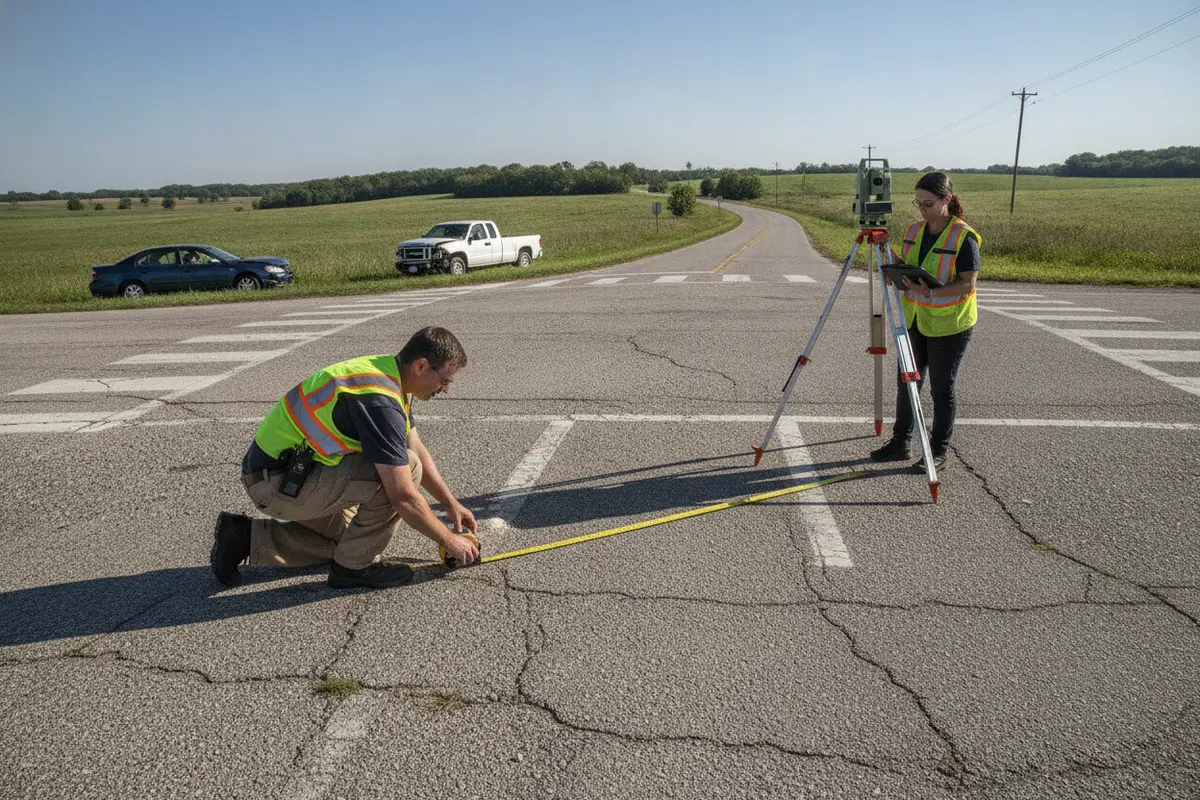
Reconstruction is an effort to evaluate how a collision may have unfolded using physical evidence, measurements, photographs, vehicle data, and other reliable information. Depending on the collision, an analyst may assess vehicle paths, points of impact, stopping distance, visibility, or whether a particular account fits the physical evidence.
The analysis does not independently establish every legal issue. A diagram may help explain where vehicles were located, for example, but may not prove what a driver saw or intended. A conclusion can also depend on assumptions about speed, braking, road conditions, or vehicle movement. Those assumptions should be identified and tested rather than treated as established facts.
Think of reconstruction as one way to answer defined physical questions, not as a complete narrative of the people involved. It may help determine whether a proposed sequence is consistent with marks, damage, and measurements. It usually cannot, on its own, tell whether a driver was distracted, what a witness could perceive, or how the law assigns responsibility.
When may reconstruction be useful?
Technical analysis may be worth considering when collision mechanics are genuinely disputed or when the sequence has a meaningful effect on a serious injury claim. Examples include a crash with conflicting accounts, a complex intersection collision, a multi-vehicle impact, or a question about whether a driver had time and distance to respond. An analysis may also help an insurer, mediator, or jury understand evidence that is difficult to visualize from written descriptions alone.
Not every injury claim needs an expert reconstruction. In a straightforward collision with clear documentation and no real dispute about how it happened, other evidence may be enough. A careful decision considers both potential value and limitations. If a vehicle has already been repaired, the scene changed, or key measurements were never taken, some questions may be harder to answer. Expense also matters; expert work should address an issue that could affect the claim rather than add technical detail for its own sake.
Before commissioning work, define the question. “Who was at fault?” is broad and includes legal and credibility issues. More focused questions might be whether the damage pattern is consistent with a particular impact angle, or whether a vehicle could have stopped within the visible distance under stated assumptions. Narrow questions make it easier to determine what evidence is needed and whether a reconstruction is likely to help.
What evidence can an analyst use?
Potential sources vary by collision and may include:
- Photographs and video of the vehicles, roadway, debris, marks, signs, and sightlines.
- Vehicle damage, measurements, and inspections before repair or disposal.
- Police reports and witness statements, considered alongside other evidence.
- Available electronic data from a vehicle or commercial vehicle system, if applicable and lawfully obtained.
- Roadway geometry, traffic controls, weather, lighting, and surface conditions at the time.
- Medical records and injury information, when relevant to evaluating forces or occupant movement.
A police report is an important record, but may not answer every technical question and may reflect only information available at the scene. A witness account can provide perspective that measurements cannot, while a photograph may show something a person did not notice. Each source has a scope and possible weakness. Comparing independent sources can reveal whether they reinforce one another or leave unresolved gaps.
Preserve original files when possible. Avoid editing photos or videos; keep a copy and note when and by whom they were created. If an image has been cropped or enhanced for convenience, retain the original too. A simple record of source and date helps distinguish firsthand evidence from later annotations or recollections.
How should you protect potentially useful evidence?
Physical evidence can change quickly. Vehicles may be repaired, moved, sold, or scrapped. Skid marks and debris may disappear, and camera systems may overwrite footage. Safety and medical care always come first. Do not enter traffic, trespass, or delay needed repairs just to document a scene. If you can safely do so, take photographs from several angles and note the date, location, and conditions.
- Get medical care first. Follow medical advice and keep records of treatment and symptoms. Documentation should not interfere with care.
- Save what you already have. Preserve original photos, messages, dash-camera files, and insurer correspondence. Make a backup and avoid renaming files in a way that obscures their source.
- Write down observations. Record what you remember while it is fresh. Separate what you personally saw from what someone else said, and note uncertainty rather than filling gaps with guesses.
- Identify witnesses and cameras. Note names and contact details if available, along with nearby businesses or homes that may have recorded the area. Do not assume footage will be retained indefinitely.
- Ask about vehicle preservation. If damage may be important, get advice about inspection and preservation before repair or disposal where practicable. Do not assume that a vehicle should remain unusable indefinitely; preservation steps need to be managed reasonably.
- Keep a simple evidence log. Record each item, its source, when it was obtained, and where the original is stored. This makes it easier to find records later and spot missing pieces.
For further discussion of documentation and communications in a commercial vehicle case, see the firm’s Missouri truck accident claim guide and guide to evidence and legal steps after a truck accident. The appropriate steps differ by case; do not delay necessary medical care or repairs solely to preserve evidence.
What can a worked example clarify?
Consider a hypothetical intersection crash. One driver says the other entered the intersection late; the other says the first vehicle turned across its path. A single damage photograph may show where contact occurred but not the whole sequence. Scene measurements could help establish lane widths and sightlines. Vehicle inspections could document damage locations. A nearby camera might show timing, while witness accounts may explain what was visible from a particular corner.
An analyst could compare those materials and state whether certain movement paths fit the measurements. The analyst should identify missing or uncertain inputs, such as the exact point where a vehicle began braking. If the camera angle does not show a traffic signal, it cannot settle the signal question. If a witness was behind an obstruction, that affects how much weight to give the account. The point is not to force every item into one story, but to distinguish supported conclusions from unresolved issues.
A different scenario illustrates why preservation matters. Suppose the vehicles are moved and repaired before detailed photographs or inspections. Later, an analyst may have only scene images, a report, and estimates. The work may still be useful, but the conclusions could be narrower. Early preservation does not guarantee a definitive answer; it helps avoid losing information that may have allowed a more reliable comparison.
How does Missouri fault law affect the analysis?
Missouri follows a pure comparative fault approach. A person may recover damages even if partly at fault, with recovery reduced according to the share of fault assigned. That makes the facts about each person’s conduct important. Reconstruction can help evaluate physical questions, but fault is a legal determination based on the full record.
For example, evidence might help assess where vehicles were and how they moved, while testimony and other records address what each person perceived or did. An insurer may evaluate the same evidence differently from an injured person. Chad Mann’s background working with insurance companies informs his understanding of how insurers evaluate, negotiate, and deny claims. No single technical opinion determines the outcome, and a claim should be evaluated on its specific evidence.
Missouri generally has a five-year limitations period for many personal injury claims, but exceptions and different deadlines can apply. Do not assume that an investigation, negotiations, or evidence preservation pauses a filing deadline. The Missouri Department of Revenue provides information about accident reporting and insurance at its insurance and accident information page. That page addresses reporting and driver-record information; it is not legal advice about a particular claim.
How do evidence types compare?
Different evidence answers different questions. The table below is a practical overview, not a ranking; quality and relevance depend on the circumstances and how the information was preserved.
| Evidence type | May help clarify | Questions or limitations |
|---|---|---|
| Scene photographs and measurements | Road layout, positions, visible marks, and sightlines | Were conditions documented before they changed? Is scale or perspective clear? |
| Vehicle inspection | Damage locations and possible contact patterns | Were repairs or later handling likely to alter the evidence? |
| Witness accounts | What a person saw or heard from a particular viewpoint | What could the person see, and how soon was the account recorded? |
| Electronic data or video | Potential information about operation or timing | What does the system record, how complete is it, and how was it obtained? |
| Reconstruction analysis | Whether a proposed physical sequence fits measured facts | Which inputs and assumptions drive the conclusion, and what remains uncertain? |
How should you assess an expert’s work?
Ask what evidence the expert reviewed, what was unavailable, and which assumptions influenced the result. Find out whether alternative explanations were considered and whether the analysis can be traced to underlying measurements and data. A clear explanation distinguishes observed facts from estimates, and estimates from opinions.
It is also useful to ask what the expert did not conclude. A report may address vehicle movement but not determine which driver was credible or legally responsible. If a conclusion depends on a range of possible speeds, ask how changing the input changes the result. If a critical photograph or measurement is missing, ask whether that gap prevents a reliable answer or merely narrows the conclusion.
Consider whether the analysis addresses an issue that matters to the claim. Technical detail is not useful merely because it is complex. The work should connect to a disputed question such as impact sequence, ability to avoid the collision, or whether a proposed account fits physical evidence. A concise explanation that identifies limits can be more useful than an elaborate animation that hides uncertainty.
For an overview of when legal guidance may be useful after a crash, read what to consider when deciding whether to get a lawyer after a crash. You can also review the firm’s explanation of contingency fees in Missouri. Serious injuries and disputed liability can raise issues that deserve individual review.
What mistakes can weaken the evidence?
- Relying on one photograph or one person’s account as the complete story.
- Assuming a police report or an insurer’s early view settles fault.
- Posting detailed theories about the collision on social media.
- Allowing potentially relevant vehicle evidence to be destroyed without considering preservation.
- Treating estimated speed or distance as exact when the supporting data is uncertain.
- Waiting to ask about video or records until they may no longer be available.
- Mixing firsthand observations with assumptions in notes or statements.
If an insurer requests a recorded statement or inspection, understand what is being requested and consider getting guidance before agreeing to a step you do not understand. Keep communications, dates, and document copies together. Avoid speculating about technical causes when you do not know the answer. A precise, honest account of what you remember is more helpful than a confident guess.
What practical steps should you take before an evidence review?
A focused review is easier when the materials are organized. You do not need to conduct your own reconstruction. Instead, prepare a factual timeline and identify what is known, what is uncertain, and what may be missing. For example, list the time and location, vehicles involved, where each vehicle was last seen before impact, what happened immediately afterward, and who may have observed it. Mark estimates as estimates.
- Make a document folder. Group scene images, vehicle records, medical records, correspondence, and witness details separately. Keep originals intact.
- Create a timeline. Note when the crash occurred, when photographs were taken, when vehicles were moved or repaired, and when statements or reports were made.
- List the disputed questions. Write down the specific points that different accounts disagree on. Avoid deciding the answer in advance.
- Track evidence that may disappear. Identify camera footage, vehicle data, or physical items that could be overwritten, altered, or discarded, and raise them promptly.
- Keep legal and medical questions separate. An analyst may address physical movement; medical providers address care, and legal counsel can explain how evidence relates to the claim.
This preparation can expose gaps without implying that every gap can be fixed. It also helps an attorney assess whether additional investigation is proportionate and whether expert input could answer a material question.
Frequently asked questions
Does every Missouri injury claim need accident reconstruction?
No. It is most relevant when collision mechanics are disputed or a technical question could affect liability. The available evidence, injury circumstances, likely usefulness, and cost should be weighed before deciding whether expert work is appropriate.
Can reconstruction prove who was at fault?
It can offer opinions about physical events, such as vehicle movement or impact sequence. It does not decide legal fault by itself. The full record, including witness accounts and applicable law, matters.
How soon should evidence be preserved?
As soon as reasonably possible, especially when vehicles, video, or scene conditions may change. Safety and medical care come first. Preserve existing materials and seek advice about potentially important evidence before it is lost.
What if I may have contributed to the crash?
Do not assume partial responsibility automatically bars a Missouri claim. Comparative fault can reduce recovery based on assigned responsibility. The facts and legal issues should be reviewed individually.
Should I repair my vehicle after a crash?
Necessary repairs and safe transportation matter. If the damage may be important evidence, ask promptly whether inspection or documentation should occur before repairs. Do not assume that preservation requires leaving a vehicle unrepaired indefinitely.
What are sensible next steps?
Write down what you remember, preserve original records, track treatment and insurer communications, and avoid treating a preliminary account as settled fact. If you have serious injuries or the cause of the crash is disputed, you can contact the Law Office of Chad G. Mann to discuss your questions. Early guidance may help identify evidence worth protecting, without promising a particular outcome.
Share information about your injury claim
Every collision and claim is different, and a sound evidence review should distinguish what is measured, what is estimated, and what remains uncertain.