

Missouri Comparative Fault Car Accident Claims
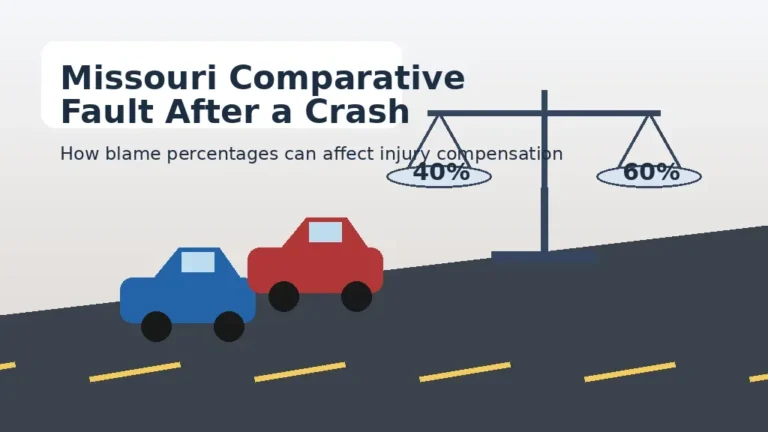
After a crash, the insurance company may agree that you were hurt but still argue that you share part of the blame. In a Missouri comparative fault car accident claim, that blame percentage can directly affect how much compensation you may recover. Learn how much your car accident case may be worth in Missouri. for medical bills, lost income, pain, and other losses.
If an insurer is trying to shift blame onto you after a crash, contact The Law Office of Chad G. Mann to discuss your options before giving another statement or accepting a settlement.
What Is Comparative Fault in a Missouri Car Accident?
Comparative fault is the rule used to divide responsibility when more than one person is blamed for an accident. Instead of treating a case as all or nothing, Missouri allows fault to be assigned in percentages. One driver might be found 100 percent at fault, or the responsibility might be split, such as 80 percent to one driver and 20 percent to another.
The important point for injured drivers is that a fault percentage is not just a label. It is a number that can reduce the value of a claim. If your total damages are valued at $100,000 and you are assigned 20 percent of the fault, the other side may argue that your recovery should be reduced by that 20 percent.
Missouri generally follows a pure comparative fault approach. That means an injured person is not automatically barred from recovery just because they share some blame. However, any assigned share of fault can still have a major financial effect, especially in a serious injury case.
How Fault Percentages Can Affect Compensation
Fault percentages matter because they are usually applied after the parties estimate the total value of damages. Those damages may include emergency care, hospital bills, follow-up treatment, physical therapy, lost wages, reduced earning ability, vehicle damage, and pain and suffering.
Here is a simple example:
- Total damages are valued at $75,000.
- The injured driver is assigned 10 percent fault.
- The insurer argues that the recovery should be reduced by $7,500.
- The adjusted amount would be $67,500 before any other disputed issues are considered.
That same math becomes much more serious when injuries are permanent or medical treatment is ongoing. A 25 percent fault argument in a case valued at $300,000 could put $75,000 at issue. This is why an insurer’s attempt to add even a small percentage of blame should be taken seriously.
Comparative fault can also affect settlement negotiations before a case ever reaches court. Insurance adjusters may use a claimed percentage of fault as leverage to push a lower offer. The percentage may not be fair, fully investigated, or supported by the evidence. It may simply be part of the negotiation strategy.
Why Insurance Companies Use Comparative Fault Arguments
Insurance companies know that reducing fault exposure can reduce what they pay. When the facts leave room for argument, an adjuster may look for details that can be used to place part of the blame on the injured person.
Common comparative fault arguments include claims that the injured driver:
- Was speeding before the crash
- Was distracted by a phone, passenger, radio, or navigation system
- Failed to keep a careful lookout
- Stopped suddenly or followed too closely
- Did not use a turn signal
- Entered an intersection too quickly
- Could have avoided the crash by braking sooner
- Made statements at the scene that sounded like an admission of fault
Some of these issues may be legitimate. Others may be exaggerated or taken out of context. For example, a driver may say, “I did not see them,” because the other vehicle ran a light or appeared suddenly, not because the injured driver was careless. The wording of a recorded statement can make a difference.
For related context, the firm’s article on how to prove negligence in a Missouri personal injury case explains the basic elements that often shape fault disputes.
Evidence That Can Help Dispute Unfair Blame
The best response to an unfair comparative fault argument is evidence. Memories fade quickly, vehicles are repaired, video can be overwritten, and witnesses may become harder to find. Early legal guidance can help preserve the facts before the insurance company builds a one-sided version of the crash.
Useful evidence may include:
- Police reports. A crash report may identify drivers, insurance information, diagrams, citations, road conditions, and statements made at the scene.
- Photos and video. Images of vehicle damage, debris, skid marks, traffic signals, road design, and visible injuries can help explain how the crash happened.
- Witness statements. Independent witnesses may be especially helpful when each driver gives a different account.
- Dashcam or surveillance footage. Nearby businesses, homes, traffic cameras, and vehicle cameras may capture the moments before impact.
- Cell phone records. In some cases, records may help address claims about distraction.
- Vehicle data. Modern vehicles may contain data related to speed, braking, steering, and seat belt use.
- Medical records. Prompt treatment can connect injuries to the crash and push back against claims that the injuries came from something else.
Evidence does not have to prove that the injured person did everything perfectly. It needs to show what actually happened and whether the insurer’s blame argument is supported by facts.
How Duty of Lookout and Rear-End Crash Issues Fit In
Many Missouri car accident cases involve arguments about lookout, following distance, and reaction time. These issues are common because they can be used by either side in a comparative fault dispute.
The duty of lookout generally involves paying attention to the road, traffic, signals, pedestrians, and hazards that should be seen in time to avoid a collision. If an insurer claims you failed to keep a careful lookout, it may be trying to assign you a share of fault even when the other driver created the danger. The firm has a separate article on the duty of lookout in Missouri that explains this issue in more detail.
Rear-end collisions can also involve more than a simple assumption that the rear driver is fully at fault. The rear driver may be blamed for following too closely, but the front driver may also be accused of stopping suddenly, having nonworking brake lights, or making an unexpected maneuver. The article on rear-end collisions and following too closely covers those disputes in more detail.
These examples show why comparative fault is fact specific. A short statement from an adjuster does not settle the issue. The full picture matters.
What Should You Avoid After a Crash?
The steps you take after a crash can affect how fault is discussed later. You do not need to argue with the other driver at the scene, but you should be careful about giving the insurance company material that can be used against you.
Consider these practical steps:
- Call law enforcement and make sure a report is created when appropriate.
- Get medical care as soon as possible if you are hurt.
- Take photos and video if you can do so safely.
- Collect witness names and contact information.
- Avoid guessing about speed, distance, or fault.
- Do not apologize in a way that sounds like an admission of legal responsibility.
- Be cautious with recorded statements before you understand your rights.
- Do not accept a settlement before you know the full extent of your injuries.
If you are unsure what to say to an adjuster, speak with a Missouri car accident attorney first. Early advice can help protect your claim before a fault percentage becomes the center of negotiations.
How Comparative Fault Can Show Up in Settlement Talks
Comparative fault often appears in settlement discussions long before a lawsuit is filed. An adjuster may say the company accepts that its insured caused the crash, but only at a reduced percentage. The adjuster might then make an offer based on that reduced share.
For example, the insurer may say:
- “Our driver was mostly responsible, but you were also speeding.”
- “You had time to avoid the crash.”
- “The damage pattern does not match your version.”
- “You gave a statement that suggests you did not see the other vehicle.”
- “We are applying 30 percent comparative fault.”
Those statements should be tested against the evidence. The insurer is not a neutral judge. It is evaluating the claim from the perspective of the company that may have to pay it.
The same issue can overlap with claim delay and denial tactics. If an adjuster repeatedly asks for more statements, emphasizes minor inconsistencies, or ignores supporting evidence, it may help to review the firm’s guide on how insurance companies deny injury claims in Missouri.
When Do You Need Legal Help?
Not every minor crash requires a lawyer. However, comparative fault arguments can quickly become serious when injuries are significant, medical bills are high, liability is disputed, or the insurer is pressuring you for a recorded statement.
Legal help may be especially important if:
- The insurer says you were partly or mostly at fault.
- The other driver changed their story after the crash.
- The police report contains errors or missing information.
- You have injuries that may require ongoing treatment.
- You missed work or may not be able to return to the same job.
- The adjuster is using your words against you.
- There are multiple vehicles, commercial drivers, or uninsured motorists involved.
An attorney can investigate liability, gather evidence, communicate with the insurance company, evaluate damages, and respond to unfair blame arguments. No lawyer can promise a specific result, but having a clear strategy early can help keep the claim from being defined by the insurer’s first version of events.
Missouri Comparative Fault Car Accident FAQ
Can I recover compensation if I was partly at fault in Missouri?
In many Missouri personal injury cases, being partly at fault does not automatically prevent recovery. However, any percentage of fault assigned to you may reduce the compensation available. The facts, evidence, and legal arguments matter.
Who decides the percentage of fault?
During settlement talks, insurance companies may propose fault percentages. If the case goes to trial, fault can be decided through the legal process based on the evidence presented. An insurer’s percentage is not automatically final.
What if the police report says I contributed to the crash?
A police report can be important, but it may not tell the whole story. Reports can contain errors, incomplete witness information, or conclusions based on limited facts. Additional evidence may help challenge an unfair report.
Should I give a recorded statement if fault is disputed?
Be careful. A recorded statement can be used to support comparative fault arguments. If you are injured or unsure how the crash will be disputed, consider getting legal advice before giving a detailed statement.
Talk With a Missouri Car Accident Attorney
Comparative fault can turn a straightforward injury claim into a dispute over every second before impact. The insurance company may focus on anything that reduces its driver’s share of responsibility, even when the other driver clearly caused the danger.
If you were injured in a Missouri car accident and the insurer is blaming you, contact The Law Office of Chad G. Mann for guidance. A timely review can help preserve evidence, answer insurance questions, and protect your claim from unfair fault arguments.