


An underride truck accident in Missouri can leave injured people and families with urgent medical needs and difficult questions about what happened. In an underride collision, a passenger vehicle can slide beneath a truck or trailer, and the impact may intrude into the passenger compartment. Understanding the event often calls for a careful look at vehicle movement, visibility, equipment, and records—not just an early description of the crash.
Discuss your crash with a Missouri injury attorney
What happens in an underride truck accident?
An underride crash occurs when a smaller vehicle travels beneath the side or rear of a larger truck or trailer during a collision. The vehicles’ relative height and structure can create a dangerous gap. The resulting damage may be severe, but the term describes a type of collision, not a conclusion about who caused it. Each event needs to be assessed on its own evidence.
A rear underride collision may happen when a car approaches a truck from behind, when a truck stops or slows, or when traffic conditions change. A side underride collision can involve a truck or trailer crossing a lane, turning, or moving across the path of another vehicle. These are examples of questions investigators may consider; they do not establish what occurred in a particular crash.
The distinction matters because the evidence to examine can differ. A rear impact may make the condition and visibility of the back of the trailer especially relevant. A side impact may require close attention to the truck’s path, turning movement, lighting, and the timing of each vehicle’s approach. Investigators should first establish vehicle positions and movements, then test possible explanations against physical and recorded evidence.
Why can an underride crash require a detailed investigation?
Severe vehicle damage can obscure the sequence of events. The truck may leave the scene before all identifying information is collected, or vehicles may be moved to protect people and reopen a road. Weather, traffic, cleanup, and repairs can also change or remove evidence. A prompt record of what was present can help later reviewers distinguish original conditions from changes made after the collision.
Evidence may also be spread among several people or businesses. The driver, motor carrier, trailer owner, maintenance provider, shipper, and insurer may each possess different information. One company may own the tractor while another owns or leases the trailer. Identifying who controlled or maintained each component is a factual task; ownership alone does not determine legal responsibility.
There can be competing explanations. One account may focus on the passenger vehicle’s speed or lane position. Other evidence might raise questions about a truck’s movement, visibility, lights, reflective materials, or equipment condition. A sound investigation does not begin by assuming that one side is right. It identifies facts that can confirm or weaken each explanation.
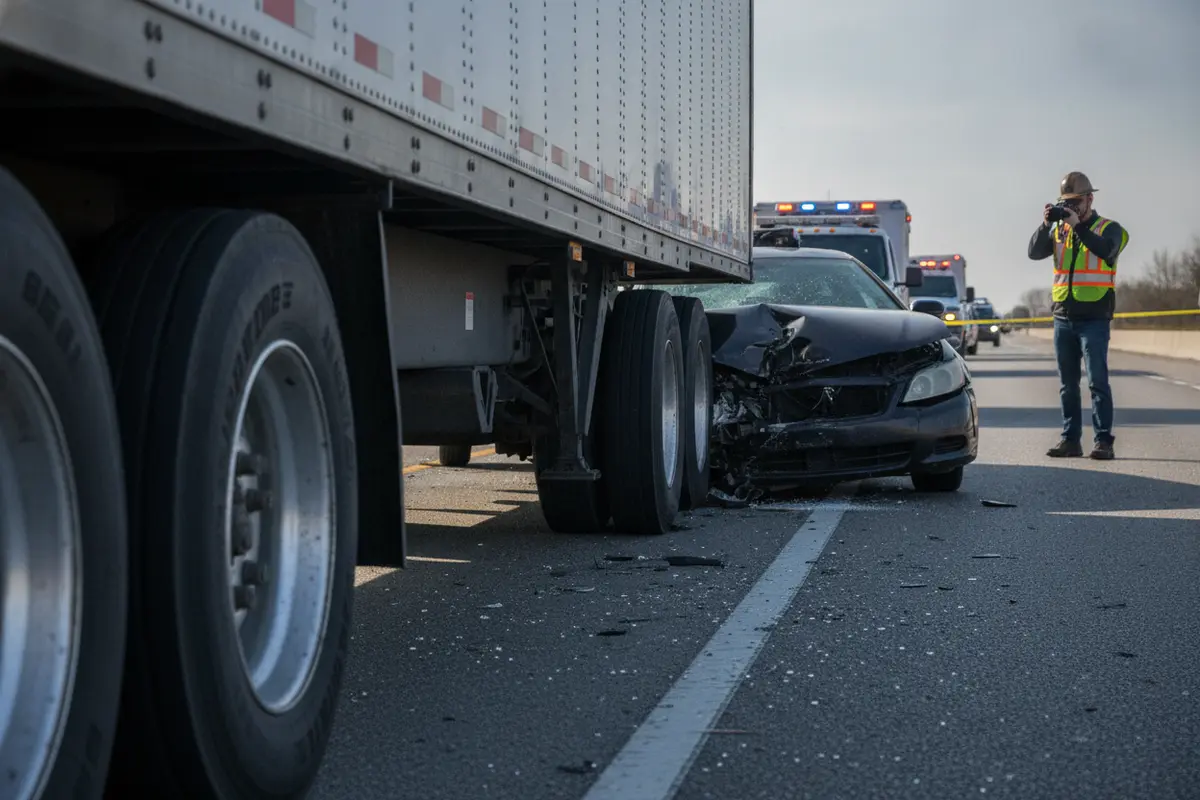
What evidence can help explain how the collision happened?
Useful evidence depends on the circumstances. A practical review usually considers several categories and how they relate to one another:
- Scene evidence: photographs, measurements, roadway marks, debris locations, lighting, signs, sight lines, weather, and the layout of nearby entrances or intersections.
- Vehicle and trailer condition: damage patterns, tires, lights, reflective materials, guards, vehicle height, and signs of prior repairs or maintenance.
- Electronic and business records: available vehicle event data, telematics, dispatch communications, driver logs, trip documents, inspection records, and maintenance files, subject to what exists and the rules that apply.
- Video and witness accounts: dash-camera footage, traffic or nearby business video, and contact information for people who observed the vehicles before or after impact.
- Official records: crash reports, photographs, citations, and other investigative materials that can properly be obtained.
- Injury and loss records: treatment notes, bills, work records, receipts, and documentation of how symptoms affect daily activities.
These pieces are most useful when they can be compared. For example, a witness may recall that a trailer was difficult to see, while photographs can show the scene’s lighting and roadway layout. The images do not prove exactly what a driver could see, but they can help frame questions for further investigation. Similarly, damage locations can be compared with vehicle paths, but damage should not be interpreted in isolation.
Keep original photographs and files when possible. Note who took each image, when it was taken, and where. Save messages and contact details rather than relying on memory. Do not alter original files or publish a detailed account online before understanding how the material may be used. If a damaged vehicle is in a storage yard, find out who controls access and whether an inspection can occur before repair, salvage, or disposal.
How should evidence be preserved after a crash?
Start with what can be done safely and lawfully. A person recovering from injuries should not return to a dangerous scene or try to inspect a truck or trailer without permission. A family member may be able to keep paperwork and photographs together, but medical care and safety come first.
For physical evidence, identify where each vehicle is stored and who has authority over it. Ask whether the vehicle is scheduled for repair or disposal. Do not assume that an insurer’s photographs will answer every technical question; the scope and timing of an inspection may matter. A qualified investigator or attorney can assess whether additional preservation steps are appropriate.
For records held by a business, write down the names of the carrier, driver, trailer owner, and any other company identified in the report or insurance communications. Preserve the information already received, including letters, claim numbers, and contact details. A written preservation request may help identify categories of records and alert a recipient that they could matter. It does not guarantee that a particular record exists or will be produced, and a request should be tailored to the facts. The firm’s discussion of truck accident evidence preservation letters provides related context.
Records can be time-sensitive for different reasons. A nearby camera may record over earlier footage; a vehicle may be repaired; and routine business retention schedules may affect electronic material. The person seeking information may not control any of those systems. It helps to identify likely sources early, preserve what is already available, and avoid assuming that a record will remain accessible indefinitely.
Which Missouri legal questions may arise?
Liability may involve more than the truck driver. Depending on the evidence, investigators may need to examine the motor carrier’s conduct, maintenance work, equipment ownership, or a manufacturer’s role. A claim requires evidence connecting a potentially responsible party’s conduct to the injury. The fact that a commercial truck was involved does not, by itself, decide who is legally responsible.
Missouri applies comparative fault principles. If more than one person’s conduct contributed to an injury, the allocation of responsibility can affect a recovery. That makes accurate evidence about speed, lookout, lane position, visibility, and the timing of the collision important. An insurer’s early view of responsibility is a position to evaluate, not a final legal determination. The relevant facts and applicable law should be considered together.
Federal trucking safety requirements could be relevant to a particular vehicle or trip, but which requirements apply depends on details such as the vehicle’s use and operation. Identify the exact equipment and operating circumstances rather than assuming that one rule governs every truck. For public reporting about debate over underride safety regulation, see Streetsblog’s report on underride crash regulation. That is advocacy-oriented reporting about the policy debate, not a substitute for the governing law or a case-specific investigation.
For a broader overview of liability and damages in commercial vehicle cases, see the firm’s guide to Missouri truck accident claims. A discussion of the court process in a Missouri semi-truck accident lawsuit may also help explain what litigation can involve. Neither resource can determine the outcome of an individual claim.
What practical steps should an injured person take?
- Get medical care. Call emergency services when needed and follow the treating professional’s instructions. Describe symptoms clearly, including changes that develop after the crash. Do not delay care to gather evidence.
- Report the collision and retain identifying information. Cooperate with responding authorities and ask how to obtain the crash report. Keep the report number, driver and carrier details, insurance information, and any claim reference together.
- Record what is safely available. Preserve photographs, witness names, messages, and documents. If family or friends help, ask them to note the source and date of each item so the history is clear.
- Keep a treatment and loss file. Save bills, prescriptions, appointment details, mileage, wage or leave records, and receipts for crash-related expenses. A brief dated note about changes in sleep, mobility, or daily tasks may help organize information for later discussion.
- Be measured in insurance communications. Ask who is contacting you, which company they represent, and what information they need. Keep copies of what you send and record dates and names. Before signing a release, make sure you understand whether it resolves claims and what rights it affects.
- Ask about preserving vehicles and records. Find out who controls the vehicles and whether repair or disposal is planned. Truck and trailer records may be held by separate entities, so identify potential record holders as early as possible.
A simple file system can prevent small details from getting lost. Keep one folder for medical care, another for insurance and official records, and a third for photos and witness details. Use dates in filenames or notes, and store copies somewhere secure. If a family member is helping, agree on one place for new documents and a short note describing what each item is. These habits do not prove fault, but they make it easier to give a consistent account and locate information when it is requested.
For information about the firm’s approach to injury cases, readers can review Chad G. Mann’s background and the firm’s practice areas. People with questions about whether legal representation may be useful can also consider these signs to hire a personal injury attorney. This general information is not a substitute for advice about a particular collision.
How do common next steps compare?
The most useful next step depends on the immediate need. Health care should not wait for a liability investigation, while evidence and claim records may need to be organized in parallel. This table can help separate those tasks:
| Issue | Practical action | Why it may matter |
|---|---|---|
| Medical condition | Seek care and follow treatment guidance | Addresses health needs and records reported symptoms |
| Scene and vehicle evidence | Save available photos and identify storage locations | Conditions and physical evidence can change |
| Truck or trailer records | Identify the carrier and other likely record holders | Different entities may hold trip, maintenance, or electronic information |
| Witness and video sources | Keep contact details and note possible camera locations | Footage may not remain available, and witnesses can be harder to locate later |
| Insurance communications | Keep correspondence and review documents before signing | Statements and releases can affect claim handling |
| Financial losses | Organize medical, wage, and out-of-pocket records | Provides a clearer record of claimed effects and expenses |
What damages and insurance issues should you consider?
Depending on the facts and applicable law, an injury claim may involve documented medical expenses, lost income, and the effects of an injury on a person’s life. The available records, the cause and extent of the injury, future medical needs, insurance terms, and any comparative fault analysis can all affect an evaluation. A crash description alone cannot establish what damages are recoverable or what a claim may be worth.
Commercial crashes can involve more than one insurance policy, but the existence or amount of available coverage should not be presumed. Different policies may cover different parties or vehicles, and questions can arise about who was operating or responsible for equipment. Keep letters and claim communications, and ask for clarification when a request is unclear. Consider getting legal guidance before accepting a settlement or signing a release, particularly if the injury’s course or treatment needs remain uncertain.
Documentation should be accurate rather than elaborate. Save actual bills and wage records, and keep a running list of expenses with dates and receipts. If symptoms interfere with ordinary activities, describe specific examples in a dated note—for instance, which task changed and what assistance became necessary. A clear record is more useful than trying to reconstruct several months from memory. Do not guess at figures or characterize an expense as crash-related unless you have a basis for doing so.
When can an attorney help with an underride crash?
Legal guidance may be useful when injuries are serious, fault is disputed, several companies may be involved, or important evidence could be lost. An attorney can review available information, identify questions about potentially responsible parties, communicate with insurers, and explain the process. The role is to assess facts and protect a client’s interests—not to promise a result.
The Law Office of Chad G. Mann represents injury victims in Springfield and Southwest Missouri. Chad Mann’s prior work with major insurance carriers informs his understanding of how insurers evaluate claims. The firm describes its approach as personalized, with the attorney overseeing cases. For general information about possible fees, see the firm’s explanation of contingency fees in Missouri; terms for any representation should be confirmed in the written agreement.
Frequently asked questions
Does an underride crash automatically mean the truck driver was at fault?
No. Fault depends on the evidence about how the collision happened and the conduct of any potentially responsible parties. A review may consider both drivers, the carrier, equipment, maintenance, and the surrounding conditions.
Should I keep my damaged vehicle from being repaired or disposed of?
Find out who controls the vehicle and whether an inspection can occur before repair or disposal. Do not put yourself at risk to access it, and do not assume you have authority to prevent a change. Photographs and records may help, but they may not replace a proper inspection.
Could a trailer owner or maintenance company be involved?
Possibly, depending on the facts. The carrier, trailer owner, maintenance provider, or another business may have relevant responsibilities or records. Identifying a role requires evidence; a company’s connection to the trip does not by itself establish liability.
How long do I have to bring a claim in Missouri?
Deadlines can depend on the claim, the parties, and the circumstances. Do not use a general online article to calculate a filing deadline. Ask a Missouri attorney to review the facts and any time limits that may apply.
Contact the Law Office of Chad G. Mann to discuss your situation
After a serious truck collision, appropriate medical care and careful preservation of available information can help you make informed decisions while the circumstances are investigated.