
Poor Road Conditions Car Accident Missouri
A crash caused by poor road conditions can leave you with more questions than answers. A pothole, missing sign, loose gravel, road debris, construction zone, or slick untreated roadway may have contributed to the collision, but that does not always mean the case is simple. In a poor road conditions car accident Missouri claim, the key issue is often not just what was wrong with the road. It is who knew about the hazard, who should have fixed it, and what evidence proves the condition contributed to the crash. For more information, see our guide on construction. A Missouri car accident lawyer can help identify whether a driver, contractor, or public entity may be responsible. Dangerous-road claims may involve a government vehicle accident claim process or facts similar to a construction zone accident.
If you were injured in a crash involving a road hazard in Springfield or Southwest Missouri, contact The Law Office of Chad G. Mann before the evidence disappears.
The Law Office of Chad G. Mann helps injured drivers, passengers, motorcyclists, pedestrians, and families understand their options after serious crashes. These cases often require a close look at photographs, police reports, repair records, witness statements, construction documents, and insurance coverage. The sooner that investigation starts, the better chance you have of preserving the facts that matter.
Can Poor Road Conditions Cause a Missouri Car Accident Claim?
Yes. Poor road conditions can be part of a Missouri car accident claim when a dangerous roadway condition contributes to the crash and someone had a legal duty to address it. That responsible party might be another driver, a construction company, a trucking company, a private property owner, a city, a county, or a state agency, depending on where the crash happened and how the hazard was created.
Road hazard cases are different from ordinary two-driver collision claims because the dangerous condition may be outside the damaged vehicles by the time the investigation begins. A pothole may be patched. Debris may be cleared. A missing sign may be replaced. Construction barrels may be moved. Weather may change within hours. That is why documentation can make or break the claim. For more information, see our guide on government.
These cases can also involve more than one theory of fault. A driver may have been following too closely or speeding for conditions, while a road defect or missing warning sign also made the crash worse. Missouri fault rules allow responsibility to be divided by percentage, which makes evidence especially important. For more on how blame can be allocated, see our guide to Missouri comparative fault car accident claims.
Common Poor Road Conditions That Lead to Crashes
Not every rough road creates a legal claim. The condition must be significant enough to create an unreasonable risk under the circumstances. Still, Missouri drivers regularly encounter hazards that can cause or contribute to serious wrecks.
Potholes and broken pavement
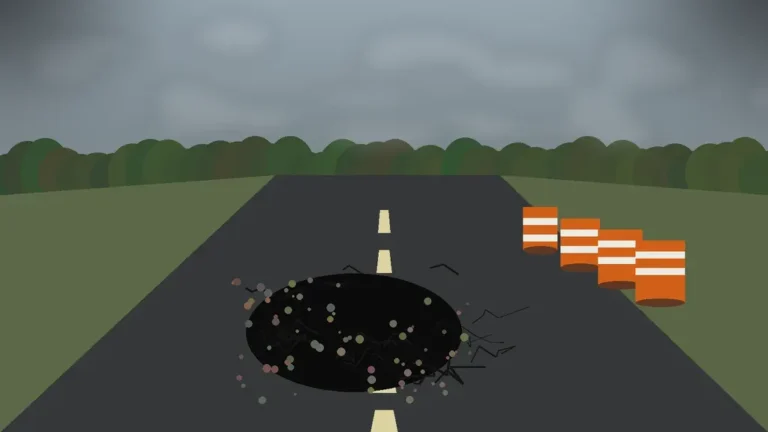
A deep pothole can cause a driver to lose control, damage a tire, bend a wheel, or force a sudden evasive maneuver. Motorcyclists are especially vulnerable because a pothole that jolts a car may throw a rider from the bike. Broken pavement, sunken utility cuts, uneven lanes, and pavement edge drop-offs can create similar risks.
The legal question is usually whether the dangerous condition existed long enough for the responsible party to discover it and fix it, or whether a worker or contractor created the condition in the first place. Photos showing depth, width, location, tire marks, and lack of warning signs can be valuable.
Missing, blocked, or confusing signs
Warning signs matter because drivers rely on them to make safe choices. A missing stop sign, hidden curve warning, absent lane closure sign, blocked speed sign, or unclear detour sign can change how a driver approaches the road. When signage is missing near construction, rural roads, intersections, or abrupt pavement changes, the danger can be severe.
Missouri road sign cases often turn on maintenance records, prior complaints, inspections, and whether the entity responsible for the road had notice. A sign that disappeared minutes before a crash is different from a sign that had been missing for weeks.
Debris, spilled cargo, and objects in the road
Road debris can come from unsecured loads, blown tires, fallen equipment, crashes, storms, or construction work. A driver may swerve to avoid the object, strike it directly, or get hit by another vehicle reacting to the same hazard.
In some cases, the claim may be against the driver or company that dropped the debris. In others, the question may be whether a public agency, property owner, or contractor failed to remove a known hazard within a reasonable time. Evidence can include dash camera video, nearby surveillance footage, 911 call logs, police reports, and witness statements.
Construction zones and temporary traffic control problems
Construction zones can be dangerous when lane shifts, barrels, cones, flaggers, lighting, signs, and pavement markings do not give drivers a clear path. A work zone crash may involve a contractor, subcontractor, traffic control company, public entity, or another driver who ignored the setup.
Common construction zone issues include abrupt lane closures, confusing detours, missing advance warning signs, uneven lanes, exposed drop-offs, poor nighttime visibility, and equipment placed too close to traffic. These claims may require construction plans, traffic control diagrams, inspection records, and project logs.
Weather-related hazards and untreated roads
Rain, ice, fog, flooding, and snow can make a road dangerous, but bad weather alone does not automatically create a claim. The issue is whether someone acted unreasonably under the conditions. That might involve a driver going too fast for a slick road, a business allowing water to drain across an entrance, a contractor leaving mud on the pavement, or a responsible agency failing to address a known hazard when it had time and ability to act.
Weather cases need careful handling because insurance companies often try to blame the weather itself. The stronger approach is to identify specific conduct or conditions, such as inadequate warnings, poor drainage, negligent maintenance, or unsafe driving for the conditions.
Who May Be Liable for a Road Hazard Crash?
Liability depends on the facts. A road hazard may point to one responsible party, or it may require claims against several parties. The first step is identifying where the crash occurred, who controlled that area, and how the hazard developed.
- Another driver may be liable if they swerved, sped, followed too closely, ignored road conditions, or dropped debris from a vehicle.
- A trucking company or cargo loader may be responsible if unsecured cargo, tire debris, or equipment created the hazard.
- A construction contractor may be liable for unsafe traffic control, missing warnings, poor cleanup, or dangerous lane changes.
- A private property owner may be involved if the hazard came from a driveway, parking lot, drainage issue, or access road.
- A city, county, or state agency may be responsible in limited circumstances when a public road or public property was in a dangerous condition and legal requirements are met.
These claims require more than pointing to a bad road. You must connect the hazard to the crash and show why the responsible party should be held accountable. For a broader explanation of the proof required in injury claims, read how to prove negligence in a Missouri personal injury case.
How Government Notice Issues Can Complicate the Claim
When a public road is involved, the case can become more complicated because government entities have protections that private defendants do not. Missouri law recognizes limited exceptions for injuries caused by a dangerous condition of public property, but those cases require specific proof.
Under Missouri Revised Statutes Section 537.600, a public entity may face liability for injuries caused by a dangerous condition of public property if the injured person can establish key elements. Those include that the property was in dangerous condition, the injury directly resulted from that condition, the condition created a reasonably foreseeable risk of the type of harm that occurred, and either a public employee created the condition or the public entity had actual or constructive notice in enough time to take protective measures.
In plain English, notice is often the battleground. The injured person may need to show that the agency knew or should have known about the pothole, missing sign, debris, drainage problem, or other danger before the crash. Evidence may include prior complaints, maintenance logs, inspection records, work orders, emails, photographs, prior crashes, or witness reports.
Government claims may also involve shorter notice periods, special procedures, and different insurance issues. Do not wait to ask for legal help if you believe a public road defect contributed to the crash.
Have questions about a crash involving a pothole, missing sign, or unsafe construction zone? Talk with a Missouri car accident lawyer about what evidence needs to be preserved.
What Evidence Helps Prove a Poor Road Conditions Claim?
The best evidence is usually gathered quickly. Once repairs are made or the scene changes, it becomes harder to show what the roadway looked like at the time of the crash.
Scene photographs and video
Photographs should show the hazard from several angles. Include wide shots that show where the condition was located, close-ups that show the condition itself, and reference points such as lane markings, signs, intersections, mile markers, businesses, or driveways. If there is a pothole or pavement drop-off, measurements can help. If debris is involved, photograph the debris before it is moved if it is safe to do so.
Police report and witness information
The police report may identify contributing circumstances, statements from drivers, citations, road conditions, weather, and witness names. Witnesses can explain what they saw before the crash, whether the hazard had been present earlier, or whether other drivers had trouble in the same location.
Dash camera, surveillance, and traffic camera footage
Video can be powerful, but it may be overwritten quickly. Nearby businesses, homes, work zones, parking lots, and public intersections may have cameras. Prompt preservation requests may be needed to keep that footage from disappearing.
Maintenance and complaint records
For public road claims, records may show whether the responsible entity had notice. That can include citizen complaints, prior work orders, inspection reports, repair logs, emails, dispatch records, and prior crash reports. For construction zones, traffic control plans and daily logs may show whether the setup matched the plan.
Vehicle damage and medical records
Tire damage, wheel damage, suspension damage, undercarriage impact, and crash reconstruction evidence can help connect the roadway condition to the collision. Medical records help connect the crash to the injuries and document the extent of harm. Settlement value depends on more than a formula, which is why our guide to what a Missouri car accident case may be worth explains the real factors that affect recovery.
What Should You Do After a Crash Caused by Poor Road Conditions?
Your health and safety come first. If you can do so safely, take steps that preserve the claim before the road changes.
- Call 911 and report the crash. Ask that the road hazard be documented in the report if it contributed to the crash.
- Get medical care. Some injuries worsen after the adrenaline fades. Delayed treatment can also give the insurance company room to dispute causation.
- Photograph the scene. Capture the road condition, signs, debris, skid marks, vehicle positions, weather, lighting, and surrounding landmarks.
- Get witness names and contact information. Do not rely on the police report to capture every witness.
- Preserve vehicle evidence. Do not repair or dispose of damaged tires, wheels, or parts until they have been documented.
- Avoid detailed statements to insurers before getting advice. Adjusters may try to frame the crash as your fault before the road hazard is investigated.
- Contact an attorney quickly. Road hazard evidence can disappear, and government-related claims may require fast action.
These steps are especially important in motorcycle crashes, truck crashes, and multi-vehicle collisions because the other side may argue that the injured person overreacted to the hazard or failed to control the vehicle.
How Insurance Companies Defend Road Hazard Claims
Insurance companies and defense attorneys often push back hard in poor road condition cases. Their arguments may sound reasonable at first, but they often ignore missing evidence or try to shift focus away from the hazard.
- They may blame the driver. The insurer may claim you were speeding, distracted, following too closely, or should have avoided the hazard.
- They may blame the weather. Rain, ice, or fog may be used to argue the crash was unavoidable.
- They may deny notice. A government entity or contractor may argue it did not know about the condition and had no reasonable chance to fix it.
- They may argue the condition was minor. Photos, measurements, expert review, and vehicle damage can help show why the hazard mattered.
- They may point to another party. A contractor may blame a public agency, a public agency may blame a driver, and a driver may blame the road.
This is why the investigation should not stop at the police report. The report is important, but it may not identify every responsible party or every missing piece of evidence.
How Chad Mann Helps After a Road Hazard Accident
The Law Office of Chad G. Mann reviews road hazard crashes with a practical focus on proof. Chad looks at what happened, what insurance coverage may apply, what evidence still exists, and what deadlines could affect the claim. His background includes insight into how insurance companies evaluate and defend injury claims, which helps when adjusters try to minimize responsibility.
For many clients, direct attorney access matters. You should not be left wondering who is handling your case or whether key evidence has been preserved. A road condition claim can involve multiple parties, technical records, and fast-changing evidence. Clear communication and early investigation can make a real difference.
If poor road conditions contributed to your Missouri crash, contact The Law Office of Chad G. Mann to discuss what happened and what evidence may still be available.
Frequently Asked Questions About Poor Road Condition Accidents in Missouri
Can I sue the government for a pothole accident in Missouri?
Possibly. Government liability depends on specific facts, including whether the road was public property, whether the condition was dangerous, whether it directly caused the injury, and whether the public entity created the condition or had actual or constructive notice in time to act. These claims can involve special rules and should be reviewed quickly.
What if I swerved to avoid debris and hit another car?
You may still have a claim, but fault will depend on the evidence. Investigators may look at how the debris got there, whether another driver dropped it, whether you reacted reasonably, and whether any other driver contributed to the crash.
Does bad weather excuse a dangerous road condition?
Not always. Weather can be part of the story, but it does not automatically eliminate responsibility. The question is whether a person, company, or public entity acted unreasonably under the circumstances. Examples may include unsafe driving for conditions, poor drainage, missing warnings, or untreated known hazards.
How fast should I act after a road hazard crash?
Act as soon as possible. Road defects can be repaired, debris can be removed, camera footage can be overwritten, and witnesses can become harder to locate. If a public entity may be involved, timing can be especially important.
What compensation may be available after a road condition crash?
Compensation depends on the injuries, liability evidence, insurance coverage, medical treatment, lost income, pain, long-term limitations, and how fault is divided. No attorney can promise a specific amount at the beginning, but a careful investigation can identify the damages that should be included.