

Two drivers can leave the same intersection crash certain that the other person caused it. Only one account may match the signals, vehicle damage, and available video. In intersection accident liability Missouri cases, the driver who violated a right-of-way rule or otherwise failed to use reasonable care is usually responsible. Fault may still be divided when both drivers contributed. A car accident lawyer in Springfield can help connect signal timing, witness statements, and insurance issues.
Complete the injury questionnaire to request a review of your Missouri intersection accident.
A left-turning driver, a motorist entering against a red light, or a driver who ignored a stop sign may bear fault. Still, the location of the damage, signal timing, witness accounts, and video can change the result. Do not assume you have no claim merely because an insurer says you contributed. Preserve evidence before it disappears and seek advice based on the specific facts.
How intersection accident liability Missouri cases are decided
Intersection accident liability in Missouri is decided by identifying each driver’s duty, the careless act that breached that duty, and whether that act caused the collision and injuries. A ticket can support a claim, but signal records, vehicle damage, video, and witness accounts often provide the fuller answer.
Right-of-way rules establish the starting point
Traffic lights, stop signs, yield signs, lane markings, and turning rules tell drivers when they may enter an intersection. A driver who proceeds against a red light or enters from a stop sign without yielding may be negligent. Likewise, a motorist with the right of way must remain attentive and take reasonable action when danger becomes apparent.
Right of way is important, but it is not permission to drive without care. A driver who speeds into an intersection, looks at a phone. Or makes an unsafe lane change may share responsibility even if the other motorist committed the first violation. For a deeper explanation, review the firm’s guide to right-of-way laws at Missouri intersections.
Causation connects the violation to the injuries
A claimant must connect the careless conduct to the crash and the resulting losses. Vehicle damage, medical records, photographs, and expert analysis may help show that the impact caused or worsened an injury. Prompt medical attention also creates a clearer record of symptoms and treatment. Review common delayed injury symptoms after a Missouri car accident if symptoms appeared later.
People hurt in a Springfield-area collision can learn more about how an auto accident injury attorney in Springfield, Missouri evaluates fault, insurance coverage, and damages.
Is the left-turning driver always liable?
No. A left-turning driver often bears fault because that driver generally must wait for a safe opening before crossing oncoming traffic, but liability is not automatic. An oncoming driver’s excessive speed, red-light violation, distraction, or unsafe lane change may support a shared-fault finding.
When an oncoming driver may share fault
An oncoming driver may contribute by speeding, entering after the light changes, driving without headlights, or changing lanes while passing through the intersection. These actions can reduce the time available for the turning driver to react. Video, event data, and the severity and angle of impact can help determine whether excessive speed or another unsafe action played a role.
Protected arrows and signal timing matter
A driver turning under a green arrow usually has a stronger right-of-way argument than someone making an unprotected turn. Yet both drivers may claim they had a favorable signal. In that situation, the precise traffic-signal sequence becomes crucial. Municipal signal-timing records may show the duration of each phase and whether there was enough time for one account to be true.
Witnesses who were stopped at the same light can also be valuable. Their positions may have given them a clear view of the signal or the vehicles before impact. Obtain their contact information quickly because memories fade and witnesses become difficult to locate.
Red-light and failure-to-yield crashes
Red-light and failure-to-yield disputes are resolved by testing each driver’s account against objective proof. Traffic-camera or dashcam footage, signal timing, impact location, skid marks, and neutral witnesses can show who entered first and whether either driver had time to avoid the crash.
| Crash scenario | Likely focus of the investigation | Useful evidence |
|---|---|---|
| Red-light collision | Which vehicle entered after its signal changed | Traffic cameras, dashcams, signal timing, witnesses |
| Four-way stop crash | Who arrived first and whether each driver stopped | Witnesses, video, skid marks, vehicle positions |
| Right turn on red | Whether the turning driver stopped and yielded | Camera footage, impact location, pedestrian accounts |
| Uncontrolled intersection | Whether each driver used reasonable care | Sight-distance measurements, speed data, photographs |
Failure to yield can take several forms
A driver may fail to yield while turning left, entering a main road from a side street. Making a right turn on red, or approaching a pedestrian in a crosswalk. Investigators should identify the exact movement each vehicle made instead of treating every intersection crash the same way. The analysis can differ at an uncontrolled intersection, where no signal or sign directs traffic.
A citation is useful but not conclusive
A police officer may issue a citation based on statements and observations at the scene. The report can identify drivers, witnesses, insurance information, and an initial narrative. However, the officer may not have seen the collision. Additional evidence can support or contradict the report, so obtain a copy but do not treat it as the only proof. Learn how to request and use a Missouri car accident police report.
Ask a Springfield auto accident attorney to evaluate the evidence before it disappears.
How does Missouri comparative fault affect a claim?
Missouri’s pure comparative-fault approach allows responsibility to be assigned by percentage. An injured person’s recovery can be reduced by that person’s share of fault. Evidence that accurately separates each driver’s actions can directly affect the value of a claim.
A simple comparative-fault example
Suppose a left-turning driver enters the path of an approaching car, but evidence shows the approaching driver was speeding. A factfinder could assign most of the responsibility to the turning driver and a smaller share to the speeding driver. Any recovery would then be reduced by the injured person’s percentage of responsibility.
For example, if the injured person proves $100,000 in losses but is assigned 20 percent of the fault, the recoverable amount would be reduced to $80,000. The example is illustrative, not a prediction. The actual allocation depends on credible evidence about speed, signal phase, visibility, reaction time, and each driver’s conduct.
The percentages depend on the evidence. Insurers may argue that an injured driver was distracted, drove too fast for conditions, or could have avoided the impact. Those arguments should be tested against video, vehicle data, roadway measurements, and witness statements rather than accepted at face value.
How insurers investigate shared fault
An insurer may compare the drivers’ statements with the police report, photographs, and damage patterns before making a liability decision. The adjuster may also request a recorded statement and look for language that supports assigning part of the blame to the injured person. A quick decision from an insurer is not the final legal answer.
Evidence can expose weaknesses in a shared-fault argument. For example, signal records may conflict with a driver’s timeline, while video may show that a claimed evasive maneuver never occurred. Medical documentation also matters because the carrier may dispute whether the collision caused every claimed injury. Keep copies of all communications and do not sign a broad release before understanding what rights it gives up.
More than two parties may be responsible
Some claims involve a commercial vehicle owner, an employer, a governmental entity, or another party in addition to the drivers. For example, an employer may become relevant if a driver was working at the time. A dangerous roadway condition or malfunctioning signal may also require investigation. Claims involving public entities can present special procedural issues, making timely legal review important. The firm’s overview of a government vehicle accident claim in Missouri explains additional considerations.
What evidence can prove who caused the crash?
The most persuasive evidence combines scene documentation, neutral witnesses, digital records, and medical proof. Because cameras overwrite recordings, vehicles are repaired, and roadway marks fade, preservation efforts should begin as soon as possible after an intersection collision.
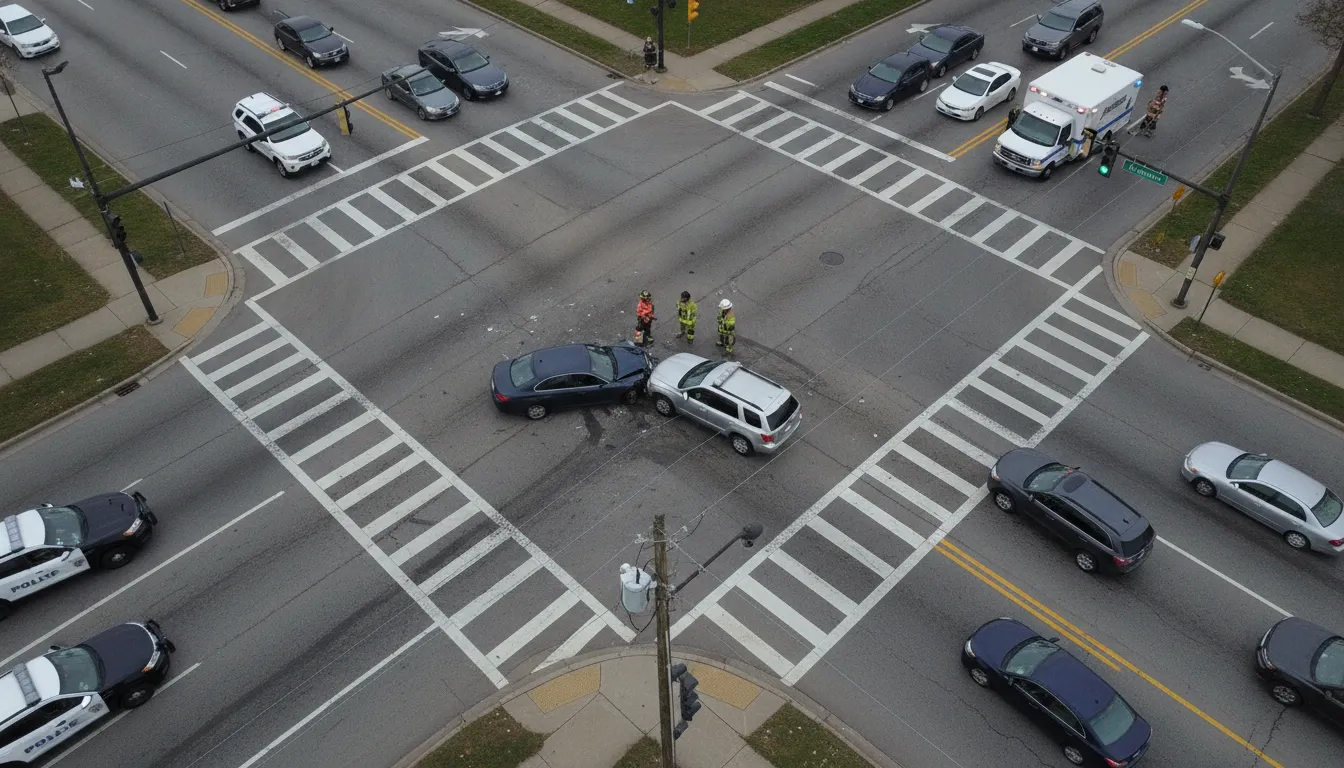
- Document the scene. If it is safe, photograph the vehicles, damage, debris, skid marks, traffic controls, lane markings, and sight obstructions. Capture wide views and close details.
- Identify witnesses. Ask for names, phone numbers, and a short description of what each person saw. Note where each witness was positioned.
- Look for video sources. Traffic cameras, nearby businesses, homes, buses, and other vehicles may have recorded the crash. Request preservation quickly because recordings may be overwritten.
- Obtain official records. Secure the police report and identify the agency responsible for the signal. Signal-timing and maintenance records may clarify a red-light dispute.
- Preserve vehicle and phone data. Modern vehicles may contain event data related to speed, braking, and acceleration. Phone records may become relevant when distraction is disputed. Do not alter or dispose of potential evidence.
- Keep medical and loss records. Save treatment records, bills, wage documents, receipts, and notes about how injuries affect daily activities.
Why camera footage can be decisive
Neutral video can show the traffic signal, vehicle speed, lane position, and reaction time. It can also resolve disagreements that would otherwise depend on credibility. A preservation request should identify the correct time window and camera location as precisely as possible.
Potential sources are easy to overlook. Nearby businesses, homes, buses, and other vehicles may have useful recordings even when a government traffic camera did not capture the collision. Write down visible camera locations at the scene, ask witnesses whether they recorded anything, and request preservation promptly. The longer the delay, the greater the risk that routine recording cycles will erase important footage.
How vehicle damage helps reconstruct impact
The point and direction of impact can support or weaken a driver’s account. Damage to the front of one vehicle and side of another may help establish their movements, though it does not automatically prove who had the right of way. Reconstruction professionals may consider crush patterns, final resting positions, roadway marks, and available electronic data together.
Preserving the vehicle before repairs can matter when speed, braking, or steering is disputed. Photographs should capture all sides of each vehicle and the passenger compartment, not only the most obvious damage. Repair estimates and tow-yard records can also help establish the vehicle’s condition and location while an investigation is underway.
What should you do after an intersection collision?
After an intersection collision, move to safety if possible, call for emergency assistance, report the crash, exchange information, and seek medical attention. Then preserve photographs, witness details, insurance correspondence, and medical records while avoiding guesses or admissions about fault.
Avoid guessing about fault at the scene
Cooperate with law enforcement, but do not speculate about speed, distance, or injuries. Give truthful facts you know. A rushed apology or guess may later be quoted out of context, even though you did not yet understand how the collision happened.
Be careful when speaking with insurers
An adjuster may ask for a recorded statement or broad authorization soon after the crash. Before providing information beyond what is required, consider obtaining advice about the request. You should also keep copies of correspondence and record the names and contact information of everyone you speak with.
Do not sign a release until you understand the injuries, available coverage, and the rights being released. An early offer may not account for future care, lost earning capacity, or a disputed-fault investigation.
A practical claim file should include a timeline of treatment, missed work, transportation costs, and communications with every insurer. Consistent records make it easier to answer questions about causation and damages months after the collision. They can also reveal when an insurer’s liability position changes as new evidence becomes available.
Frequently asked questions about Missouri intersection crashes
Who is usually at fault in an intersection accident?
The driver who violated a right-of-way rule or otherwise failed to use reasonable care is often at fault. Liability can be shared when another driver’s speed, distraction, or unsafe maneuver also contributed.
Can I recover compensation if I was partly at fault?
Potentially. Missouri’s comparative-fault system can reduce a recovery according to the injured person’s assigned percentage of responsibility. The outcome depends on the evidence and circumstances.
Does the driver who received a ticket automatically lose?
No. A citation may be relevant, but it does not by itself decide a civil injury claim. Video, witnesses, physical evidence, and other records may lead to a different allocation of fault.
How long should I wait before requesting camera footage?
Do not wait. Many systems overwrite footage on a short schedule. Identify possible cameras and request preservation as soon as possible after the collision.
Talk to a Springfield car accident attorney
Intersection claims can turn on seconds of signal timing and evidence that may soon disappear. The Law Office of Chad G. Mann can review the circumstances, identify potential sources of proof, and explain the options available under Missouri law.
Complete the firm’s injury questionnaire or contact a Springfield auto accident injury attorney to discuss your next step. A timely review can help preserve evidence and clarify how comparative fault may affect the claim.